


The Global Burden of Cardiovascular Disease
Cardiovascular diseases (CVDs), including coronary artery disease, arrhythmias, and heart failure, represent a leading cause of global mortality, accounting for nearly 18 million deaths annually. These conditions are not only life-threatening but also impose significant socioeconomic burdens on healthcare systems. Factors such as aging populations, lifestyle changes, and the rise of comorbidities like diabetes have contributed to the growing prevalence of CVDs. Timely intervention and reliable diagnostics are critical to reducing morbidity and mortality rates, yet disparities in healthcare access remain pervasive. Rural and underserved regions often lack specialised care, resulting in delayed diagnoses and treatment. Furthermore, variability in clinical expertise adds complexity to accurate and consistent diagnostics. Integrating AI-powered remote diagnostics has emerged as a transformative solution to these challenges, enabling equitable access to high-quality cardiovascular care while overcoming geographical and logistical barriers.
AI Enhancing Remote Diagnostics
Accelerating Diagnosis
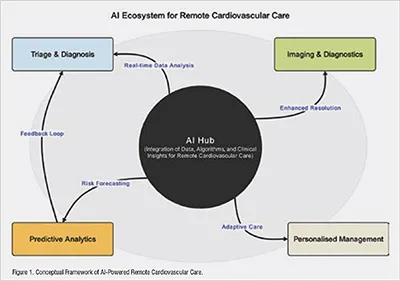
In cardiovascular care, early diagnosis is paramount to improving outcomes. Figure 1 is a conceptual framework of AI-powered remote cardiovascular care. This diagram illustrates the role of artificial intelligence in revolutionising cardiovascular care, highlighting its applications in diagnostics, imaging, predictive analytics, and personalised management. Arrows indicate the interconnectivity facilitated by AI, ensuring comprehensive, patient-centred healthcare delivery in remote settings. AI tools accelerate this process by harnessing data from remote monitoring devices, wearable technology, and telemedicine platforms. Machine learning algorithms can process vast datasets, identifying subtle patterns and anomalies that human clinicians might miss. For example, deep learning models analysing electrocardiograms (ECGs) accurately detect arrhythmias, including atrial fibrillation and ventricular tachycardia. These models operate at speeds and accuracies unmatched by manual analysis, facilitating real-time insights. By transmitting diagnostic results instantaneously to healthcare providers, AI minimises delays and supports timely interventions, which are particularly critical in managing acute conditions like myocardial infarctions. Delivering these capabilities remotely ensures that patients in underserved areas receive the same standard of care as those in well-equipped medical centres.
Advancing Imaging
Imaging technologies are indispensable for diagnosing cardiovascular conditions, yet their accessibility remains limited in remote and resource-constrained settings. AI addresses this gap by enhancing the functionality of portable imaging devices. Advanced algorithms improve image clarity and detect abnormalities in scans such as echocardiograms, CT angiograms, and cardiac MRIs. Generative AI models like GANs (Generative Adversarial Networks) further refine imaging resolution by reconstructing high-quality visuals from low-resolution inputs. This capability is particularly beneficial for portable devices, which are often constrained by hardware limitations. By integrating these tools into telemedicine workflows, patients can undergo comprehensive cardiovascular assessments without the need to travel to specialised facilities. AI-enhanced imaging also facilitates remote consultations, enabling specialists to provide accurate interpretations and tailored recommendations even from afar.
Personalised Remote Patient Management
Tailored Treatment Plans
Personalisation is a cornerstone of effective cardiovascular care, especially in remote settings where patient needs vary widely. AI-driven models excel at analysing individual health data, such as metrics from wearable devices and patient-reported symptoms, to craft tailored treatment strategies. For heart failure management, predictive algorithms assess factors like medication adherence, fluid retention, and blood pressure trends to recommend precise adjustments in therapy. These systems also account for variations in patient response, ensuring that treatments remain effective over time. The ability to personalise care remotely reduces the risk of complications, such as fluid overload or arrhythmias, and minimises hospital readmissions. This not only improves patient outcomes but also alleviates the burden on healthcare systems.
Continuous Monitoring
Continuous monitoring is crucial for managing chronic cardiovascular conditions, and AI-powered systems are redefining how this is achieved. Wearable devices equipped with sensors capture real-time data, including heart rate, blood pressure, and oxygen saturation levels. These data streams are analysed by AI algorithms to identify deviations from normal patterns, serving as early warning signals for potential deterioration. For instance, a sudden increase in heart rate variability or a drop in oxygen saturation could indicate the onset of complications, prompting immediate intervention. AI systems can also generate personalised alerts, notifying both patients and healthcare providers about critical changes.
Predictive Analytics for Preventive Care
AI’s ability to predict cardiovascular risks is revolutionising preventive care strategies. By analysing a combination of electronic health records, genetic data, and lifestyle factors, AI models identify individuals at heightened risk of developing conditions such as hypertension, coronary artery disease, or heart failure. These predictions enable targeted interventions, such as recommending dietary changes, exercise routines, or preventive medications, well before symptoms manifest. For instance, wearable devices that continuously monitor physiological parameters can detect subtle patterns, such as prolonged periods of elevated blood pressure or irregular heart rhythms, which might signal the early stages of heart disease.
Beyond individual care, predictive analytics also informs public health strategies. By analysing regional health data, AI identifies patterns of cardiovascular risk in specific populations, guiding resource allocation and policy development. For example, areas with high rates of obesity and smoking-related illnesses may benefit from targeted awareness campaigns or increased deployment of screening programs. Such insights ensure that healthcare resources are utilised efficiently, improving outcomes for underserved communities while addressing systemic inequalities in care delivery.

AI in Emergency Remote Care
Triage and Diagnosis
In emergencies, rapid response determines patient outcomes. AI-powered systems analyse data from wearable devices, such as heart rate monitors and oxygen saturation trackers, to prioritise high-risk cases efficiently. This data-driven triage helps optimise resource allocation, ensuring that critical patients receive immediate attention. Integrated clinical decision support tools access patient records and cross-reference symptoms, providing healthcare providers with precise recommendations even in time-sensitive scenarios. For instance, during cardiac emergencies, AI can suggest interventions such as defibrillation or anticoagulant administration, saving precious seconds.
Imaging and Support
Portable imaging devices augmented by AI have revolutionised remote emergency care. These compact systems process real-time scans, such as portable ultrasounds or ECGs, enhancing image resolution and diagnostic accuracy. By detecting subtle abnormalities, AI highlights potential complications, enabling clinicians to make informed decisions promptly. Additionally, AI bridges the gap between remote locations and specialised facilities by transmitting annotated imaging data for expert consultation, ensuring patients in underserved areas receive high-quality diagnostics without delay.
Generative AI in Remote Care
Enhanced Insights
Generative AI models, particularly transformers, revolutionise remote care by interpreting unstructured data sources like telemedicine transcripts, wearable data logs, and patient-reported symptoms. These models synthesise complex information, offering actionable insights that augment clinical decision-making. For example, a transformer-based system can identify nuanced patterns in patient speech during virtual consultations, such as breathlessness or fatigue, which might indicate early-stage heart disease.
Training and Simulation
Generative AI also plays a pivotal role in training healthcare professionals. Virtual simulations powered by generative models replicate real-world medical scenarios, enabling providers to practise handling emergencies in a risk-free environment. These tools incorporate rare and complex case studies, improving clinician preparedness for diverse challenges in remote care.
Addressing Challenges
Data Security
Protecting patient information remains a cornerstone of AI adoption in remote healthcare. Encryption technologies such as homomorphic encryption and secure multi-party computation ensure that data remains confidential during transmission and processing. Compliance with international data protection regulations, including GDPR and HIPAA, establishes a trustworthy framework for handling sensitive medical data. Transparent policies and robust security measures reinforce patient trust in remote diagnostic systems.
Integration Barriers
Aligning AI tools with existing telehealth platforms is essential for cohesive care delivery. Interoperability between diverse systems, facilitated by standardised data formats and APIs, reduces technical hurdles. Collaborative efforts involving technologists, healthcare providers, and policymakers are critical to achieving seamless integration. Pilot projects and shared knowledge repositories further accelerate the adoption of interoperable AI solutions.
Affordability
Cost-effective AI solutions are imperative for widespread implementation in remote clinics and low-resource settings. Innovations in hardware, such as low-power AI chips, and the development of open-source AI algorithms reduce financial barriers. Public-private partnerships and subsidised programs further support the dissemination of affordable diagnostic tools, ensuring equitable access to advanced healthcare technologies.
Provider Acceptance
Educating clinicians about AI’s potential to augment their expertise fosters acceptance and trust. Tailored training programs emphasise the practical applications of AI-driven decision support tools, demystifying complex technologies. By demonstrating the tangible benefits of AI in improving patient outcomes and reducing workloads, these initiatives encourage providers to embrace AI as a reliable partner in care delivery.
Future Trends
Real-Time Monitoring
AI-powered wearable devices equipped with advanced sensors are at the forefront of real-time health assessments. These wearables continuously monitor vital signs, alerting both patients and clinicians to early signs of deterioration. For example, AI-integrated smartwatches capable of detecting atrial fibrillation enable proactive interventions, preventing serious complications. Such advancements redefine chronic disease management, emphasising prevention over treatment.
Integrated Telemedicine
The integration of AI into telemedicine platforms streamlines the diagnostic process and enhances patient management. AI-powered chatbots conduct preliminary assessments, collecting detailed medical histories before consultations. During virtual visits, AI analyses patient inputs and provides clinicians with summarised findings, optimising consultation time.
Proactive Care Models
AI-driven predictive models transform healthcare from reactive to proactive. By analysing trends in patient health data, these models forecast disease progression and recommend preventive measures. For instance, AI can predict the likelihood of heart failure exacerbation based on changes in weight, blood pressure, and fluid retention.
Conclusion
Artificial intelligence is revolutionising cardiovascular diagnostics and remote care by enabling timely, accurate, and personalised solutions. Through advancements in imaging, continuous monitoring, and predictive analytics, AI addresses critical challenges such as accessibility, variability in clinical expertise, and delayed interventions. By overcoming integration barriers and ensuring data security, these technologies empower equitable healthcare delivery, bridging gaps in underserved populations. As AI systems continue to evolve, their integration into remote care holds the promise of transforming cardiovascular disease from a leading cause of mortality into a condition that can be proactively managed. This paradigm shift paves the way for a future where innovative AI tools enhance not only clinical outcomes but also the overall quality of life for millions worldwide.