
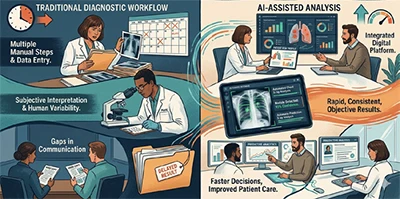
Healthcare systems are increasingly being shaped by data. From electronic medical records to connected medical devices, the amount of information available to clinicians has grown significantly over the past decade. Artificial intelligence is now being introduced to make sense of this data, helping identify patterns, support decision-making, and improve efficiency across care delivery.
As AI begins to operate within real clinical workflows, it is revealing an uncomfortable truth. The challenge in diagnostics is not always the lack of advanced tools or algorithms. In many cases, the weakest link lies in how diagnostic data is captured, structured, and made available in the first place. AI does not create this problem, but it makes it more visible. By depending on data quality and continuity, AI exposes the gaps that have long existed in diagnostic systems.
The Dependence of AI on Data Quality
Artificial intelligence systems rely on consistent and reliable data. Whether analyzing cardiac signals, laboratory results, or patient histories, the output is only as useful as the input. In theory, healthcare generates a vast amount of diagnostic information. In practice, this information is often incomplete, inconsistent, or fragmented.
Diagnostic data is collected across multiple points of care, including clinics, laboratories, and hospitals. These systems frequently operate in silos, with limited interoperability. As a result, patient records may lack continuity, forcing clinicians to make decisions based on partial information.
AI systems struggle in such environments. When data is missing or inconsistent, algorithms cannot establish meaningful patterns. Instead of improving clarity, they may highlight uncertainty. This is where the underlying weakness in diagnostics becomes evident.
Fragmentation Across the Care Journey
One of the most persistent issues in diagnostics is fragmentation. A patient’s journey through the healthcare system often involves multiple providers, each contributing a piece of the diagnostic puzzle. Tests may be repeated, records may not be shared, and results may not be available when needed. From a clinical perspective, fragmentation creates inefficiency. From an economic perspective, it increases costs. From an AI perspective, it limits effectiveness.
AI systems are designed to analyze trends over time. Fragmented data disrupts these trends. Without a continuous stream of information, the ability to identify gradual changes is reduced. This weakens the very advantage that AI is meant to provide. Fragmentation is therefore not just a workflow issue. It is a structural limitation that becomes more visible as AI tools attempt to operate within the system.
The Problem of Delayed Diagnostics
Another weakness that AI highlights is the timing of diagnostics. In many healthcare systems, diagnostic testing occurs after symptoms become noticeable. This reactive approach means that early signals are often missed.
AI has the potential to support earlier detection by identifying subtle changes across repeated measurements. However, this requires data to be collected consistently over time. When testing is infrequent or delayed, the opportunity for early detection is lost.
This creates a mismatch. AI is capable of analyzing early trends, but the system does not always provide the data needed for such analysis. As a result, the benefits of AI remain underutilized. The issue is not the capability of AI, but the timing and availability of diagnostic inputs.
Inconsistency in Measurement Standards
Diagnostic accuracy depends not only on technology but also on how measurements are taken. Variability in devices, calibration standards, and testing environments can introduce inconsistencies in data.
For clinicians, these inconsistencies are often managed through experience and judgment. For AI systems, variability can be more problematic. Algorithms rely on patterns that assume a certain level of consistency.
When measurements differ due to non-clinical factors, the reliability of analysis is affected. This inconsistency highlights another weak link in diagnostics. Standardization is essential for both clinical decision-making and AI-driven analysis. Without it, the value of collected data is reduced.
Data Overload Without Context
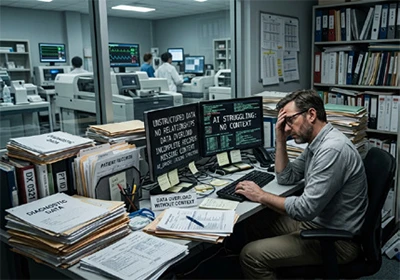
Healthcare systems are not lacking data. In many cases, they are overwhelmed by it. The challenge lies in organizing this data in a way that provides meaningful insight.
AI is often introduced as a solution to data overload, but it can only be effective when the underlying data is structured and contextualized. When records are disjointed or lack clear relationships, even advanced algorithms struggle to deliver useful outputs.
This situation reveals a paradox. While healthcare generates more data than ever before, the lack of structure and continuity prevents that data from being fully utilized. AI does not resolve this issue on its own. Instead, it brings attention to the need for better data management practices within diagnostics.
Workflow Gaps and Clinical Realities
Diagnostic processes are influenced by real-world constraints. Time pressures, patient volumes, and resource limitations all shape how data is collected and used. In busy clinical settings, the priority is often immediate care rather than long-term data organization. AI systems must operate within these constraints. If workflows are not designed to support consistent data capture, the effectiveness of AI will remain limited.
This is where the gap becomes evident. The promise of AI assumes a level of system coordination that does not always exist in practice. Bridging this gap requires not only better technology but also improvements in workflow design and clinical processes.
Economic Implications of Diagnostic Gaps
The weaknesses exposed by AI are not only clinical but also economic. Fragmentation, duplication of tests, and delayed diagnostics all contribute to higher healthcare costs. When data is not shared effectively, tests are often repeated. When conditions are detected late, treatment becomes more intensive. When workflows are inefficient, resources are used less effectively.
AI has the potential to improve efficiency, but only if the underlying diagnostic system supports it. Without addressing structural issues, the economic benefits of AI will remain limited. This highlights the need to view diagnostics not just as a technical function, but as a core component of healthcare economics.
The Path Forward
The increasing use of AI in healthcare provides an opportunity to address long-standing weaknesses in diagnostics. By exposing gaps in data quality, continuity, and workflow design, AI encourages a closer examination of how diagnostic systems are structured.
Improving diagnostics requires a focus on several key areas. Data must be captured consistently and made accessible across care settings. Measurement standards must be reliable. Workflows must support both immediate care and long-term data use. These changes are not simple, but they are necessary for AI to deliver meaningful value.
The goal is not to build more complex algorithms alone, but to strengthen the foundation on which those algorithms depend.
Conclusion
AI-led healthcare is often discussed in terms of innovation and progress. While these aspects are important, its most immediate impact may be in revealing the limitations of existing systems. Diagnostics, as a critical component of healthcare, contain several structural weaknesses that have gone largely unaddressed. AI brings these issues into focus by relying on the very elements that are often inconsistent or fragmented.
The future of AI in healthcare will depend not only on technological advancement but also on the ability to improve the systems that support diagnostics. When data is reliable, continuous, and well-structured, AI can deliver on its promise. Until then, the weakest link in diagnostics will remain a defining challenge, one that must be addressed before the full potential of AI can be realized.