
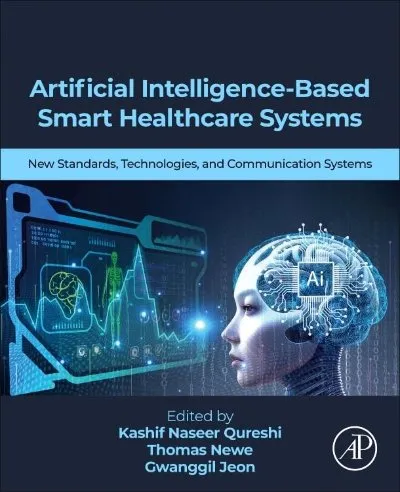
1. What inspired you to explore the convergence of artificial intelligence and smart healthcare systems, and how does your academic background in cybersecurity influence you perspective on this integration?
My inspiration stemmed from the growing need to improve healthcare delivery through technology, especially in underserved communities. With the rapid evolution of AI, I saw a unique opportunity to enhance diagnostic accuracy, patient monitoring, and system efficiency. My background in cybersecurity plays a critical role in shaping this vision ensuring that as we build smarter healthcare systems, we also embed robust security, privacy, and trust mechanisms from the ground up.
2. In your book, you discuss the transformation of traditional healthcare frameworks through AI. What do you see as the most disruptive or game-changing AI application currently being deployed in smart healthcare?
AI-driven diagnostics, especially in radiology and pathology, are among the most disruptive applications. Tools that can analyze medical images to detect anomalies with high precision are transforming the diagnostic process, reducing human error, and enabling earlier interventions. These systems are now capable of not only supporting clinical decisions but in some cases, outperforming traditional methods.
3. You emphasize the importance of intelligent architectures in AI-powered healthcare networks. Could you elaborate on how software-defined networks and mobility-based architectures contribute to scalability and responsiveness in real-time clinical scenarios?
Software-defined networks (SDNs) allow healthcare networks to be flexible and programmable, which is essential for handling large volumes of clinical data and varying traffic loads. Mobility-based architectures enable seamless access to healthcare services regardless of the location critical for telemedicine and emergency response. Together, they support real-time data flow and rapid decision-making, improving patient outcomes and operational efficiency.
4. With the increasing reliance on AI for medical decision-making, how do you address the ethical and accountability challenges that emerge in AI-powered diagnostics and treatment recommendations?
Ethical concerns must be addressed through transparency, explainability, and shared accountability. My book recommends establishing clear audit trails for AI decision-making, integrating human-in-the-loop frameworks, and adopting policies that define liability when AI tools are used in clinical decisions. Trust in AI systems comes from both technical validation and ethical governance.
5. The book discusses human pose estimation, speech recognition, and image analysis within smart healthcare systems. Which of these technologies do you believe holds the most promise for immediate implementation, and why?
Image analysis holds the most immediate promise due to its maturity and proven utility in diagnostics. AI models trained on vast datasets of medical images can detect conditions such as tumors or retinal diseases with high accuracy, aiding radiologists and improving early diagnosis. Its integration into clinical workflows is already underway in many institutions globally.
6. One of the core themes in your book is interoperability. What are the main barriers to achieving interoperable AI-based healthcare systems, and how can they be overcome through standards or policy?
The key barriers include inconsistent data formats, lack of unified communication protocols, and vendor-specific systems. To overcome this, my book advocates for the adoption of international standards like HL7 FHIR and the development of open APIs. Policy frameworks must mandate interoperability as a requirement for healthcare IT systems to ensure seamless data exchange across platforms.
7. Considering the volume and sensitivity of healthcare data, how does your book propose to tackle issues related to data security, privacy, and compliance, especially when AI is involved in data processing?
The book emphasizes secure-by-design principles. It recommends the integration of encryption, access controls, anonymization techniques, and blockchain for data integrity. Compliance with GDPR, HIPAA, and other relevant regulations is stressed, along with regular audits and AI model monitoring to ensure ongoing compliance and data protection.
8. Can you walk us through the design of an ideal AI-driven smart healthcare ecosystem as envisioned in your book, particularly in terms of data flow, communication protocols, and decision layers?
An ideal ecosystem includes data layer, communication layer, processing kayer, decision and security layer.
• Data Layer: Collects input from wearable sensors, EMRs, and diagnostic tools.
• Communication Layer: Uses secure protocols (e.g., MQTT, HTTP/2, 5G) to transmit data to processing nodes.
• Processing Layer: Utilizes edge computing for real-time decisions and cloud computing for deep learning analysis.
• Decision Layer: Integrates AI models that provide recommendations to clinicians, with dashboards for visualization.
• Security Layer: Implements continuous monitoring, access control, and data integrity checks.
9. Edge and cloud computing are often discussed together in AI deployments. How does your book differentiate their roles within the healthcare context, and what recommendations do you provide for selecting between them?
Edge computing is best for latency-sensitive applications, such as emergency monitoring or bedside diagnostics. Cloud computing, on the other hand, is suited for resource-intensive tasks like training AI models or managing large-scale patient data. The book recommends a hybrid approach deploying edge nodes for real-time decisions and cloud platforms for long-term storage and analytics.
10. Given the global disparities in healthcare infrastructure, how adaptable are the architectures and standards proposed in your book for low-resource settings or developing nations?
The proposed architectures are designed with flexibility in mind. Lightweight AI models, mobile-based interfaces, and modular systems can be deployed in low-resource environments. The book also discusses solar-powered IoT devices and offline data syncing strategies to ensure functionality even with limited infrastructure.
11. The book sheds light on the role of AI in streamlining administrative healthcare tasks. Could you share some insights or examples of how AI is reshaping hospital operations and administrative efficiencies?
AI is being used for automating billing, managing patient flow, and scheduling appointments. Chatbots assist with patient inquiries, while NLP tools help convert physician notes into structured data. These applications reduce administrative burden and free up time for healthcare professionals to focus on patient care.
12. How does your book address the role of AI in pandemic preparedness or response, particularly in light of recent global health crises?
The book explores how AI can aid in early outbreak detection through anomaly detection in health records or social media. It also covers AI’s role in tracking infection rates, optimizing resource allocation, and predicting case surges. AI-driven simulation models can support policy decisions and vaccine distribution planning during pandemics.
13. As new AI models emerge rapidly, how do you see the lifecycle of AI integration evolving in smart healthcare systems, and what mechanisms should be in place to ensure continuous validation and performance optimization?
AI integration must be treated as an ongoing process. My book emphasizes model retraining, continuous performance evaluation using real-world data, and inclusion of feedback loops. Governance structures must be in place to validate models before deployment and monitor them throughout their lifecycle to prevent model drift or biases.
14. What key message or takeaway would you like readers - especially researchers, engineers, and healthcare policymakers - to leave with after reading your book?
The key message is that AI has the power to transform healthcare, but it must be implemented responsibly. Interdisciplinary collaboration, ethical oversight, and a focus on equity are essential. As we design AI-powered healthcare systems, our goal must always be to enhance human well-being and ensure that no one is left behind.