
1. You highlight that healthcare supply-chain disruptions are rising globally. How has the nature and intensity of these disruptions evolved in recent years?
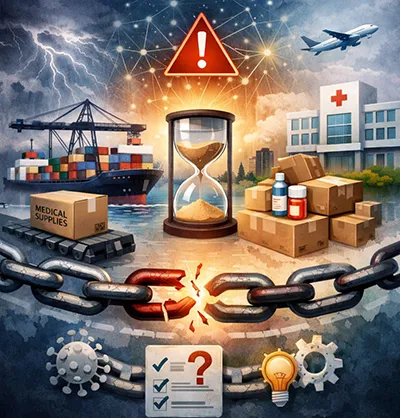
Healthcare supply chains have become increasingly vulnerable, with the sector now facing more than 18,000 logistics incidents annually. Disruptions that once appeared isolated, including customs delays, port congestion or capacity constraints, are now frequent and widespread. External shocks have amplified this fragility: 95% of healthcare cargo owners were affected by COVID-19 legacy disruptions, while port congestion in major global hubs and geopolitical tensions further strained networks.
At the same time, new crises such as tariff changes, Red Sea shipping disruption and climate-related events have added layers of unpredictability. These pressures translate into fulfilment delays, difficulty responding quickly to change and risks of treatment disruption. As a result, healthcare organisations experience disruption as a systemic reality rather than an occasional challenge, with operational continuity increasingly exposed to factors far beyond their direct control.
2. Which macroeconomic or geopolitical shifts are currently exerting the greatest pressure on healthcare logistics networks?
Macroeconomic and geopolitical volatility now has one of the most significant influences on healthcare logistics performance. Healthcare cargo owners view geopolitical instability and trade volatility as the greatest threats to their strategies over the next three years, reflecting the turbulence caused by conflicts, tariff regimes and regulatory shifts.
The Russia-Ukraine conflict, restrictions in the Panama Canal and the Red Sea disruption have all demonstrated how vulnerable essential trade routes can be. Meanwhile, tariff changes in the US and other major markets add cost and uncertainty, prompting companies to build more flexible sourcing and routing models. Climate-driven constraints and infrastructure challenges further exacerbate the strain. Together, these forces are reshaping shipping times, route availability and cost structures – making geopolitical and macroeconomic shifts front-line drivers of supply-chain reliability.
3. Among operational, financial, and reputational risks, which ones are escalating most rapidly for healthcare supply chains, and what is driving this acceleration?
Financial and reputational risks are accelerating sharply as operational fragility becomes more visible. Between 2022 and 2025, the average logistics disruption cost $595,000, contributing to more than $11 billion in annual losses across the sector. Operational time is also heavily affected, with 57% of healthcare cargo owners losing more than a month in a disrupted year.
These disruptions escalate customer and partner-facing risks: 85% report increased customer complaints, while 76% say they have lost business and 67% report damage to their reputation. The acceleration is driven by a mix of frequent external shocks, customs complexity, visibility gaps and heightened expectations for reliability in healthcare delivery. As healthcare systems become more interconnected, each disruption carries more pronounced operational and reputational consequences.
4. Can you share examples where supply-chain fragility directly impacted patient outcomes or caused reputational fallout for healthcare organisations?
Fragile supply chains have direct clinical implications. Delays in medical devices, diagnostic equipment or essential medicines can lead to postponed surgeries, missed diagnostics or reduced access to treatment. Recent research showed that providers frequently cancel or reschedule procedures due to product shortages, demonstrating how operational vulnerabilities translate into patient impact.
During disruptions such as Hurricane Helene, many US healthcare providers experienced shortages that required conservation strategies, including the postponement of elective or non-emergency procedures. These operational pressures rapidly turn into reputational challenges: complaints rise, contracts are lost, and partners begin to question reliability.
Because healthcare logistics underpin continuity of care, any breakdown affects not only operational efficiency but institutional trust – reinforcing how sensitive the sector is to delays and disruption across supply chains.
5. Customs complexity continues to delay critical healthcare shipments. What specific gaps within current customs processes make them particularly challenging for this sector?
Customs processes present structural barriers for healthcare shipments due to complex documentation requirements, strict regulatory expectations and limited temperature-controlled capacity during inspection. These gaps are particularly problematic for time-sensitive and highly regulated products such as cardiovascular and oncology medicines. Fragmented digital oversight compounds the issue, making it difficult to track consignments through customs-intensive nodes and increasing the risk of delay.
In India, an essential production and export hub for African healthcare supply, complex customs and regulatory requirements, alongside limited compliant infrastructure, slow product clearance and restricted cross-border flows. These delays affect the reliability of high-demand products reaching their intended destinations. For healthcare organisations, customs complexity is more than an administrative challenge: it directly influences treatment timelines, product integrity, and access to care in critical markets.
6. Despite advances in digital logistics, visibility remains limited. What are the structural reasons behind the persistent lack of end-to-end visibility in healthcare supply chains?
End-to-end visibility remains elusive because healthcare supply chains are highly fragmented across manufacturers, logistics providers, customs authorities and last-mile distributors. Each uses different systems, creating siloed data and limited interoperability. Technology or systems failures are also common, contributing to planning challenges and inconsistent real-time monitoring.
Investment patterns play a role: while many organisations invest in warehousing and storage, fewer prioritise risk management, customs compliance or production logistics technology – all of which underpin effective visibility. Gaps are particularly pronounced at customs and regulatory touchpoints, where digital oversight is often limited. Although many leaders believe they have strong visibility, slow recovery from disruption indicates that it remains incomplete. Overall, structural fragmentation combined with uneven investment and variable digital maturity limits seamless monitoring across modes and borders.
7. How do varying levels of regulatory maturity and compliance readiness across different regions contribute to fragmentation and delays?
Regulatory maturity varies widely across markets, creating fragmented requirements for documentation, inspection and compliance. These differences slow clearance times and increase the likelihood of delay, especially for highly regulated healthcare goods. Despite the importance of compliance, only a minority of healthcare organisations invest in customs and regulatory readiness, leaving documentation gaps and inconsistent preparedness for inspection.
In key production and export hubs such as India, a mix of complex customs environments, evolving regulatory requirements, and capacity constraints amplifies delays. These inconsistencies create unpredictable timelines, additional costs, as well as reduced reliability for healthcare providers, who depend on consistent product availability. The result is a sector-wide challenge in which varying regulatory maturity acts as both a structural and operational barrier to delivering safe, timely and compliant healthcare products across borders.
8. Which emerging digital technologies, data tools, or analytics frameworks hold the greatest potential to transform visibility and predictability across the healthcare supply chain?
Digital transformation offers compelling opportunities in this area. Healthcare cargo owners overwhelmingly expect the strongest return on investment from supply-chain digitisation, with many planning increased spending on AI, robotics, automation and digitalisation. Predictive analytics, digital visibility tools and real-time monitoring systems help organisations anticipate disruptions, optimise routing and maintain product integrity throughout transit.
These technologies support proactive rather than reactive operations by identifying risks earlier and enabling faster decision-making. Investment in supply-chain or production logistics technology has already been shown to reduce disruption costs, showing that digital tools directly enhance resilience. When combined with compliant, temperature-controlled infrastructure, emerging technologies create more connected, transparent and agile supply chains capable of responding dynamically to rapidly changing conditions.
9. How effectively can real-time monitoring and predictive analytics mitigate risks for temperature-sensitive or life-saving medical products?
I would say they are highly effective in doing so. The Nhava Sheva Free Trade Zone near Mumbai, for example, demonstrates how integrating temperature-controlled facilities with real-time digital visibility and expedited customs processes helps maintain cold-chain integrity from production to destination. This approach reduces the likelihood of temperature excursions, delays or product degradation.
Predictive tools further enhance resilience by identifying emerging risks such as congestion, geopolitical disruption or climate-related events before they escalate, allowing organisations to reroute or adjust inventories proactively. By supporting consistent product quality and reducing waste, these technologies enable more reliable delivery of medicines to providers and patients. Real-time oversight, therefore, plays a crucial role in safeguarding treatment continuity and ensuring that essential products arrive in usable condition.
10. What barriers – organisational, technological, or regulatory – still prevent stakeholders from adopting unified digital platforms for better integration?
I would argue that the adoption of unified digital platforms is currently hindered by a combination of overconfidence, fragmented systems and uneven regulatory environments. Many leaders believe they outperform peers in resilience, visibility and recovery – yet actual recovery times reveal significant gaps. This perception reduces urgency for systemic digital integration. Technologically, organisations often invest heavily in warehousing while underinvesting in logistics technology, resilience planning or customs compliance, resulting in dispersed data and limited interoperability.
Regulatory diversity adds further complexity: differing documentation, data standards and privacy requirements make it challenging to deploy common platforms across all markets. Together, these barriers create an environment where integration remains partial, visibility is inconsistent, and opportunities for predictive, data-driven logistics are not fully realised. Addressing these issues requires coordinated investment, aligned processes and greater cross-border standardisation.
11. You emphasise the need for targeted investment in domestic transport. Which regions or logistics segments face the most critical infrastructure weaknesses today?
Critical infrastructure weaknesses appear most acutely in domestic transport and last-mile logistics, where investment remains limited. Only a minority of healthcare organisations allocate resources to these segments, despite evidence that strengthening domestic transport can reduce disruption costs significantly.
The effects of weak infrastructure are most pronounced in developing regions, where even short delays can halt essential services. Corridors connecting production hubs in India to African healthcare markets highlight this challenge: limited temperature-controlled capacity, fragmented digital oversight and complex customs processes slow product movement and restrict reliable distribution. These weaknesses extend beyond ports to road networks, storage capacity and clinic-level delivery systems: because last-mile execution ultimately determines whether products reach patients, gaps at this stage pose some of the most significant risks to healthcare continuity.
12. How is DP World specifically addressing last-mile inefficiencies and infrastructure gaps in markets where challenges are deeply systemic?
We address these challenges through integrated solutions that combine compliant infrastructure, regulatory facilitation and real-time digital oversight. In the Nhava Sheva Free Trade Zone, we created a purpose-built, temperature-controlled pharmaceutical facility designed to overcome customs complexity, limited cold-chain capacity and fragmented digital visibility. The model removed the need for local incorporation, providing duty deferment options and enabling transactions in freely convertible currencies.
By integrating expedited customs clearance, regulatory-compliant sampling and real-time tracking, DP World ensured cold-chain integrity from origin to healthcare destinations across Africa. The solution generated over USD 16 million in regional sales and expanded access in other markets, including Nigeria, Ghana, Kenya, Botswana, Namibia and South Africa. This case illustrates how coordinated infrastructure and visibility investments can significantly strengthen last-mile reliability.
13. What collaborative models between governments, logistics providers, and healthcare manufacturers are proving most effective in accelerating supply-chain resilience?
Effective collaborative models align regulatory authorities, logistics providers and healthcare manufacturers around shared goals of compliance, speed and reliability. The Nhava Sheva example shows how joint engagement can streamline customs clearance, enable regulatory-compliant sampling and strengthen cold-chain management for products destined for African markets. This type of collaboration allows manufacturers to benefit from compliant infrastructure while regulators maintain oversight and logistics providers ensure operational efficiency.
More broadly, organisations that invest across multiple logistics dimensions – technology, infrastructure, risk planning and compliance – experience substantially lower disruption costs, demonstrating the benefits of coordinated effort. Our experience has taught us that stronger partnerships and shared investment priorities are essential to building connected, future-ready supply chains capable of withstanding geopolitical, operational and environmental pressures.
14. Looking ahead, what long-term investments or bold solutions do you believe will define the next generation of resilient, future-ready healthcare supply chains?
The next generation of healthcare supply chains will be shaped by integrated investment across infrastructure, digitalisation, and resilience planning. Our data shows that businesses investing in three or more logistics areas already see significantly lower disruption costs, while those strengthening domestic transport and last-mile capabilities can reduce incident costs by up to 80%.
Digitisation will also be a defining force, with healthcare leaders expecting the greatest returns from AI-enabled visibility, real-time monitoring and predictive analytics. Investment momentum is strong, with many planning increased budgets for AI, automation and digital tools. In addition, long-term resilience will depend on GDP-compliant infrastructure – such as temperature-controlled hubs and integrated facilities in strategic trade zones – that protect product integrity and improve speed-to-market.
Ultimately, the most effective healthcare organisations will view logistics not as a cost centre or back-office function – but as a core capability that directly supports patient safety, uninterrupted care and overall performance.