
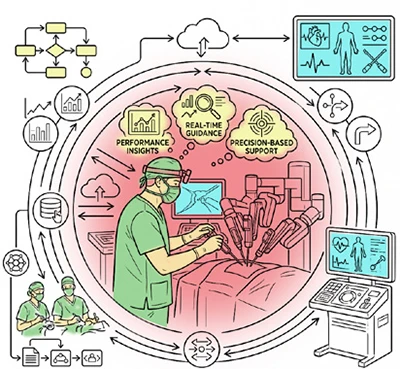
1. Robotic surgery is moving beyond standalone platforms toward integrated, intelligent systems. How do you define a “smart operating system” in this context, and what marks this shift as a true inflection point for surgical care?
A smart operating system is the digital layer that connects the robotic surgical platform, imaging, other OR devices, workflow data, and clinical context into a coordinated environment. Its value is not automation, but meaningful integration. The inflection point comes when surgery begins to move from isolated decisions toward data-enriched, continuously informed execution, with the potential to improve precision, decision-making, and ultimately patient outcomes.
2. From your dual perspective as a surgeon and innovator, what are the most pressing gaps in today’s robotic surgery landscape that connected, data-driven platforms are aiming to address?
The biggest gaps remain fragmentation, variability, and limited feedback. Too much of surgery still depends on individual experience and local variation, without a consistent way to capture what actually happened in the room. Data from pre-operative risk stratification, imaging, energy use and instrument motion, and workflow often remain disconnected. Connected platforms can help make performance more discreet and alterable, and therefore quality improvement more actionable.
3. How is the integration of real-time intraoperative data and analytics changing the way surgeons execute complex procedures, particularly in high-risk or minimally invasive cases?
Real-time data can improve how surgeons interpret anatomy, anticipate risk, and adapt during a procedure. In minimally invasive and high-risk surgery, where visualization and precision are critical, analytics can help identify deviations in workflow, variants, and critical anatomy, and potentially flag concerns earlier. The goal is not to replace surgeon judgment but to better inform decisions.
4. To what extent can smart operating systems standardise surgical performance across institutions and varying experience levels, while still preserving surgeon judgment and autonomy?
They can standardise process better than they can standardise judgment, and that matters. Smart systems may help define best-practice techniques, reduce unnecessary variation within surgical teams across a campus or around the world. At the same time, surgery is nuanced and highly variable, and individual patients do not always follow a neat script. The surgeon still has to interpret uncertainty and patient-specific complexity that demands flexibility.
5. Interoperability remains a major challenge in healthcare. What needs to happen to enable seamless integration between robotic systems, imaging technologies, and hospital IT infrastructure?
Interoperability will require technical standards, shared data architectures, and a greater willingness across industry and health systems to prioritize connectivity over silos. We need to avoid isolated and proprietary outputs. Real integration will require collaboration across industry, hospitals, and regulators, with clinicians defining what information actually matters at the point of care.
6. Data is foundational to intelligent surgical ecosystems. How can healthcare organisations ensure the accuracy, consistency, and clinical relevance of the data being captured and utilised?
Data quality begins with routine and disciplined capture, clinically meaningful definitions, and diversity of inputs. Accuracy cannot be assumed because information is digital. Surgeons, nurses, informaticians, data scientists, and other stakeholders should all be involved. The right dataset is one that reflects real surgical practice and answers pressing clinical questions.
7. Moving beyond passive assistance, how close are we to systems that can actively guide or influence intraoperative decision-making in real time?
We are getting closer to systems that can guide, but not independently decide. Pattern recognition, surgical workflow awareness, and contextual prompts are already becoming more realistic. The near-term future is augmentation, not autonomy. Guidance must be accurate, explainable, and trusted for surgeon decision-making. Today, commercially available soft-tissue robotic platforms are not autonomous, they are actively manipulated by surgeons.
8. What are the key barriers—technical, regulatory, financial, or cultural—that could slow the adoption of smart operating systems in operating rooms globally?
All of them matter, but culture may be the most underestimated. Technical integration can be hard, regulation pathways for adaptive systems remain complex, and financial models, including capital investment is significant. But even strong technology will struggle if it adds friction or lacks trust. Adoption depends on fitting into the realities of surgical care and alignment with real clinical needs.
9. How do you see these platforms transforming surgical education and ongoing skill development, particularly in shortening the learning curve for advanced robotic procedures?
They could make surgical learning more intentional and directed. Instead of relying only on case numbers, variable teaching and individual skill acquisition, or subjective feedback, we can begin to measure proficiency, technique, and progression more objectively. And this can be benchmarked to the learner over time, and to international norms. That has value for trainees, but also for experienced surgeons who want to refine and improve performance over time.
10. Can you share a real-world example or use case where a connected surgical platform has delivered measurable improvements in surgical performance, efficiency, or patient outcomes?
One practical example is video-enabled procedural review combined with workflow analytics. In both laparoscopic and robotic surgery, surgeons can then identify variations in key steps, inefficiencies, and opportunities for technical refinement that may otherwise go unnoticed during a procedure. For instance, in a large department of surgery, there may be significant variance in time to perform a step of procedure, which could be identified in an individual surgeon as an outlier and allow for guided improvement. Even before linking these data points directly to clinical outcomes, this type of feedback can improve efficiency and support targeted coaching.
11. From a hospital leadership perspective, how should organisations evaluate the return on investment (ROI) when adopting smart operating systems?
Return on investment should be measured beyond the capital outlay or cost of a single surgical episode. Leaders should ask whether the platform improves workflow, reduces variation, strengthens training, and generates usable insight that results in better care. This should be measured across the patient journey- including pre-operative evaluations and post-operative recovery, not just in the OR and the cost of the surgical event.
12. With increasing reliance on digital infrastructure, how should providers address concerns around cybersecurity, patient data privacy, and system reliability in the operating room?
These concerns must be addressed as core design requirements. Cybersecurity, privacy, and reliability are patient safety issues. That means strong governance, clear data access controls, rigorous validation, system redundancy, and transparency around how data are stored and used. This includes disclosure to patients.
13. Looking ahead, how will technologies such as artificial intelligence, machine learning, and augmented reality converge to shape the next generation of robotic surgery?
I expect convergence around computer vision and prediction. Artificial intelligence and machine learning will likely help systems interpret anatomy, recognise procedural context, and identify patterns linked to risk or improved technical performance. Augmented reality may then serve as the interface that delivers that insight to the surgeon in a useful way. The most meaningful advances cannot be technological novelty alone, but clinically useful guidance accessed easily within the flow of surgery.
14. Finally, what is your long-term vision for the intelligent, fully connected operating room—and what key milestones still need to be achieved to make that vision a reality?
My long-term vision is an OR that functions as a coordinated ecosystem, not a collection of disconnected devices. The room should understand workflow, support decision-making, and continuously contribute to learning. To reach that point, we still need interoperability, better evidence, and an implementation that is designed around the clinical team. The connected operating room will succeed if it advances both surgical performance and improves patient care.