
1. Doctor Anywhere envisions a “connected continuum of care.” How does this concept redefine the traditional boundaries of healthcare delivery, particularly in moving beyond hospital-centric models?
For most of healthcare’s history, the hospital was the centre of gravity, patients moved toward it, and everything else radiated outward. At Doctor Anywhere, we’re building the opposite: a healthcare experience that meets patients where life is already happening, with intelligence woven through every step.
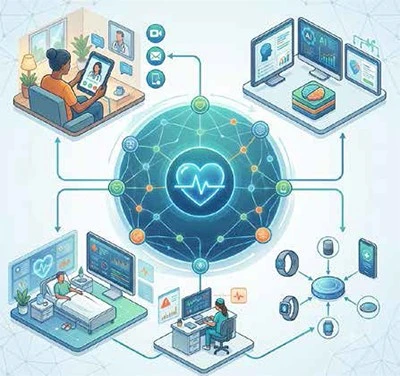
We see healthcare as five connected stages: preventive, primary, specialist, hospital, and step-down, orchestrated as one seamless experience. The hospital still plays a critical role, but as one node in an intelligent network, not the destination patients must navigate toward. Healthcare stops being a place you go, and becomes a service that follows you.
2. In a virtual-first ecosystem, what structural changes are required within hospitals and health systems to support care that begins and often continues outside physical facilities?
The shift has to happen on three fronts simultaneously: people, process, and product.
Touch one, and you don’t get a transformation; you get a pilot.
Healthcare needs clinicians who can deliver care virtually and in person, care navigators who guide patients between visits, and leaders who truly understand both healthcare and technology.
On process, workflows must assume the patient journey began long before the front desk, with AI embedded structurally into triage, claims, and follow-up. On product, the experience has to feel like one continuous service, not disconnected touchpoints.
We're well into that rebuild at DA.
3. How do you see virtual-first care models reshaping patient entry points into the healthcare system, and what implications does this have for triage, diagnosis, and long-term care pathways?
The “front door” of healthcare is no longer a building. It’s a phone — often late at night, when someone is unsure what their symptoms mean.
That changes everything downstream. With AI supporting clinicians in stratifying risk and guiding next steps, triage becomes earlier and far more effective. Patients can be routed to self-care, a GP, a specialist, or emergency care more efficiently than traditional systems allow, which we call right-sitting of care.
For chronic disease, especially continuous, low-friction engagement surfaces issues earlier, enabling intervention weeks or months sooner. That’s the real promise: earlier and better decisions.
4. Integration remains a major challenge in healthcare. What are the biggest barriers to building unified digital health platforms, and how can providers overcome legacy system constraints?
Three barriers stand out: data, workflow, and trust. Each of them shifts in interesting ways once you have serious AI capability.
Data has long been the visible challenge, but AI changes the equation by making unstructured information, consult notes, lab reports, claims, prescriptions, usable at scale. That removes constraints legacy systems have struggled with for decades.
Workflow is the quieter challenge. Technology alone doesn’t change entrenched clinical habits; meaningful redesign only happens when clinicians are deeply involved.
Trust is the deepest. Providers and patients won’t share data unless they trust the foundation beneath it. That’s why we rebuilt our TPA platform, Vantage, from the ground up before layering AI on top.
5. From an operational standpoint, how can healthcare providers ensure seamless coordination across multiple care touchpoints, including teleconsultations, diagnostics, pharmacy, and in-person care?
Coordination is increasingly an intelligence problem, not just a logistics one. The fundamentals still matter: a single patient view, clear ownership across the in-between, and simple defaults for next steps. Our unified DA Healthcare App brings these touchpoints into one place for the member.
What’s changing the game is AI underneath: routing that learns from outcomes, claims adjudication that improves over time, 24/7 multilingual support, and analytics that surface population-level patterns earlier. These aren’t experiments, they’re how our operations increasingly run.
At the centre sits our DA Medical Concierge, where humans manage complex cases, supported by intelligence that handles the rest.
6. Data continuity is critical for connected care. What strategies or technologies are most effective in enabling real-time, interoperable data exchange across fragmented systems?
The standards conversation has matured, open APIs, structured exchange formats, and modern data infrastructure are table stakes. What separates real interoperability from PowerPoint interoperability is now less about protocols and more about three disciplines.
First, capture data in structured form at the point of care, not retrofit it later. Second, design AI to work with messy, partial, multi-source data because that’s healthcare reality. Third, make the patient the connective tissue; consented sharing resolves many cross-provider gaps.
When we rebuilt Vantage, we designed a flexible backend for exactly this reason. The real advantage is architectural conviction, not any single technology.
7. How does Doctor Anywhere approach balancing data accessibility with patient privacy and regulatory compliance, especially across different geographies?
We operate across Singapore, Malaysia, Thailand, the Philippines, and Indonesia, with further regional expansion underway. Each market brings its own regulations and cultural expectations, which we treat as a design input, not a constraint.
Our principles are consistent: the patient owns their data, we collect only what’s needed, and we’re transparent about usage. We localise storage and comply with each country’s rules, defaulting to the more protective standard where regulations differ. As we scale AI, we’ve built clear guardrails on data use, model training, and auditability.
Trust is asymmetric — slow to earn, quick to lose. The faster we move on AI, the more disciplined we must be.
8. In virtual-first care delivery, what role do AI and predictive analytics play in enhancing clinical decision-making and patient outcomes?
AI is not a feature for us. It’s the lens we’re rebuilding the company through, across people, process, and product. We’ve chosen to be early, because this is a generational shift in healthcare.
In practice, our internal GenAI platform, DA Genius, supports teams across the organisation. Our TPA backbone, Vantage, runs AI agents across claims, fraud detection, customer service, policy queries, and analytics. Clinically, AI surfaces relevant history, improves triage, and reduces administrative burden.
The real shift, however, is cultural: hiring, training, and leadership all change together. Touch only one, and you get a pilot, not a company. The clinician remains the hero, and the patient the point.
9. How can healthcare organisations measure the ROI and clinical effectiveness of virtual-first models, particularly in comparison to traditional care delivery?
Measurement in this space is maturing fast, and AI is accelerating that by giving us instrumentation we never had before.
On the operational side, the key metrics are access, continuity, adherence, and right-siting, whether patients are guided to the right level of care. For payers and partners, right-siting is increasingly central to value.
Clinically, it’s outcomes patients recognise: fewer complications, better-controlled chronic disease, and earlier detection. AI makes longitudinal tracking far more possible by connecting data across touchpoints.
And the hardest measure: whether patients trust the model enough to use it for what truly matters. That remains the deepest test of effectiveness.
10. With increasing digital touchpoints, how do you ensure patient engagement and trust remain strong throughout the care journey?
Trust is built, not scaled — one consultation at a time. That’s been true for a hundred years and will remain true regardless of how technology evolves.
In digital healthcare, there’s a temptation to optimise for engagement metrics. We resist that. The real measure is whether the patient feels reassured, understood, and looked after. If that’s achieved, engagement follows.
AI helps by removing friction: less paperwork for doctors, faster answers for patients, and reliable follow-up through system memory.
Healthcare is personal. People want reassurance, not options. The test for every AI investment is whether it makes care feel more human, not less.
11. What are the key considerations in designing scalable virtual care models for emerging markets, where infrastructure and digital literacy may vary significantly?
The biggest lesson is not to copy-paste. Every market has forced us to relearn healthcare from the ground up.
Practically, this means designing for the lowest realistic specification, not the highest, with human-centred design — fewer screens, clearer language, more handholding. It also means localised distribution, such as HMOs in the Philippines, employers, and insurers in Singapore.
AI is now changing expansion economics, handling claims, service, and localisation with smaller teams. But it doesn’t remove the need for local presence and cultural understanding.
The principle remains: humility. Test, learn, adapt. AI accelerates the journey, but it doesn’t replace the discipline.
12. How do partnerships across insurers, providers, and technology companies — accelerate the development of an integrated care ecosystem, and what makes such collaborations successful?
No single company can build connected care alone. We work with insurer partners across the region, alongside corporate clients and provider networks, with alignment around specific patient outcomes.
AI is changing what these partnerships can deliver. With richer data across the ecosystem, we can enable proactive interventions for high-risk members, faster and more accurate claims, and real-time population health insights. The strongest partnerships are those where each party evolves its own operations to unlock this.
What makes them work remains simple: clear accountability, operational integration, data sharing, and honest conversations when things don’t work. This collaborative mindset is becoming increasingly visible across industry platforms like ATxEnterprise 2026, where healthcare organisations, insurers, and technology companies are jointly shaping the next phase of connected care.
13. Looking ahead, what will define an “intelligent hospital” in the next 5–10 years, and how central will virtual-first care be to that evolution?
Let me share where I think this is heading, with the caveat that we’re still building the future as we describe it.
The hospital of the next decade will focus more on what only it can do — complex acute care, specialised procedures, and high-intensity diagnostics. Everything else will move beyond its walls. At DA, we call this a “decentralised hospital” care that follows the patient, not the other way around.
The intelligence won’t just be the technology, but the orchestration: AI woven through triage, diagnosis, claims, coordination, and population health. The real differentiator is how well the system holds the patient together across it all.
14. Finally, what strategic advice would you give to healthcare leaders who are transitioning from fragmented systems to a fully integrated, virtual-first care model?
Three things.
First, treat AI as a transformation, not a project. The companies that will lead are rebuilding their people, process, and product around it not layering it onto existing operations.
Second, hold the human anchor while moving fast. Patients don’t want innovation for its own sake; they want to feel reassured, understood, and looked after. Every AI decision should make healthcare feel more human, not less.
Third, build for the long game. We rebuilt Vantage over the years because foundations matter. The leaders who succeed will be the ones who stay disciplined, curious, and focused on serving patients above all else.
Read the full article — it's free
Register with AsianHHM to unlock expert insights, research articles and in-depth industry analysis.