
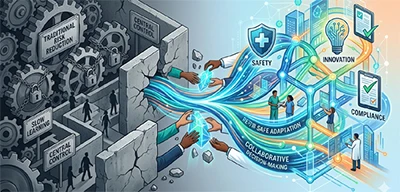
Digital transformation in healthcare is often described through what becomes possible: new technologies, expanded capabilities, and increasing connectivity. What receives far less attention is whether the system itself is able to absorb these changes while still keeping coherence high.
Ambition alone will not pave the way. This is a question of architecture at its core.
As capabilities expand, the nature of coordination changes. Decisions become more interdependent, consequences more far-reaching, and the tolerance for delayed clarity significantly smaller. What used to be manageable through escalation and retrospective control begins to exceed those mechanisms. At that point, transformation exceeds technological challenges. Its success lies in the underlying organizational structures.
Healthcare operates under a specific form of complexity. Clinical judgment, regulatory requirements, ethical responsibility, and operational constraints are not separate dimensions. They interact continuously. Decisions are rarely isolated; they are situated within systems that must remain both adaptive and accountable at the same time. The challenge is not to accelerate change indiscriminately. It is to ensure that change can occur without the system fragmenting under its own complexity. That requires a different level of design. Here, architecture comprises infrastructure, and it describes how decisions are made, how responsibility is carried, how evidence is generated, and how oversight is enacted in practice. It determines whether an organization can remain intelligible to itself while adapting.
Where this architecture is coherent, transformation becomes absorbable. Where it is not, progress accumulates locally while friction grows systemically. One of the most persistent structural issues is decision architecture.
In many organizations, authority, expertise, and accountability are distributed across different layers without clear alignment. Decisions travel. They are revisited, delayed, or refrained from as they move. This is not a question of individual capability, but of how the system organizes responsibility. The consequence is decision latency: the time it takes for knowledge, authority, and accountability to converge.
In a regulated environment, latency is not neutral. It affects predictability, increases rework, and diffuses ownership at precisely the points where clarity would matter most. A more deliberate decision architecture makes governance functional. Authority is positioned closer to expertise. Trade-offs become visible earlier. Decisions become less about escalation and more about resolution. Closely linked to this is compliance by design.
Compliance is often treated as a phase, as something that follows development. In practice, this separates value creation from regulatory validation. Constraints surface late, when they are costly to address and difficult to integrate cleanly. A more resilient approach integrates both from the outset. Regulatory requirements, quality criteria, and documentation logic become part of how work is structured. Evidence is generated as a natural consequence of delivery, rather than assembled retrospectively.
This approach relocates rigor to where it is most effective. It integrates compliance into early development already, which I love to call DevCompOps. The same applies to traceability. In healthcare, outcomes alone are insufficient. It must remain possible to understand how a decision was reached, which information informed it, and where responsibility resides. Traceability preserves this continuity.
It allows organizations to adapt and to keep their own narrative at the same time. On the one hand, without it, speed would become fragile. On the other hand, jointly, adaptation remains governable. This also means to shift the documentation left in development. Besides that, as systems become more capable, the question of human oversight becomes more precise. We have already reached a reality in which tech supports decision-making. Crucial to the successful tackling of this technological watershed is where human judgment is positioned within that system, and how it is exercised when it matters.
This is where clear boundary conditions and rules come into play. Central questions are: At which process step does a human enter? Which AI results need oversight? What do humans have ownership of in increasingly complex systems? Without this clarity on human roles and responsibilities, and the human USP, oversight becomes formal rather than effective. Closely related is also explainability.
Systems must remain interpretable to those responsible for them. Next to being a technical requirement, this is a fundamental condition for governance. Leaders, clinicians, and regulators need to understand how outputs are generated and under which assumptions they operate. Interpretability is what keeps oversight substantive rather than symbolic. No architectural model functions independently of the human system.
Healthcare organizations operate with finite cognitive capacity. When complexity is not structured, it is absorbed by people. When priorities remain unclear and decisions are delayed, individuals compensate. They simplify, focus locally, and navigate ambiguity as best as possible. Over time, this shapes behavior more strongly than any formal design. This is where psychological safety becomes operational.
The ability to surface uncertainty, articulate constraints, and question assumptions has to be made a structural requirement for systems that need to remain in contact with their own reality. Where this is not possible, problems risk accumulating until it becomes a challenge to contain them.
Governance provides structure for control, and at the same time enables the generation of usable insight. Systems that produce reports without resolution, or visibility without clarity, retain formal governance while remaining operationally opaque. Boards engage with this indirectly, but decisively. The role of the board extends beyond driving transformation activity to ensuring that the conditions for safe adaptation are consistently in place. This shifts the questions that are detrimental to future-proofing organizations. Beyond roadmaps and implementation plans, attention moves to the structure of decisions, the alignment of accountability, and the integration of regulatory logic into daily work. Where in our systems are decisions delayed, and why? Where do we have dependencies in decisions that make our processes inefficient? Where does responsibility dilute? Are our roles and responsibilities clear, also at the interfaces with LLMs? At what point do regulatory constraints enter the process? Can the organization reconstruct how it arrived at its decisions? Is oversight enacted or assumed? These questions make transformation viable. Beyond that, a related topic is becoming increasingly visible at the system level.
As populations age, healthcare systems face a growing imbalance between demand and capacity. Chronic conditions, long- term care needs, and cumulative treatment pathways place sustained pressure on structures historically designed around episodic intervention. In this context, prevention becomes less an abstract objective and more a structural necessity. Yet prevention remains difficult to operationalize at scale. The root cause of this lies in its misaligned incentives, even though the value of prevention is obvious. Prevention requires investment in the present for outcomes that materialize later. Effort is immediate. Benefit is distributed, delayed, and often not attributable to a single action.
As a result, prevention is frequently addressed at the level of individual responsibility rather than system design. This is where the architectural question returns. If systems are structured primarily around treatment, optimization will occur within that frame. If prevention is to become effective, it must be embedded into how attention is allocated, how outcomes are measured, and how accountability is defined. It requires the ability to recognize early signals, to act before conditions escalate, and to align incentives across actors who do not experience the same time horizons.
Prevention, in this sense, has to become more than a small, parallel initiative. It should grow into an expression of the same capability: whether a system is designed to respond to problems or to anticipate them. This marks a broader shift in how transformation is understood. Instead of simply introducing new capabilities, the next evolutionary step for the organization and our health system as a whole is to become better at learning, deciding, and adapting while maintaining coherence. In an environment shaped by increasing technological capability (or even disruption), this distinction becomes even more pronounced.
Surely, healthcare does need speed, without a doubt. Yet, it also requires systems that remain intelligible, governable, and anchored in human judgement. Organizations that recognize this move their assessment of architecture from a mere supporting function towards a strategic discipline. Not architecture in the narrow sense of infrastructure, but as the design of how the organization thinks, decides, and takes responsibility under constraint.
Where this is achieved, the dynamic changes.
• Innovation integrates while keeping the stability of the system intact.
• Compliance aligns with the flow of work and is embedded into development processes.
• Human expertise retains its orientation and value, within increasing complexity.
Transformation, then, moves from an episodic stance to a core property of the organization. It becomes an integral part of its DNS.
For executive leadership, this reframes the central question of ‘What’s the next innovation we should aim at?’ to:
‘What kind of organization are we shaping: one that accumulates complexity, or one that can absorb it while being at the forefront of human-centered innovation?’
This distinction determines whether healthcare systems remain capable of acting under pressure, under uncertainty, and in the presence of increasing technological and societal complexity.
And that, ultimately, is what safe change requires.
References
1. WHO (2021a), Global Strategy on Digital Health 2020–2025
2. WHO (2021b), Ethics and Governance of Artificial Intelligence for Health WHO (2025), Guidance on Large Multi-Modal Models
3. WHO (2021c), UN Decade of Healthy Ageing: Plan of Action 2021–2030 WHO (2025), Integrated Care for Older People (ICOPE)
4. Edmondson (2019), psychologische Sicherheit Meadows (2008), Systemdenken
5. EU AI Act (2024)
6. OECD AI Principles (2019/2024)