


Why Collaborative Governance Matters in Healthcare Innovation
The healthcare industry is at a crossroads. Faced with mounting operational costs, workforce shortages, and fragmented care delivery, healthcare systems across the world are struggling to keep pace with demand. According to the World Health Organization (WHO), there will be a global shortfall of 10 million healthcare professionals by 2030, while healthcare spending continues to rise at an unsustainable annual rate of 5.4% (WHO, 2022). Meanwhile, inefficiencies in healthcare delivery cost the global economy approximately $1.3 trillion annually (Institute for Health Metrics and Evaluation, 2023).
At the same time, startups developing digital health solutions, medical devices, and new therapeutics face significant barriers when attempting to enter the market. While their innovations may hold the potential to improve patient care and optimize healthcare delivery, they often struggle to navigate the complex regulatory pathways, secure funding, and establish strategic partnerships with healthcare providers. Without access to real-world clinical settings, their ability to generate the clinical evidence required for regulatory approvals and market adoption remains limited.
To address these challenges, collaborative governance has emerged as a powerful approach that brings together hospitals, university hospitals, healthcare organizations, and startups to facilitate feasibility testing, regulatory compliance, and commercialization. By fostering multi-stakeholder collaboration, this model ensures that promising healthcare innovations can transition successfully from concept to clinical reality.
Enabling Feasibility Testing and Clinical Validation
For any healthcare innovation to achieve widespread adoption, demonstrating safety, effectiveness, and regulatory compliance is essential. However, the traditional pathway from research to clinical use is often lengthy, rigid, and slow moving —particularly challenged by dynamic technologies like AI, which require iterative validation and ongoing oversight. Collaborative governance provides a structured solution, enabling startups to partner directly with healthcare institutions and regulators to test, refine, and validate technologies efficiently in real-world settings. To be truly scalable, this model must balance rapid innovation with rigorous safety standards, while simultaneously addressing data interoperability, ethical considerations, and public acceptance.
Public-Private Partnerships: A Model for Market Access
Singapore’s Regional Health Clusters: A Model for Efficiency
A strong example of this approach is seen in Singapore’s regional health clusters, which integrate public hospitals, primary care clinics, and specialty services into coordinated networks. By grouping healthcare facilities under a unified structure—such as SingHealth, the National Healthcare Group (NHG), and the National University Health System (NUHS)—Singapore has created an ecosystem that supports innovation by reducing operational redundancies and improving care coordination.
Startups that engage with these networks benefit from structured feasibility testing, early-stage regulatory guidance, and potential adoption pathways within hospital systems. According to a McKinsey & Company report, such models reduce hospital readmissions by up to 30% and lower administrative costs by as much as 12% (McKinsey & Company, 2021).
Saudi Arabia’s Vision for PPPs in Healthcare Innovation
Saudi Arabia is rapidly advancing its healthcare sector through public-private partnerships (PPPs) as part of Vision 2030. The Saudi Ministry of Health (MOH) has been actively promoting PPPs to drive investment, innovation, and efficiency in healthcare delivery. These partnerships aim to:
• Enhance specialized healthcare services by integrating private-sector expertise.
• Facilitate the adoption of digital health solutions and medical technologies.
• Reduce the financial burden on the government while accelerating healthcare innovation.
A key initiative in this transformation is the Saudi Health PPP Framework, which enables collaborations between startups, hospitals, and investors to improve healthcare accessibility, efficiency, and quality. This initiative encourages startups developing AI-driven diagnostics, remote patient monitoring solutions, and mental health technologies to integrate into the Saudi healthcare ecosystem (World Health Expo, 2023).
Moreover, according to Healthcare Saudi Arabia (2023), PPPs have led to the establishment of advanced medical facilities, increased private sector participation, and improved patient outcomes. The Saudi government’s goal is to have the private sector contribute 35–40% of total healthcare expenditure by 2030, signaling a significant shift towards collaborative governance in healthcare delivery.
These PPP initiatives provide startups with an unparalleled opportunity to test, refine, and scale their innovations within a dynamic and growing healthcare market. By partnering with leading hospitals, regulatory bodies, and healthcare investors, startups can accelerate their clinical validation processes and secure a pathway to commercialization in Saudi Arabia.
University Hospitals: Innovation Hubs for Clinical Validation
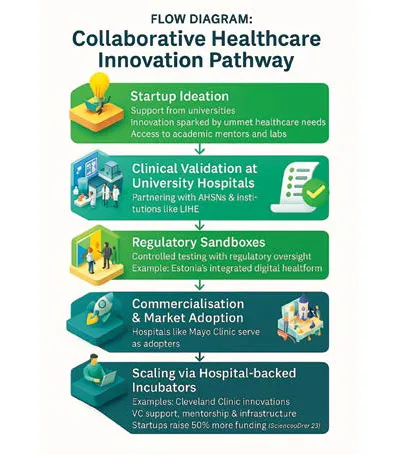
Beyond public-private partnerships, university hospitals play a crucial role in bridging the gap between research and real-world clinical applications. With deep expertise in clinical trials and medical research, these institutions provide startups with structured pathways for feasibility testing and clinical validation.
In the UK, Academic Health Science Networks (AHSNs) exemplify this approach, connecting startups with leading university hospitals, researchers, and regulatory experts to rigorously test innovations before they reach the market. By integrating startups into academic environments, AHSNs facilitate early-stage clinical trials, mentorship, and funding opportunities—key factors in scaling healthcare innovation.
King's College London's London Institute for Healthcare Engineering (LIHE) further illustrates this collaborative model. Embedded within St Thomas' Hospital, LIHE unites King's research excellence, the clinical expertise of Guy’s and St Thomas’ NHS Foundation Trust, and the MedTech industry. This strategic alignment ensures rapid translation of healthcare engineering research into practical technologies benefiting patients. LIHE also provides executive support, enabling MedTech entrepreneurs to confidently transition their innovations from research to clinical practice and commercialization. With dedicated spaces supporting collaboration among startups, SMEs, and industry leaders, LIHE represents a robust example of how university hospitals serve as dynamic hubs driving healthcare innovation.
Research by ResearchGate reinforces this role, indicating that university hospitals are responsible for 40% of all early-stage clinical trials, underscoring their critical function as enablers of healthcare innovation (ResearchGate, 2023).
Regulatory Sandboxes: A New Approach to Compliance
One of the most significant challenges that healthcare startups face is navigating the regulatory landscape. Complex approval processes can delay market entry by years, making it difficult for startups to bring their innovations to patients in a timely manner.
To address this issue, regulatory sandboxes are being introduced as a way for startups to work alongside regulators while testing their products in real-world conditions. These sandboxes offer a controlled environment where startups can refine their technology under regulatory supervision, ensuring compliance while accelerating approval timelines.
A prime example of this approach is found in Estonia’s digital health governance model. Estonia, recognized globally as a digital leader, has developed a nationwide e-Health system that integrates patient records across public and private healthcare providers, creating a seamless data ecosystem for startups to test digital health solutions. This model has been highly effective in reducing regulatory bottlenecks, with the World Bank estimating that Estonia’s digitally integrated system has reduced healthcare costs by 12% through faster diagnostics and reduced duplicate testing (World Bank, 2022).
From Clinical Validation to Commercialization
Once an innovation has been clinically validated, the next major hurdle is commercialization—ensuring that the solution is adopted by healthcare providers and made accessible to patients. Collaborative governance can also play a key role at this stage by creating market entry pathways through hospital networks and venture-backed incubators.
The Role of Hospitals in Market Adoption
Major hospital systems often serve as early adopters of validated healthcare technologies, helping startups integrate their solutions into clinical practice. For example, Mayo Clinic Ventures actively collaborates with startups to co-develop and license new medical technologies, ensuring that validated solutions are rapidly integrated into hospital workflows. Research published in ScienceDirect suggests that hospital-backed commercialization models generate $3–$5 billion annually in healthcare innovation revenue, further demonstrating their impact (ScienceDirect, 2022).
Venture Capital and Hospital-Backed Incubators
In addition to direct adoption, hospitals are increasingly launching venture capital funds and incubators to support early-stage healthcare startups. One leading example is Cleveland Clinic Innovations (CCI), which provides startups with investment capital, regulatory support, and access to Cleveland Clinic’s global healthcare network.
Data from ScienceDirect (2023) suggests that startups backed by hospital incubators raise 50% more funding in Series A rounds compared to independent startups, highlighting the importance of hospital-led investment initiatives in driving innovation.
Regulatory, Ethical, and Social Considerations in Collaborative Governance
While collaborative governance offers numerous opportunities for accelerating healthcare innovation, it also introduces new complexities and ethical considerations that stakeholders must navigate carefully. Key issues include data privacy, patient consent, and ethical usage of AI, stakeholder trust, and societal acceptance of new technologies.
Data privacy remains a primary concern, particularly in innovations involving digital health and AI-driven solutions. Collaborative governance models must clearly define responsibilities regarding patient data protection, data ownership, and compliance with evolving regulations, such as GDPR and HIPAA. To address privacy concerns, stakeholders—including healthcare providers, tech companies, and regulators—need to establish shared guidelines and transparent practices that build patient trust and safeguard personal health information.
Ethical considerations related to patient consent and autonomy become increasingly complex in the era of AI-driven diagnostics and predictive healthcare tools. Clear frameworks for informed consent are required, ensuring patients fully understand how their data will be used and the implications of AI-driven medical decision-making. Additionally, addressing algorithmic bias in healthcare AI is critical to ensuring equitable outcomes, especially in fields like FemTech, where historical biases have contributed to gaps in care.
Social acceptance of new healthcare technologies is another crucial factor. Public hesitancy, driven by concerns about safety, privacy, or effectiveness, can significantly delay or derail adoption. Collaborative governance provides a solution by involving patient advocacy groups, healthcare professionals, and regulatory bodies early in the innovation process, fostering dialogue and trust through transparency and inclusive decision-making.
Finally, regulatory adaptation is vital. Traditional regulatory processes, often static and slow, may hinder innovation, particularly for dynamic technologies like AI and FemTech. Collaborative governance should actively support regulatory bodies in adopting more iterative, flexible frameworks that balance rapid innovation cycles with thorough oversight and safety assessments.
Looking Ahead: The Future of Collaborative Governance in Healthcare
As healthcare continues to evolve, collaborative governance models will play an increasingly central role in fostering innovation. Emerging trends such as AI-driven governance models, blockchain for healthcare compliance, and cross-border clinical trials are expected to enhance regulatory efficiency, improve transparency, and accelerate the adoption of new technologies.
For startups, hospitals, and healthcare organizations alike, the key to success lies in building sustainable partnerships that bridge the gap between innovation and implementation. By fostering cross-sector collaboration, regulatory adaptability, and strategic commercialization pathways, healthcare stakeholders can ensure that groundbreaking solutions reach the patients who need them most.
References
1. The Power of Partnerships: How Collaboration Drives Clinical Evidence in Digital Health – Galen Growth
2. ScienceDirect: Collaborative Governance in Health Systems – ScienceDirect
3. ResearchGate: Collaborative Governance in Health and Technology Policy – ResearchGate
4. McKinsey & Company: The Impact of Coordinated Governance Models on Healthcare Efficiency – McKinsey & Company
5. World Bank: The Role of Digital Integration in Healthcare Cost Reduction – World Bank
6. Healthcare Saudi Arabia: The Future of Healthcare & Public-Private Partnerships – Healthcare.com.sa
7. World Health Expo: The Prominent Role of PPPs in Advancing Saudi Arabia’s Healthcare Landscape – World Health Expo
8. World Health Organization: Global Health Workforce Shortage & Economic Impact – WHO
9. Institute for Health Metrics and Evaluation: Global Healthcare Expenditure & System Inefficiencies – IHME