
For many years, hospital accreditation has been treated as a marker of quality, safety and institutional credibility. In Singapore, as in many healthcare systems, international accreditation frameworks such as the Joint Commission International helped hospitals establish discipline in governance, patient safety, documentation, facility management, medication safety, and clinical quality. They created a common language for quality and gave institutions an external benchmark against which to measure themselves.
But healthcare has changed. Hospitals today are no longer simple buildings where care is delivered episodically. They are complex ecosystems, connected to primary care, community partners, digital platforms, national registries, insurers, regulators, training institutions and patients who are increasingly informed and mobile. In this environment, accreditation cannot remain a periodic exercise built around preparing files, polishing documentation and surviving a survey week.
Singapore’s gradual move towards a more locally adapted accreditation framework is therefore not a rejection of international standards. It is a sign of maturity. It reflects a healthcare system that has grown confident enough to ask a more important question: what does safe, effective and sustainable care look like in our own context?
This matters because healthcare quality is never abstract. It is shaped by manpower realities, patient demographics, financing models, care integration, national priorities and the operational constraints of each system. A standard that works well in one country may not translate perfectly into another. A hospital may look compliant on paper, yet still struggle with workflow fragmentation, duplicated audits, data fatigue or staff who experience quality work as administrative punishment rather than meaningful improvement.
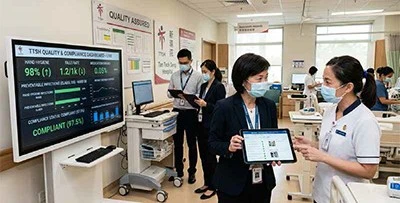
The future of accreditation in Singapore must therefore move beyond compliance towards intelligence. This is where digital audit systems, quality dashboards and real-time compliance tools become more than administrative conveniences. Used well, they can transform accreditation from a retrospective inspection exercise into a living management system.
Traditionally, accreditation has been episodic. Teams prepare for months, conduct gap analyses, compile evidence, run mock surveys, chase departments for documents, and hope that the organisation performs well during the formal assessment. While this can drive improvements, it also creates a familiar problem: quality becomes seasonal. The organisation becomes most alert just before inspection, and then slowly relaxes after the accreditation cycle is over.
Digital tools can change that rhythm
A well-designed digital audit system allows standards to be mapped clearly to evidence, workflows and responsible owners. Instead of maintaining scattered spreadsheets, email trails and shared folders, institutions can track compliance status in one place. Audit findings can be assigned, escalated and closed with evidence. Recurrent lapses can be analysed across departments. Leaders can see not only whether a standard is met, but also where the system is fragile.
This shift is important because modern healthcare leaders do not simply need more data. They need better visibility. A dashboard that shows medication incidents, hand hygiene compliance, delayed discharge summaries, infection indicators, patient complaints, audit closure rates and risk trends can help leaders move from anecdote to action. It allows the hospital to ask: Are we improving, or are we merely documenting improvement?
However, dashboards are only useful if they are designed around decisions. One common mistake in healthcare digitalisation is assuming that more indicators automatically lead to better governance. In reality, too many dashboards become digital wallpaper. They exist, they are colourful, and nobody changes their behaviour because of them.
A useful quality dashboard should answer three questions. First, what requires attention now? Second, who needs to act? Third, what will happen if no one intervenes? Without these questions, dashboards become another reporting burden. With them, they become leadership tools.
The same principle applies to real-time compliance tools. In a hospital setting, risks do not wait for audit cycles. A missing consent form, an expired competency record, a delayed review of a high-risk result, or an incomplete medication reconciliation process can have real consequences. When compliance tools are integrated into daily workflows, they allow issues to be detected earlier and corrected closer to the point of care.
This is especially relevant in Singapore, where healthcare is increasingly integrated across institutions and care settings. Patients move between acute hospitals, specialist outpatient clinics, community hospitals, primary care providers and home-based services. Accreditation tools must therefore evolve beyond the walls of a single hospital. They should support continuity of standards across the patient journey.

For example, a locally adapted accreditation framework can place greater emphasis on care transitions, discharge coordination, shared accountability, workforce sustainability, patient communication and system-level safety. These are deeply relevant to Singapore’s healthcare model. They are also areas where imported accreditation frameworks may not fully capture local operational nuance.
This does not mean lowering standards. In fact, local adaptation should raise the bar. The goal is not to make accreditation easier. The goal is to make it more meaningful.
A hospital can comply with a policy yet still deliver a poor patient experience. A department can pass an audit, yet still operate with inefficient workflows. A team can meet documentation requirements yet still feel psychologically unsafe to speak up about risks. True quality requires more than evidence. It requires culture.
This is where leadership becomes central. Digital accreditation tools can show us gaps, but they cannot create ownership by themselves. A dashboard can highlight a trend, but it cannot make people care. An audit system can assign corrective actions, but it cannot build trust. Real-time alerts can detect non-compliance, but they cannot replace professional judgment.
In fact, the danger of digital accreditation is that it may become a more sophisticated version of the same old compliance mindset. Instead of chasing paper, teams may end up chasing digital fields. Instead of preparing physical folders, they may prepare online folders. Instead of meaningful improvement, the organisation may simply become better at producing evidence.
That would be a missed opportunity.
The real promise of digital accreditation tools lies in reducing administrative burden so that healthcare workers can focus on what actually improves care. If nurses, doctors, allied health professionals, and administrators spend less time duplicating documentation for audits, they can spend more time solving real operational problems. If leaders can access reliable dashboards, they do not need to depend on last-minute reporting exercises. If compliance can be monitored continuously, accreditation becomes part of daily work rather than a disruptive event.
This is particularly important in the current healthcare climate. Manpower is tight. Patient complexity is rising. Staff are tired. Any accreditation framework that adds burden without improving care will eventually lose legitimacy on the ground. Healthcare workers are not resistant to quality. They are resistant to work that feels performative, duplicated or disconnected from patient outcomes.
A good accreditation tool should therefore pass a simple test: does it make it easier for staff to do the right thing?
If the answer is yes, it is a quality enabler. If the answer is no, it is probably just another administrative layer.
Singapore is well-positioned to make this transition. As a small and highly connected healthcare system, it has the advantage of national coordination, strong institutional governance and a culture of measurement. A locally adapted framework can support national benchmarking in a way that is more contextually relevant than comparing hospitals against broad international norms. It can help institutions learn from one another, identify system-wide risks and spread good practices faster.
However, benchmarking must be handled carefully. If used poorly, it can create defensiveness. Hospitals may focus on looking good rather than being honest. Departments may under-report risks if they fear being judged. Staff may become reluctant to surface problems if every metric is treated as a performance weapon.
This is why psychological safety is not a soft concept in accreditation. It is fundamental infrastructure. A mature quality system is one where people can say, “This is not working,” before harm occurs. It is where near misses are treated as opportunities to learn, not occasions to blame. It is where data is used to improve systems, not shame individuals.
In my own journey across healthcare operations, hospital administration, clinical service management, and now graduate medical education, I have come to appreciate that accreditation is never just about standards. It is about behaviour. I have seen teams work incredibly hard before audits, sometimes with genuine pride, sometimes with quiet exhaustion. I have seen how a well-run accreditation process can bring clarity, discipline, and shared purpose. But I have also seen how easily quality work can become reduced to folders, screenshots and last-minute evidence collection. My personal reflection is that the best accreditation systems are not the ones that make people afraid of being caught. They are the ones who help people become proud of doing things properly, even when nobody is watching.
That is the mindset Singapore’s next phase of accreditation should aim for.
Digital tools should support this by making quality visible, timely and actionable. A nurse manager should be able to see emerging risks in her ward before the next formal audit. A hospital leader should be able to understand whether corrective actions are truly closing gaps or merely closing tasks. A quality department should be able to spend less time chasing evidence and more time coaching teams. A national regulator should be able to identify patterns across the system and support targeted improvement.
This requires careful design. Accreditation tools must be interoperable with existing hospital systems where possible. They must avoid duplicating data entry. They must be simple enough for frontline teams to use. They must produce insights that matter to different levels of leadership. And most importantly, they must be connected to an improvement methodology. Data without improvement capability only creates anxiety.

The future accreditation team will therefore need a different skill set. Quality professionals will still need to understand standards, audit methodology, and patient safety principles. But they will also need to understand data interpretation, digital workflow design, change management and human behaviour. They will need to translate standards into operations, and operations into measurable improvement.
This is where hospitals should invest. Not only in software, but also in people who can use these tools wisely. A dashboard does not create transformation. A reflective, skilled, and empowered team does.
There is also a broader national opportunity. A locally adapted accreditation framework can help Singapore define what excellence means for an integrated health system. It can move the conversation from “Are we compliant?” to “Are we safer, more coordinated, more sustainable and more responsive to our population’s needs?” That is a far more powerful question.
The transition from international accreditation to local adaptation should not be seen as a step away from global standards. It should be seen as Singapore taking ownership of its next stage of healthcare maturity. International standards helped us build a structure. Local intelligence can help us build relevance.
Ultimately, accreditation should not be a theatre of compliance. It should be a mirror that helps hospitals see themselves clearly. Digital audit systems, dashboards and real-time compliance tools are useful only if they make that mirror sharper, not heavier.
The future of hospital accreditation in Singapore will not be defined by how many standards we can document. It will be defined by how effectively we convert standards into everyday practice, data into insight, and insight into safer care.
That is the real promise of accreditation tools. Not to help hospitals pass inspections, but to help healthcare systems learn continuously.
Read the full article — it's free
Register with AsianHHM to unlock expert insights, research articles and in-depth industry analysis.