
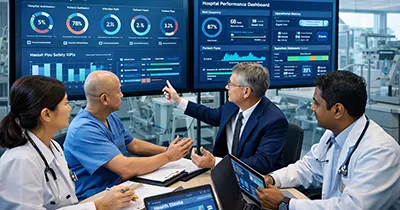
 Healthcare delivery in India is undergoing a remarkable transformation. As hospitals expand, diversify services, and adopt new technologies, leadership faces a central challenge: How do we ensure consistent, high-quality care across departments, units, and locations? The answer lies in data-driven governance, where dashboards and Key Performance Indicators (KPIs) act as the nerve centre of decision-making. In a landscape defined by rapid change and rising patient expectations, dashboards enable healthcare leaders to see the entire system in real time - clinical performance, operations, financial health, patient experience, process adherence, and staff responsiveness. When monitored consistently, KPIs strengthen not just measurement, but a culture of accountability and continuous improvement.
The Need for Data-Driven Leadership in Healthcare
Healthcare is an intricate ecosystem where clinical decisions, operational workflows, and administrative processes must come together with precision. Relying on traditional monitoring methods such as manual reporting, verbal updates, or siloed documentation exposes hospitals to delays, inaccuracies, and inefficiencies. Dashboards overcome these limitations by offering immediate visibility into performance metrics, early warnings for potential issues, and standardised reporting that aligns everyone – from department heads to frontline staff – toward shared goals. As hospitals scale new departments, centres of excellence, multiple branches, manual monitoring becomes impossible. Dashboards provide the operational “radar system” required to keep quality consistent regardless of expansion speed. For a growing healthcare network, dashboards become indispensable, ensuring that leadership can monitor progress and intervene proactively rather than reacting after adverse events or inefficiencies occur.
Understanding KPIs in Healthcare
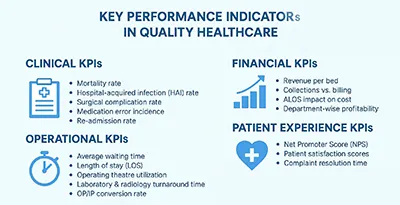
Key Performance Indicators are quantifiable metrics used to evaluate how effectively a hospital achieves its goals. In a hospital setting, KPIs typically span four key domains: clinical outcomes, operational efficiency, financial sustainability, and patient experience. Clinical KPIs relate to patient safety and treatment effectiveness, covering data points such as mortality rates, infection rates, readmissions, and complications. Operational KPIs focus on efficiency indicators like waiting times, turnaround times, length of stay, and discharge processes. Financial KPIs measure the economic health of the organization, tracking revenues, billing efficiency, denial rates, and cost-performance balance. Patient experience KPIs capture satisfaction levels, responsiveness, communication quality, and resolution of complaints. When integrated into dashboards, these KPIs create a holistic picture of hospital performance that helps leaders understand how well systems are functioning and where improvements are needed.
What are Healthcare Dashboards?
A healthcare dashboard is essentially a visual performance management tool that displays KPIs using charts, colours, alerts, and data visualisations. The dashboard combines data from multiple sources and presents it in an intuitive, easy-to-understand format. Dashboards may be real-time, drawing live data from digital systems; role-specific, designed for leaders such as CEOs or medical directors; or department-focused, enabling units like the ICU, ER, OT, laboratory, or pharmacy to track their own metrics. In a multi-hospital network, dashboards become invaluable, allowing leadership to compare performance across locations, maintain uniform standards, and identify best practices that can be replicated across the organisation. Through charts, color-coded alerts, trend lines, and performance summaries, dashboards help leaders make quick, informed decisions.
Enhancing Quality and Patient Safety Through Dashboards
Dashboards significantly enhance patient safety by enabling real-time monitoring and early detection of deviations. They immediately flag rising infection rates, prolonged waiting times, or increasing medication errors, prompting rapid corrective action such as adding staff or initiating targeted training. Instead of discovering issues after harm occurs, healthcare teams gain timely insights that prevent escalation. By transforming healthcare from reactive to proactive, dashboards empower organisations to anticipate risks, intervene early, and consistently protect patients through data-driven vigilance.
Ensuring Standardisation Across Healthcare Networks
Maintaining consistent quality across multiple hospitals is a major challenge. Variations in clinical practice, documentation, workflows, and compliance often emerge when systems operate independently. Dashboards address this challenge by enabling leadership to track the same KPIs across all units, compare performance, and immediately spot deviations. They allow best-performing hospitals to serve as benchmarks and enable cross-learning among teams. Over time, dashboards help establish a unified identity of excellence, strengthening the reputation of a network that offers predictable, reliable care regardless of location. This is particularly important in fast-growing healthcare chains seeking to maintain uniform standards.
Promoting Accountability at Every Level
Dashboards bring transparency to operations, making it clear who is responsible for each metric and how departments are performing. Nursing dashboards reveal compliance in documentation, medication administration, and patient counselling. ER dashboards reflect the speed of triaging and the timeliness of doctor evaluation. Radiology dashboards track reporting delays, while revenue cycle dashboards highlight pending claims and denial trends. When individuals and teams know their performance is visible and measurable, accountability naturally increases. This fosters a performance-driven culture where staff strive to meet standards and improve processes.

Reducing Operational Bottlenecks
Operational delays affect patient satisfaction, efficiency, and cost. Dashboards help identify bottlenecks in real time, enabling administrators to resolve issues promptly. For example, if laboratory turnaround times increase, the dashboard signals the delay, prompting workflow analysis and corrective action. If discharge timelines are prolonged, leaders can examine whether documentation, pharmacy clearance, or billing are causing the delay. Dashboards also help anticipate bed shortages, streamline patient flow, and reduce administrative lag. By minimising bottlenecks, dashboards directly enhance the patient experience and overall operational efficiency.
Strengthening Financial Sustainability
Economic stability is essential for healthcare organizations to invest in technology, staff, and infrastructure. Financial dashboards support this by displaying daily revenues, billing accuracy, denial trends, consumable costs, and departmental profitability. When financial KPIs are analyzed alongside clinical and operational KPIs, leadership develops a clearer picture of cost-effectiveness and resource utilization. This integrated view helps ensure that hospitals deliver high-quality care without compromising financial sustainability.
Enabling Predictive and Preventive Decision-Making
Advanced dashboards powered by analytics and artificial intelligence extend beyond reporting. They begin to predict trends, identify high-risk patients, forecast resource needs, and anticipate operational challenges. Predictive dashboards can warn leaders about potential patient surges, infection spikes, or staffing shortages, enabling teams to prepare in advance. This evolutionary shift transforms dashboards from static tools into intelligent decision-support systems, enabling preventive leadership that aligns with the goals of smart healthcare systems.
Fostering Staff Performance and Engagement
Dashboards influence staff behaviour by making performance measurable and transparent. For nurses, dashboards reinforce the importance of protocol adherence, timely documentation, and patient counselling. For departments, dashboards highlight strengths and areas needing improvement, fostering healthy competition and motivation. They also support learning by identifying training needs. Over time, dashboards help create a culture where teams take pride in achieving—and maintaining—high performance.
Supporting Accreditation and Continuous Quality Compliance
For hospitals preparing for accreditation from organisations such as NABH, JCI, or ISO, dashboards provide concrete evidence of ongoing quality compliance. Instead of gathering data retrospectively during audit cycles, dashboards maintain continuous documentation of infection control practices, incident reports, committee reviews, and staff training. This not only eases audit processes but also ensures the hospital consistently adheres to established standards throughout the year.
Key Considerations in Building Effective Dashboards
The success of dashboards depends on thoughtful design and implementation. Organisations must choose KPIs that truly support strategic goals rather than collecting excessive or irrelevant data. Integration with HIS, LIS, RIS, and PACS ensures real-time accuracy, while role-based dashboards prevent information overload by providing each team with the data most relevant to its function. Visual cues such as color coding help highlight priorities quickly. Defining ownership for each KPI ensures accountability, and regular review of dashboards in leadership meetings transforms them from passive tools into active drivers of improvement. Most importantly, dashboards must be embedded into a culture of action, where insights lead to interventions that improve clinical outcomes and patient experience.
Challenges in KPI Monitoring
Despite their benefits, dashboard implementation can present challenges. Data overload can dilute focus if too many KPIs are tracked, making it essential to prioritise high-impact metrics. Poor documentation or incomplete entries compromise dashboard reliability, highlighting the need for a strong documentation culture and staff training. Some staff may resist transparency, fearing blame, which underscores the importance of building a culture centered on learning rather than punitive action. Technical challenges may arise if systems are not well integrated, reinforcing the need for interoperable platforms and robust IT support.
The Future of Healthcare Dashboards
The future of healthcare lies in intelligent, interconnected systems powered by data. Dashboards will soon integrate AI-based monitoring, wearable data, remote patient management, and predictive analytics. Future dashboards may automatically alert clinicians about early signs of deterioration, summarise patient data in natural language, recommend staffing changes, or integrate smart device data from home monitoring systems. As hospitals evolve into digital ecosystems, dashboards will become the command centres of smart healthcare, enabling precise, efficient, and personalised care.
Conclusion
Dashboards and KPI monitoring have become foundational elements of high-quality healthcare delivery. They enhance governance, strengthen patient safety, standardise care across multiple locations, reduce operational inefficiencies, and support financial sustainability. In an era where patients expect consistent, safe, and compassionate care regardless of the facility they visit, dashboards serve as essential tools that make excellence measurable, repeatable, and scalable. Healthcare organisations that embrace data-driven decision-making will lead the transformation toward a smarter, more reliable healthcare future.
References
Kaplan R.S., Norton D.P. The Balanced Scorecard in Healthcare Management. Harvard Business Review.
Institute for Healthcare Improvement (IHI). Using Data for Improvement.
World Health Organization (WHO). Quality of Care: A Technical Report.
Joint Commission International (JCI). Standards for Hospital Performance Measurement.
McLaughlin, D.B., & Kaluzny, A.D. Continuous Quality Improvement in Health Care.
HIMSS Analytics. Dashboards and Analytics for Healthcare Leaders.