

Healthcare stands at one of its most technologically advanced inflection points. Artificial intelligence, robotic process automation, digital training platforms, and conversational AI assistants are being introduced across clinical and administrative environments at an unprecedented pace. Governments, hospital networks, and health systems across Asia and beyond have committed significant capital to digital transformation strategies, with the expectation that technology will improve efficiency, reduce costs, and elevate patient outcomes.
Yet a persistent and uncomfortable pattern has emerged: the majority of digital transformation initiatives in healthcare fail to deliver meaningful, measurable results. Research from McKinsey suggests that approximately 70 per cent of large-scale transformation programmes do not reach their stated goals (McKinsey & Company, 2019). In healthcare, this figure may be even higher due to the complexity of clinical environments and the regulatory constraints under which they operate.
The central argument of this article is straightforward. The failure is not one of technology. It is a failure of execution - specifically, execution at the workforce level, where strategy meets daily operational reality. Understanding this gap and addressing it with discipline represents one of the most significant opportunities available to healthcare leaders today.
The Illusion of Digital Progress
Across healthcare systems globally, digital initiatives are frequently interpreted as evidence of progress. Organisations procure platforms, deploy new systems, and announce transformation roadmaps with confidence. Press releases are issued. Dashboards are built. Leadership teams report momentum.
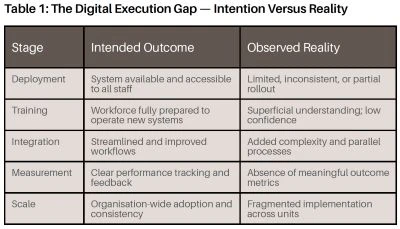
However, a closer examination often reveals a different reality. Implementation frequently stalls at the point of deployment. The prevailing assumption - that once technology is introduced, adoption will naturally follow - proves consistently unreliable in practice
What emerges instead is a pattern familiar to anyone who has led operational change in healthcare: systems remain underutilised, workflows become more complex rather than simpler, and frontline staff gradually revert to familiar manual processes. A significant disconnect develops between what leadership believes is happening at the strategic level and what is actually occurring on the ground.
This disconnect is the execution gap. It is not theoretical. It is observable in hospitals and health systems across every continent, and it carries real consequences - wasted investment, workforce frustration, and eroded trust in future innovation.
Where Transformation Breaks Down
The failure of digital initiatives in healthcare rarely stems from the technology itself. Modern platforms are generally well-designed, scalable, and increasingly sophisticated. The breakdown occurs at the intersection of systems and people - the space where technology must integrate with established human behaviour, clinical protocols, and institutional culture.
Three consistent failure points can be identified from operational experience and supported by existing research.
Misalignment Between Tools and Workflows
Digital tools are frequently introduced without adequate consideration of existing clinical and operational workflows. Rather than simplifying processes, these tools often introduce additional steps, data duplication, or procedural friction. Healthcare professionals operate under constant time pressure. When a system adds complexity rather than removing it, clinicians and administrators will deprioritise or abandon it entirely - regardless of its theoretical value. As Greenhalgh et al. (2017) observed, technology adoption in healthcare depends critically on whether the innovation aligns with existing work routines and professional identities.
Insufficient Workforce Enablement
Training for digital systems is commonly treated as a one-time onboarding event: a workshop, a webinar, a quick-start guide. However, meaningful digital workforce transformation requires far more than technical instruction. It demands behavioural adaptation, a genuine understanding of how the system fits within broader processes, and sustained support over time. Without this depth of enablement, staff may understand how a system functions mechanically but fail to grasp why it matters or how to embed it effectively into daily routines. The distinction between knowing how to use a tool and actually using it consistently is the gap where most training programmes fall short.
Absence of Defined Ownership
Many digital initiatives lack clearly defined ownership at the operational level. Responsibility tends to be distributed across information technology departments, clinical leadership, and administrative management - resulting in diffused accountability, slow decision-making, and limited follow-through. Without a single defined owner responsible for outcomes rather than merely for implementation, initiatives lose momentum within weeks of deployment. The literature on change management consistently highlights that successful transformation requires clear accountability structures (Kotter, 2012).
The Workforce as the Critical Variable
Digital transformation in healthcare is conventionally approached from a systems and infrastructure perspective - platforms, data architecture, interoperability standards. These are important. However, the most critical variable in determining success or failure is the workforce.
Healthcare professionals are not passive consumers of technology. They are active, autonomous decision-makers operating in high-stakes, time-sensitive environments. Any system introduced into these environments must support their ability to deliver care - not disrupt it. When technology is perceived as an obstacle, resistance is not irrational; it is a rational response to poorly designed implementation.
This recognition demands a fundamental shift in approach: from technology-first thinking to workflow-first design. The starting point for any digital initiative should not be the capabilities of the platform, but the reality of the environment into which it will be introduced.
Closing the Gap: Three Strategic Shifts
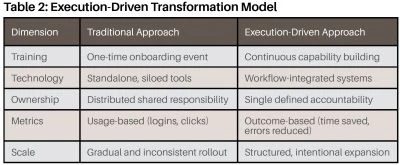
Addressing the execution gap requires healthcare organisations to fundamentally reconsider how digital initiatives are designed, delivered, and sustained. The focus must move from deployment to operationalisation - from installing systems to embedding them into the fabric of daily work. Three strategic shifts are essential.
From Training to Continuous Capability Building
Traditional training models are insufficient for the demands of digital environments. A single orientation session cannot prepare a clinician or administrator for the behavioural and procedural changes that new technology requires. Organisations must adopt continuous capability-building frameworks that incorporate scenario-based learning, real-time decision support, and structured feedback loops. The objective is not to train staff once, but to build an institutional capacity for ongoing adaptation. Research by Topol (2019) reinforces that digital literacy in healthcare must be treated as an evolving competency, not a fixed milestone.
From Standalone Tools to Integrated Workflows
Digital tools must not exist as isolated additions layered on top of existing processes. They must be woven into existing workflows. This requires rigorous process mapping, identification of friction points, and deliberate system design that reduces complexity rather than adding to it. When technology aligns with the way healthcare professionals already work, adoption becomes organic rather than forced. The most successful implementations observed in practice are those where clinical and operational end-users cannot easily distinguish where manual processes end and digital systems begin.
From Shared Responsibility to Defined Ownership
Every digital initiative requires a clearly defined owner who is accountable for outcomes - not merely for the act of implementation. This owner must track adoption rates, measure performance impact, and drive continuous optimisation. Critically, ownership should sit at the intersection of clinical, operational, and technical domains, ensuring that no single perspective dominates and that alignment is maintained across all functional areas. Without this structural clarity, even well-designed initiatives will stall.
Measuring What Matters
One of the most overlooked dimensions of digital transformation is measurement. Many organisations track surface-level indicators such as system login frequency, feature utilization rates, and training completion percentages. While these data points offer some visibility, they do not capture genuine impact.
Organisations committed to execution-driven transformation should instead prioritise outcome-oriented metrics: time saved per clinical or administrative workflow, reduction in procedural errors, measurable improvement in patient outcomes, and changes in staff satisfaction and operational efficiency. These indicators provide a far more accurate picture of whether a digital initiative is delivering real value or merely generating activity.
The Cultural Dimension
Execution is not only a structural or procedural challenge. It is fundamentally a cultural one. Healthcare organisations typically operate under conditions of high pressure, inherent risk aversion, and deeply established routines. In such environments, change is naturally and often justifiably resisted.
Overcoming this resistance requires leadership that communicates clear and specific value propositions for digital change, aligns institutional incentives with adoption behaviours, and creates environments where experimentation and adaptation are supported rather than penalised. The cost of failing to address culture is high: wasted financial investment, deepened workforce frustration, and a growing institutional scepticism that makes each subsequent transformation initiative progressively harder to launch.
Conclusion
Healthcare does not suffer from a shortage of innovation. The tools are available, increasingly sophisticated, and more accessible than ever. What the sector lacks is the discipline of execution - the ability to translate technological capability into sustained operational reality at the workforce level.
The organisations that will lead the next phase of healthcare transformation across Asia and globally are not necessarily those that adopt the most advanced technologies. They are the organisations that can operationalise those technologies effectively, embedding them into clinical and administrative workflows with precision, accountability, and respect for the professionals who must use them every day.
Digital transformation is not a technology project. It is an execution discipline. Until this distinction is recognised and acted upon, the gap between strategic ambition and measurable impact will persist.
REFERENCES
1. Greenhalgh, T., Wherton, J., Papoutsi, C., Lynch, J., Hughes, G., A’Court, C., Hinder, S., Fahy, N., Procter, R. and Shaw, S. (2017). Beyond adoption: A new framework for theorizing and evaluating nonadoption, abandonment, and challenges to the scale-up, spread, and sustainability of health technologies. Journal of Medical Internet Research, 19(11), e367.
2. Kotter, J.P. (2012). Leading Change. Boston: Harvard Business Review Press.
3. McKinsey & Company. (2019). Unlocking success in digital transformations. McKinsey Global Survey.
4. Topol, E.J. (2019). The Topol Review: Preparing the healthcare workforce to deliver the digital future. Health Education England, NHS.
5. World Health Organization. (2021). Global strategy on digital health 2020–2025. Geneva: WHO.
6. Cresswell, K. and Sheikh, A. (2013). Organizational issues in the implementation and adoption of health information technology innovations: An interpretative review. International Journal of Medical Informatics, 82(5), e73–e86.
Read the full article — it's free
Register with AsianHHM to unlock expert insights, research articles and in-depth industry analysis.