
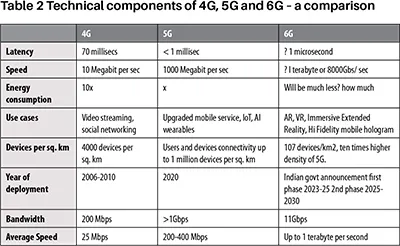
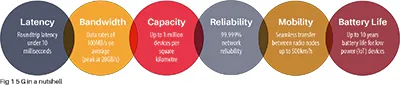
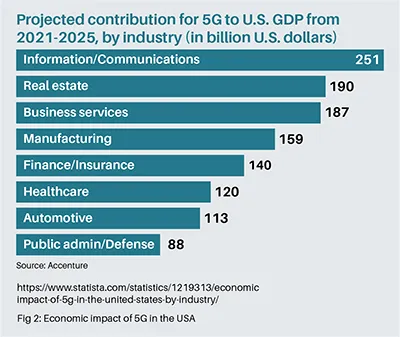
This communication summarises potential real-world applications of 5G in Digital Health. Mobile networks commenced with the first generation (1G) in the 1980s, 2G in 1991, 3G in 2000, 4G in 2009 and 5G in 2019. 5G was launched in India on 1st October 2022. The properties and characteristics unique to 5G are elaborated in Fig 1. Within the next 15 years, 5G (essentially software based, with minimum specialized hardware) is expected to bring $150 billion in additional GDP (Gross Domestic Product) for India. Today, IoT is composed of 21 billion connected devices (5.7 billion are unique cell phone users). In addition to human-to-human connectivity, telecommunication networks now connect 25 billion, and by 2030, 60 billion. 5G deployment is expected to reach USD 1.1 trillion in the healthcare sector by 2035. 50 billion smart devices and 212 billion sensors will be supported through the 5G network. Technology limitations and challenges include a mismatch between new communication capabilities with human limitations. The latter include behaviour, politics, equity, cost, access and availability. The infographic (Fig.2) on the economic impact of 5G in healthcare in the USA shows that industry wise, healthcare is expected to contribute 120 billion US dollars, ranking sixth among other industries.
Response to the introduction of 5G in Healthcare
New technology in healthcare elicits varied responses. Management wants to be future ready, better than the best and ahead of the curve with RoI (direct and indirect) playing a major role. Supporting them, is a group of patients who want to be the first to avail of futuristic technology, in managing their own health problems. Sceptics believe that “Old is Gold” arguing that the universe has survived without 5G. Finally, conservatives – sitting on the fence, want evidence that deployment of 5 G is making a difference in healthcare outcomes. Alas, in the real world, all cannot be satisfied. 5G in Healthcare at this point of time, probably fits into all of these buckets.
5G is only a component in the Digital Healthcare Ecosystem
5G in healthcare, cannot be considered in isolation. It has to be part of an integrated ecosystem with AI, IOMT, Big data, Blockchain and software designed networks (SDN). 5G needs to interact with IoT devices that are mobile, or location based, consisting of microchips of sensors, actuators, transmitters and/or receivers, other MEMS and nanotechnologies that provide input and output at either end of the communication network.5G is likely to increase use of a wireless body sensor network (WBSN) in real-time, monitoring applications, data transmission, emergency situations and patient location5G enables massive data acquisition, through continuous monitoring of microsensors in devices, equipment systems, living systems and machine to machine communications
Impact of 5G and Healthcare
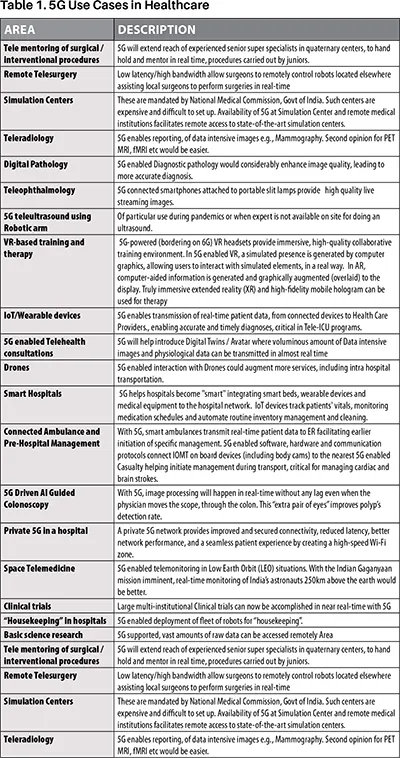
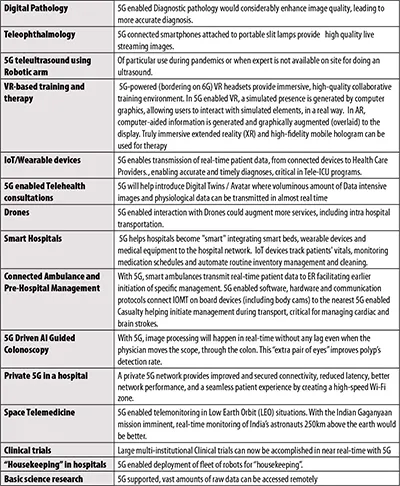
Digital transformation has considerably impacted Healthcare. Deploying 5G’s high data speed, ultra-low latency, massive device connectivity, reliability, increased network capacity and increased availability is expected to ensure better healthcare delivery with expanded communication capabilities. Challenges in implementing 5G extend to clinical applications, education and research. Transmission of ultrasound video, ambulance video, heart rate, body temperature, oxygen saturation levels, blood pressure, respiratory rate, electrocardiography and electroencephalography would be easier, faster and more reliable. Use of Virtual Reality (VR) glasses during remote video transmission enables doctors to be in an immersive milieu. Ultra-high-definition cameras part of Internet of Medical Things (IoMT) devices will function better in a 5G environment. The capacity to connect devices per unit in real time will result in an intelligent 5G ecosystem. 5G augmented VR and Augmented Reality (AR) would be useful in limb exercises, robotic support for fine motor skills, gravity compensation, customised and individually tailored video training programs. Thousands of medical devices from sensors to mobiles, video cameras and medical equipment could be supported simultaneously. This would result in sharper, clearer streaming video with more details.
Challenges in deploying 5G
Raising funds, demonstrating an adequate Return on Investment (ROI), obtaining approvals for reimbursement and demonstrating a direct relationship with improved health care outcomes would be ideal. Accompanying reliability and availability are the “seven nines” (99.99999% reliability). AI, ML, Deep Learning, VR, AR, Mixed Reality and Extended Reality with 5G has a high untapped potential. 5G is becoming increasingly available in urban areas. Acceptance of 5G applications in healthcare will take time. Interoperability, portability, customization, human factors (skills, resistance, distrust, and cyber-attacks), legislation and regulation dealing with 5G compatible devices add to the challenges. Other challenges include providing adequate infrastructure, compliance and adherence with future ready regulations and legal issues (including guaranteeing privacy and cybersecurity).
Conclusion:
IoT is estimated to increase to about 500 billion new “things” by 2030 (60 times greater than the global population). 6G commercialized network will integrate human and machine generated data. This could radically change healthcare services. Future ready enthusiasts are already evangelising 6G. 6G with its ultra-low latency, high throughput and ultra-high reliability connected to high density enabled IoT networks will result in smarter healthcare applications. Audio, visual, somatosensory and additional haptic sensory information will result in real-time interaction. 6G will eventually support all IOMT. However, in our anxiety to be ahead of the curve, we may be developing solutions and then going in search of problems.
A clinician’s primary avocation is to promote good health and improve health outcomes. Will 5G make this difference? With Multi-National Companies stressing on RoI, evidence is required. In the real world, 5G is expected to be used yesterday! Combination of 5G and AI will result in a network of connected smart devices, facilitating decision-making. 5G networks could support tactile internet and Brain Computer Interfaces and remote surgery. Future smart healthcare networks will combine IoT and advanced wireless communication technologies. Current limitations related to coverage, network performance and security issues will be overcome. New 5G communication features could result in new healthcare applications. Network access to existing connected medical devices could be expanded. Key Performance Indicators have to be demarcated for different uses of 5G in healthcare. Medical devices need to integrate 5G technology, safely and effectively, to permit patient access to medical devices 5G-healthcare requirements are not the same as 5G capabilities Time alone will tell if 5G is to be an integral part of a hospital’s armamentarium