
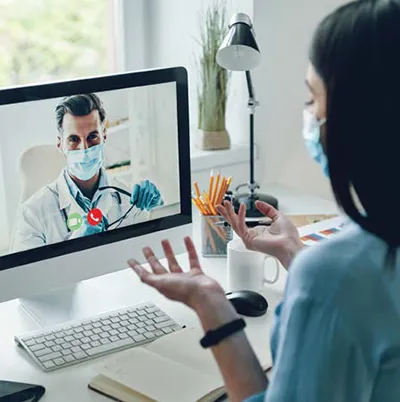
Telemedicine is a way to deliver healthcare services that leverages new technologies and devices to provide medical services remotely. This is possible thanks to the usage of new telecommunications tools, digital platforms, new devices and information technology, facilitating the diagnosis, treatment, and follow up of patients without the need for in-person visits or to complement them.
Despite Telemedicine is not a new concept, Covid 19 pandemic accelerated the transition to new models of remotely delivered healthcare. There was a boost of new technologies and services development, allowing new patients journeys creation and transforming the healthcare landscape with lasting consequences.
The Most Common Telemedicine Services are:
Video visit with patients through GDPR (Global Data Privacy Protection) compliant video calls systems to identify patients’ symptoms or prescribing/adapting tailored therapies allowing patient to receive tailored medical support anywhere.
Teleconsultation
Healthcare providers can collaborate remotely anywhere in the world with their peers for complex cases diagnosis and management. This is particularly valuable when a multispecialty team approach is needed or in cases where higher expertise is needed.
Patients Remote Monitoring
Healthcare providers can monitor remotely patients using AI (artificial Intelligence) tools, or IoT (Internet of Things) Devices, new wearables, such as sensors detecting patients' vital signs, as blood pressure, heart rate, glucose levels, oxygen saturation, body weight and more, smart home devices. This real-time data helps in early diagnosis and in managing chronic conditions, such as diabetes, hypertension, and asthma. Moreover, the usage of Artificial Intelligence (AI) and machine learning to analyse big set of data is a great complement to physician work, providing new insights for patient diagnosis and personalised treatments, opening endless opportunity to clinical research with the final goal to improve patient care and outcome.
Remote Reporting
A doctor interprets and report medical imaging examinations from a location outside the clinic or hospital where the examination has been performed, thanks to the usage of digital platform.
Other less well known Telemedicine services are:
Telae-assistance/Telepresence Robots
Dedicated Totem or Robots are equipped with cameras, microphones, screens allowing healthcare professionals to remotely interact with patients real-time. Totem can be installed in in dedicated area, even outside the hospitals, allowing patients to communicate with doctors without going to the hospital. Telepresence mobile robot can navigate hospital corridors, patients rooms, deliver goods, interacting with patients, providing even more immersive experience compared to traditional video conferencing. Rehabilitation robot with telemedicine features can guide patients through personalised rehabilitation programmes, providing feedback on their movement and progress, remotely monitored by healthcare professionals, facilitating therapy adherence and optimisation.
Telae-proctoring
A doctor assists other health care professionals at distance to perform a medical act using new technologies such as “smart glasses” or other innovative systems. The adoption of other new technologies in telemedicine such as Augmented Reality (AR) and Virtual Reality (VR) is driving more immersive experiences enhancing new users learning capabilities. For instance physicians can use AR for guidance during complex procedures, and VR is utilised for therapeutic interventions.
As technology continues to advance, telemedicine is expected to play a growing role in shaping the future of healthcare delivery.
What are the key advantages of Telemedicine for and beyond the patient care?
Telemedicine is a more accessible, equitable, sustainable, personalised, humane, environmentally friendly medicine, and safer, reducing the exposure of contagious illness.
That thanks to telemedicine, even patients living in remote areas can access to healthcare services. Telemedicine allows for quicker access to medical professionals, reducing waiting times for appointments and diagnostics. This is especially valuable when time matters to treat patient and their outcome.
Enhancing healthcare accessibility everywhere and faster, Telemedicine removes geographical barriers and allows better patients outcome. Earlier diagnosis and treatment, improved adherence to treatment plans with the use of digital health applications in fact, may impact on patient morbidity and mortality reduction and improved health and well-being.
Telemedicine allows as well personalised medicine, incorporating genomic information, new diagnostic and monitoring tools to tailor treatment plans based on an individual's genetic makeup and records. This personalised medicine approach allows for more targeted and effective interventions.
Virtual consultation allows economic and time savings due to no need for travelling to the healthcare facility. Patients that benefit the most are individuals with mobility issues and their caregivers, often obliged to require time off from work to accompany them. Others are patients that lives in rural areas and chronic patients requiring continuity of care or support from different healthcare professionals. Others are busy professionals or parents or in general for all individuals having difficulties in taking time off for medical appointments. It is not to be underestimated the positive impact of virtual consultation on diseases prevention and care for them. Telemedicine offers the flexibility to consult with healthcare providers at a time and place that is convenient for them. During Covid 19 pandemic we learnt as well that patients with infectious diseases could benefit of virtual consultation, reducing the spread of infectious diseases, minimising the need for in person visit, facilitating timely medical consultation.
It has been proven in several studies that Telemedicine can be cost-effective for both patients and healthcare providers. Patients save on transportation costs, parking fees, and potential time off from work. Healthcare providers can reduce overhead expenses associated with maintaining physical facilities, and remote consultations may streamline the appointment process, increasing overall efficiency.
The usage of Telae-proctoring improves the health care professional learning curve and provide confidence, accelerating the adoption of new technologies, being an extremely valuable complement to the in-person training. New tools and technologies available offers endless possibilities and immersive experience to train doctors on new devices and techniques. Artificial Intelligence Assistance and deep learning tools can analyse patient data, provide diagnostic recommendations, offering decision support to doctors for more and more accurate diagnostic and treatment. Modern and faster imaging transmission facilitate doctors communication even when in the operating room facilitating best practises sharing, remote training and removing geographical barriers. The usage of telemedicine and robotic technology brings new perspectives for less invasive procedures, enabling remote or semi-autonomous surgical procedures allowing expert surgeons to deliver training, supporting trainees to operate in different geographic locations through high definition cameras and robotic arms.
Using Telepresence Robots redesign the patients journey enhancing a more efficient and effective healthcare delivery, especially in the light of healthcare professionals constrains and growing demand from patients. The integration of robotics into telemedicine opens new perspectives and holds new promise for improving access to healthcare.
One different and often overlooked benefit of Telemedicine is its positive impact on the environment.
In several studies and in recent systematic reviews1,2 the carbon emissions produced from the use of the telemedicine systems themselves were found to be very low in comparison to emissions saved from travel reductions.
Virtual consultations and remote monitoring impacts on carbon emissions and contributes to energy conservation and a more sustainable healthcare system.
Morevover, the usage of electronic recording systems in telemedicine and its shift to a paperless system helps conserve forests, decrease water usage in paper production, and reduce the environmental impact associated with waste disposal.
Last but not least, Telemedicine, by promoting remote consultations and digital prescriptions, helps mitigate the generation of healthcare waste. This shift aligns with the principles of a circular economy, emphasising sustainability through reduced waste production and increased resource efficiency.
Conclusion:
The adoption of telemedicine and the development of new technologies and devices presents an opportunity to revolutionise healthcare practises enhancing accessibility and efficiency. It improves patient care while simultaneously impacting positively the planet through carbon footprint reduction, leading a greener and more sustainable future. Healthcare providers, Payors, Industry, Patient Associations, Caregivers should work together to embrace telemedicine as a fundamental ally for the patient health and its well-being, the community and the environment, removing all barriers to adoption.
References:
1.Roadler et All, Eur Urol Focus, 2023 Nov;9(6):873-887.doi: 10.1016/j.euf.2023.11.013. Epub 2023 Nov 29.
2. Purhoit et All, Future Healthc J 2021 Mar;8(1):e85-e91.doi: 10.7861/fhj.2020-0080.