

The integration of big data into healthcare has emerged as one of the most significant developments in modern medicine. From predicting disease outbreaks to guiding personalised treatments, data-driven decision-making has redefined the possibilities of public health and clinical practice. Yet the true power of big data lies not in its size or speed, but in its quality.
High-quality, standardised, and validated data ensures that analyses produce actionable insights, rather than misleading conclusions. In contrast, poorly managed data can cause flawed diagnoses, ineffective treatments, wasted resources, and policies that fail to meet population needs. This article explores the transformative role of big data in healthcare decision-making, while emphasising why data quality must be prioritised as the cornerstone of any analytics initiative.
Big Data in Healthcare: An Overview
Big data in healthcare refers to extremely large and diverse datasets that are generated through a variety of sources:
• Electronic Health Records (EHRs)
• Medical imaging systems
• Genomic sequencing
• Wearable devices and sensors
• Public health registries
• Insurance and billing claims
• Social determinants of health (SDOH) data
The integration of these heterogeneous datasets enables powerful insights. For example, predictive algorithms can identify at-risk patients before hospitalisation occurs, while real-time surveillance can inform outbreak response strategies. However, these benefits are only realised when the datasets are accurate, complete, and harmonised.
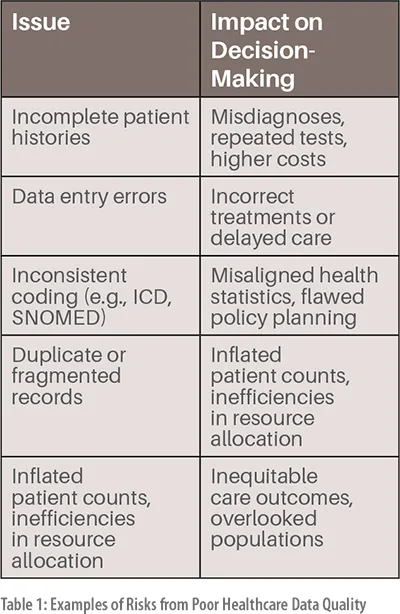
The Risks of Poor Data Quality
When healthcare decisions rely on flawed data, the consequences can be severe.
These challenges highlight why data governance frameworks and validation mechanisms are essential before big data can inform critical decisions.
The Role of Data Standardisation
Healthcare data originates from multiple systems, each with its own structure and terminology. Without standardisation, integration becomes almost impossible. Standardisation ensures that a blood pressure reading recorded in one clinic is comparable to that recorded in another. It also enables interoperability across hospitals, insurers, and public health agencies.

Sidebar: Key Standards in Healthcare Data
• HL7 (Health Level Seven) – Facilitates exchange between healthcare systems.
• FHIR (Fast Healthcare Interoperability Resources) – Modern API-based approach to interoperability.
• LOINC (Logical Observation Identifiers Names and Codes) – Standardises lab and clinical observations.
• ICD-10 & SNOMED CT – Standardised clinical terminology and coding systems.
Adopting these frameworks not only strengthens the reliability of analytics but also reduces administrative costs and duplication of effort.
Validation as the Cornerstone of Trust
Validation ensures that healthcare data is accurate, relevant, and fit for purpose. This involves applying rigorous checks such as:
• Completeness audits to detect missing information.
• Cross-verification with external registries or datasets.
• Automated anomaly detection using machine learning.
• Periodic manual reviews for high-value datasets.
Validated data creates trust among clinicians, policymakers, and patients alike. Without validation, even advanced analytics tools cannot deliver reliable insights.
Big Data in Policy and Clinical Decision-Making
High-quality data enables evidence-based policies that address pressing healthcare challenges.
1. Population Health Management – Big data identifies high-risk groups, allowing preventive measures that reduce hospital admissions.
2. Precision Medicine – Genomic and phenotypic data enable customised therapies tailored to individual patients.
3. Resource Allocation – Reliable datasets help governments and hospitals allocate staff, equipment, and funding efficiently.
4. Pandemic Preparedness – Real-time surveillance supports faster detection of disease outbreaks.
In each of these cases, the accuracy and reliability of the underlying data determine the success of the decision.
Ethical Considerations and Data Privacy
As healthcare systems collect more data, protecting patient privacy becomes critical. Strong data protection frameworks ensure that analytics can be performed without compromising confidentiality.
Best practices include:
• Data minimisation (only collecting what is necessary).
• De-identification or pseudonymization for research.
• Consent management systems to respect patient rights.
• Compliance with GDPR, HIPAA, and local regulations.
Balancing innovation with ethics is non-negotiable in healthcare decision-making.

The Future: AI and Predictive Analytics in Healthcare
Artificial intelligence (AI) and machine learning (ML) offer powerful ways to process vast datasets and reveal hidden patterns. For example:
• Predictive analytics can anticipate patient deterioration before it becomes critical.
• Natural Language Processing (NLP) can analyse clinical notes for undetected risk factors.
• AI-assisted imaging can detect early signs of disease with higher accuracy than traditional scans.
However, these technologies amplify the need for data quality assurance. Without accurate and representative datasets, AI models risk perpetuating bias and delivering unreliable predictions.
This chain emphasises that analytics and decisions are only as strong as the data feeding them. Weakness in any link compromises the entire system.
Conclusion
Big data is no longer a futuristic concept in healthcare; it is already influencing clinical practice, public health policy, and global health security. However, its transformative potential depends entirely on data quality, standardisation, and validation.
Reliable data ensures that predictive models work as intended, that policies address real needs, and that patient outcomes improve. Without it, healthcare systems risk being misled by the very tools meant to guide them.
The way forward lies in treating data not as a byproduct of healthcare delivery but as a critical asset requiring the same rigor, governance, and oversight as any medical intervention.
References (Online Version Only)
• Raghupathi, W., & Raghupathi, V. (2014). Big data analytics in healthcare: promise and potential. Health Information Science and Systems, 2(3).
• Belle, A., Thiagarajan, R., Soroushmehr, S. M., Navidi, F., Beard, D. A., & Najarian, K. (2015). Big data analytics in healthcare. BioMed Research International.
• Institute of Medicine. (2012). Best Care at Lower Cost: The Path to Continuously Learning Health Care in America. Washington, DC: The National Academies Press.
• WHO. (2021). Global strategy on digital health 2020–2025.