

Digital maturity refers to how well healthcare organisations use information technology to enhance the quality and efficiency of care delivery. It’s not just about adopting new technologies; it’s about a broader framework that includes strategic planning, implementation, and continuous evaluation of digital initiatives within healthcare settings.
Digital maturity models (DMMs) have become essential tools for assessing and guiding this transformation. These models offer a structured approach to evaluating an organisation's digital capabilities, defining desired outcomes, and identifying the steps needed to achieve those goals. By using digital maturity assessments (DMA), healthcare organisations can measure their progress and create a clear roadmap for closing the gap between their current state and best practises in the field.
However, the journey toward digital maturity is not without its challenges. Despite the development of over a hundred DMMs for healthcare organisations, their practical application is often limited by various conceptual and methodological constraints. A key issue is selecting maturity indicators that may not fully align with the unique digitalisation goals of individual organisations, regions, or countries. Moreover, equating digital maturity solely with technological implementation fails to capture the broader, long-term objectives of digital transformation - namely, creating digital added value by optimising processes and improving patient care.
To truly achieve digital maturity, hospitals need to look beyond just adopting new technology. It’s about aligning digital strategies with overall healthcare strategies and organisational goals, continuously improving, and integrating new innovations into the broader system. To do so, hospitals can choose between implementing a standardised global approach or applying a localised methodology to meet their specific needs.
Southeast Asia: Digital Maturity Achievements in Leading Hospitals
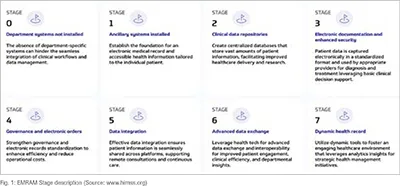
Standardised digital maturity methodologies, like the Electronic Medical Record Adoption Model (EMRAM) developed by HIMSS (Fig. 1), have proven highly effective in guiding individual hospitals through their digital transformation, particularly when these hospitals are committed to and capable of adhering to the specific roadmap outlined by the respective model.
In South Korea, Seoul National University Bundang Hospital (SNUBH) stands out as a leading example of applying the international EMRAM methodology, maintaining the highest maturity stage 7 for over a decade. The hospital’s proactive approach includes regular internal audits, system optimisations, and the development of patient engagement tools.
In Indonesia, Siloam Hospitals Lippo Village recently achieved a significant milestone by reaching Stage 6 on the same methodology, demonstrating excellence in areas such as electronic medication administration, decision support, and the integration of various health IT systems.
Similarly, in Singapore, Ng Teng Fong General Hospital (NTFGH) became the first hospital in the country to achieve EMRAM Stage 7, setting a benchmark for other hospitals in the region aiming to attain the highest levels of digital maturity.
Dubai: Regional Adoption of a Standard Methodology
As one of the first regional health systems, the Dubai Health Authority (DHA) has adopted EMRAM as a key component of their transformation strategy. Developed in the United States, EMRAM offers a structured, standardised approach to assessing and guiding healthcare facilities in deploying and utilising Electronic Medical Records (EMRs).
Dubai’s journey with EMRAM began in 2011 when the DHA selected this model to benchmark and accelerate the digital transformation of Emirate Health Services. EMRAM rates healthcare facilities on a scale from 0 to 7, with higher stages indicating more advanced digital maturity and integration of EMR systems.
Initially, most hospitals in Dubai were at lower stages of digital maturity, with the majority operating at stages 0 to 2. However, through the concerted efforts of the DHA and participating hospitals, significant improvements have been made. By 2022, more than half of Dubai's hospitals had achieved stage 4 or higher, indicating a significant leap toward advanced digital integration. The implementation of EMRAM has not only improved the digital capabilities of individual hospitals but also facilitated the creation of a unified health information exchange platform, NABIDH, connecting public and private healthcare providers across the Emirate.
While standardised global models offer flexibility and adaptability for individual hospital organisations, particularly when not part of an official national or regional policy like in Dubai, there are instances where a tailored approach is necessary. This is especially true when a model is intended to support the implementation of a national policy or strategy, as demonstrated by Germany's experience.
Germany: The Scientific Approach
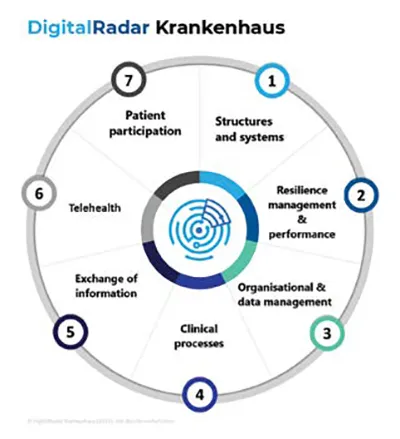
Germany’s Ministry of Health launched a groundbreaking scientific digital maturity assessment tailored to the country’s complex regulatory environment and diverse healthcare landscape, drawing global attention as a potential blueprint for other nations. By 2021, more than 90% of Germany's 1,800 hospitals had participated, making it the largest initiative of its kind worldwide. Unlike other models like EMRAM, Germany’s assessment utilised a scientifically developed and validated rating system aligned with national priorities, with hospitals averaging 33 out of 100 across seven dimensions (see figure 2). The recently completed second assessment offers critical insights into the effectiveness of Germany’s multi-billion-euro digital transformation funding initiative, providing a strategic roadmap for future health policies and investments.
Germany’s approach demonstrates the value of customising digital maturity models to address specific local healthcare needs and regulatory frameworks, ensuring alignment with national digital transformation strategies. Similarly, NHS England, the Kingdom of Saudi Arabia, and other public health systems have adopted tailored models to drive sustainable digital transformation within complex healthcare ecosystems.
Considerations for Applying Digital Maturity at Scale
To understand progress in digital transformation, it is essential to measure and re-measure regularly. When it comes to applying digital maturity methodologies in large-scale transformation projects, decision-makers must carefully assess which path to take – a standardised model or a customised model. The following aspects should be considered:
1. How to establish multi-stakeholder support: Ensuring broad multi-stakeholder support is crucial to mitigate the risk of political or organisational tensions. This inclusive approach fosters buy-in from influential organisations and ensures that the model’s suitability for the respective digital transformation strategy is fully understood.
2. How to create transparency and trust: Transparent communication and ongoing alignment with all relevant parties significantly speeds up the adoption process. When stakeholders trust the accuracy of the methodology and understand the reasoning behind it, they are more likely to embrace it, leading to a more efficient and effective implementation.
3. How to stay in control in the mid- to long-term: The long-term success of digital maturity initiatives depends on their continuous updates and regular assessments. To achieve this, health systems must maintain control over of the budget – but also of the methodology, its data, and the outcomes - especially when applied at a national level. Building up local expertise and retaining the data for in-country academic research increases digital autonomy.
4. How to incorporate international best practises: When using a localised digital maturity model, incorporating elements from international standards can enhance understanding of performance relative to global best practises. Including these elements, i.e. by mapping national results to international indicators, broadens the national discourse, supports scientific research, and offers healthcare facilities a pathway to engage in global comparisons if desired.
Future Aspects of Your Digital Maturity Journey
As health systems accelerate their digital transformation and patients become more accustomed to the benefits of digitisation, the pace of change will increase, driven by emerging technologies, evolving user expectations, and the need to address humanity’s future challenges. Here are key future aspects that health systems should consider in their digital transformation strategies today:
• AI Will Revolutionise Healthcare: AI is transforming healthcare, bringing new possibilities in diagnostics, treatment planning, and operational efficiency. By strengthening your organization’s AI capabilities - enhancing data infrastructure, refining algorithms, and addressing ethical concerns, you can unlock AI’s full potential while maintaining safety and trust.
• Healthcare Delivery Is Expanding Beyond Hospitals: The rise of Hospital@Home and telemedicine is opening up new frontiers in patient care. By adapting your digital maturity strategies to support this shift, you can ensure that health is delivered effectively across diverse care environments, bringing care closer to where patients live.
• Data Utilisation Is Expanding: The future of personalised medicine and prevention will be brighter, if we broaden data usage to include social determinants of health and other non-traditional metrics. This expansion will enhance population health management and enable more personalised, effective patient care.
• People Will Be Central to Transformation Success: While the World Health Organization highlights a global shortage of 18 million health workers, this challenge also presents an opportunity. By prioritising continuous education and skill development, you can empower your workforce to adapt to new technologies and drive sustained digital maturity.
• Health Systems Must Increase Resilience to Climate Change: With rising temperatures there’s an urgent need to build climate resilience into healthcare. By integrating climate resilience into your digital strategies, you can protect infrastructure from climate-related disruptions and ensure the long-term sustainability of digital operations.
We’re Doing This for the People
At the heart of all digital maturity efforts lies a single, unwavering priority: the people. Every digital advancement must ultimately aim at improving prevention, care, and well-being of both – the patients and the healthcare workers.
Hospital managers, CIOs, and government officials, who shoulder the responsibility of leading large-scale digital transformation initiatives, must keep this people-centric focus at the forefront of their efforts. As we navigate the complexities of integrating global innovations with local applications, the decisions we make will profoundly impact the quality of care that people receive. By mastering digital maturity at scale, we can ensure that our healthcare systems are not only technologically advanced but also deeply committed to improving the lives of those we serve.
To achieve this, we must learn from each other on a global scale, sharing knowledge and best practises to implement local health solutions that truly work for the people. After all, knowledge is global, but healthcare is local.