

Digital technologies are reshaping how we diagnose, treat, and manage patient care. The potential benefits of these innovations are immense, from telemedicine and electronic health records (EHRs) to artificial intelligence (AI) and wearable health monitors. However, as we embrace these technological advancements, ensuring that human sensibility remains at the forefront of healthcare delivery is crucial. This balance is essential for fostering a patient-centred approach that combines technological efficiency with empathy and understanding.
Digital healthcare uses digital technologies to enhance health outcomes, streamline healthcare delivery, and improve patient experiences. It encompasses many tools and applications, including telehealth services, mobile health apps, electronic health records, and AI-driven diagnostic tools. These technologies offer significant benefits, such as increased accessibility, improved efficiency, personalised care, and cost-effectiveness.
Human sensibility in digital healthcare involves integrating human factors, emotions, and sensory experiences into designing and implementing digital health technologies. It ensures that technological solutions are functional, empathetic, patient-centred, and culturally sensitive. This integration is necessary for creating compelling and humane healthcare solutions.
The intersection of human sensibility and digital healthcare advancements is a critical area of exploration. Integrating human factors and sensory experiences into digital health technologies is not merely an enhancement but a necessity. It's a call to action for all healthcare professionals, researchers, and policymakers to contribute to the creation of compelling and empathetic healthcare solutions. The shift from traditional paternalistic models to patient-centred approaches, augmented by technology, represents a significant cultural transformation in healthcare.
A crucial concept emerging from the current body of knowledge (see References) is digital empathy, which is essential for achieving positive health outcomes. Digital empathy involves understanding and addressing patients' emotional and psychological needs through technological interfaces. Implementing an emotive sensory web in virtual healthcare highlights the challenges and ethical issues that must be addressed to make digital health interventions genuinely supportive and humane.
Integrating human senses with digital sensors, particularly in telemedicine, emphasises the importance of sensory judgements in medical practise. Sensory skills, such as visual, tactile, auditory, and olfactory abilities, remain critical for accurate diagnosis and effective patient care. These skills ensure that technology enhances rather than replaces the nuanced understanding and empathetic touch that healthcare professionals provide.
Overall, a more human-centred approach to digital health is essential. This approach considers the complex interplay between technology, human factors, and healthcare delivery, ensuring that advancements in digital healthcare are both innovative and empathetic. By prioritising the integration of human sensibility into digital health, we can create a healthcare system that leverages technology while preserving the essential human touch, ultimately leading to improved patient outcomes and experiences.
The Promise and Future of Digital Healthcare
Digital health transforms healthcare by enhancing accessibility, efficiency, personalised care, and cost-effectiveness. Technologies such as telehealth services, electronic health records (EHRs), AI-driven diagnostics, and wearable health monitors are revolutionising patient care. These innovations offer significant benefits, including more accessible access to specialist care, streamlined management of patient information, continuous health monitoring, and reduced healthcare costs. Digital health promotes preventive care and optimises resource allocation, improving patient outcomes and a more efficient healthcare system (Figure 1).

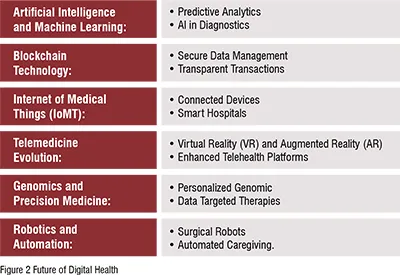
The future of digital health promises even more revolutionary changes with advancements in artificial intelligence, blockchain technology, the Internet of Medical Things (IoMT), and genomics. AI will enhance predictive analytics and diagnostics, while blockchain will ensure secure and transparent data management. IoMT will connect medical devices for real-time monitoring and smart hospital development, and genomics will enable precision medicine with personalised treatments. Emerging technologies like virtual reality (VR), augmented reality (AR), and robotics will further evolve telemedicine and automated caregiving. Embracing these advancements while focusing on human sensibility will ensure that healthcare remains compassionate, effective, and patient-centred (Figure 2).
The Need for Human Sensibility
Despite the numerous advantages of digital healthcare, the rapid integration of these technologies presents challenges that require a thoughtful and empathetic approach. Human sensibility involves considering healthcare's emotional, psychological, and social dimensions. The following areas highlight the importance of maintaining human sensibility in digital healthcare:
Digital tools should enhance, not replace, human interaction in healthcare. Providers must use technology to facilitate meaningful patient conversations, ensuring their concerns and preferences are heard and respected. For instance, while telehealth consultations offer convenience, they should allow patients to express their feelings and ask questions. The development and implementation of AI and machine learning algorithms must be transparent and fair. Ensuring these systems do not perpetuate biases and respecting patient privacy are paramount. AI-driven diagnostic tools, for example, should be designed with diverse datasets to avoid reinforcing health disparities.
Healthcare providers should recognise the emotional impact of digital health interventions. Virtual consultations and remote monitoring should include elements of empathy and reassurance to help patients feel supported, especially those dealing with chronic conditions or mental health issues. Additionally, digital health technologies should be adaptable to diverse cultural contexts. Understanding cultural nuances and patient backgrounds can enhance the effectiveness of digital health interventions. For example, telehealth platforms should be designed to accommodate language differences and cultural preferences in healthcare delivery.
Integrating Human Sensibility into Digital Healthcare
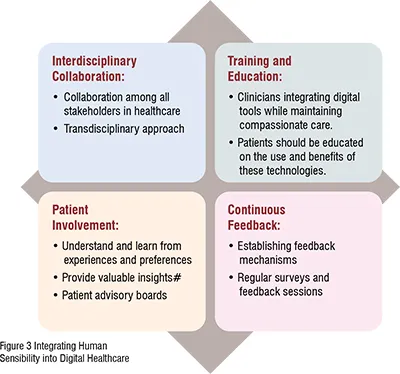
Several strategies can be employed to successfully infuse human sensibility into digital healthcare advancements (Figure 3). Collaboration among healthcare professionals, technologists, ethicists, and patients is essential for designing and implementing digital health solutions. This interdisciplinary approach ensures that technologies are user-friendly, ethical, and responsive to patient needs. For instance, involving patients in the development process can provide valuable insights into their experiences and preferences. Clinicians should receive training on effectively integrating digital tools into their practise while maintaining compassionate care. Similarly, patients should be educated on the use and benefits of these technologies. This dual approach ensures that providers and patients are comfortable with digital health interventions.
Involving patients in developing and evaluating digital health solutions can provide valuable insights into their experiences and preferences, leading to more patient-centred innovations. For example, patient advisory boards can offer feedback on new technologies and suggest improvements based on their firsthand experiences. Establishing mechanisms for continuous feedback from patients and healthcare providers can help identify areas for improvement and ensure that digital tools remain aligned with human sensibility. Regular surveys and feedback sessions can provide ongoing insights into the effectiveness and usability of digital health solutions.(Figure 3)
Challenges and Future Directions
While integrating human sensibility into digital healthcare has shown promise, several challenges remain. Addressing these challenges is crucial for advancing patient-centred digital health solutions. Ensuring the privacy and security of patient data is a significant concern in digital healthcare. Robust data protection measures and transparent data governance policies are essential to maintain patient trust. Bridging the digital divide and ensuring equitable access to digital health technologies is critical. Efforts must be made to provide access to underserved populations and address barriers such as internet connectivity and digital literacy.
Developing comprehensive regulatory and ethical frameworks for digital health technologies is essential. These frameworks should address issues such as algorithmic bias, data ownership, and informed consent. Ensuring the sustainability of digital health solutions requires ongoing investment in research, development, and infrastructure. Long-term planning and funding are necessary to support digital healthcare's continued growth and integration. By tackling these challenges, we can ensure that digital health technologies are innovative, effective, equitable, secure, and sustainable.
Policy Guidelines Recommended
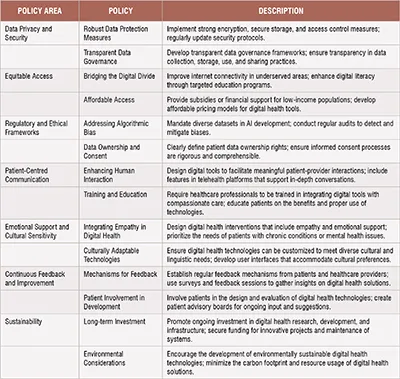
The available literature recommends several essential policy guidelines to ensure the successful integration of human sensibility into digital healthcare (See References). First, addressing data privacy and security is paramount (Table 1). Robust data protection measures, including strong encryption, secure storage, and transparent data governance policies, are essential to maintaining patient trust. Ensuring equitable access to digital health technologies is also critical, requiring efforts to improve internet connectivity and digital literacy in underserved populations. Affordable access should be promoted through subsidies or financial support for low-income groups.
Developing comprehensive regulatory and ethical frameworks is vital for the responsible deployment of digital health technologies. These frameworks should address algorithmic bias, clearly define patient data ownership rights, and ensure rigorous and understandable informed consent processes. Enhancing patient-centred communication through digital tools that facilitate meaningful interactions between healthcare providers and patients is crucial. Training programmes for healthcare professionals and patient education on digital health technologies' benefits and proper use should be mandated.
Continuous feedback mechanisms from patients and healthcare providers are essential for ongoing improvement and alignment of digital health solutions with human sensibility. Establishing patient advisory boards and regular feedback sessions can provide valuable insights. The sustainability of digital health solutions requires a long-term investment in research, development, and infrastructure, alongside environmental considerations, to minimise these technologies' carbon footprint and resource usage. By implementing these policy guidelines, we can create a healthcare system that effectively integrates technological advancements with human empathy and ethical standards (Table 1).
Conclusion
Integrating digital technologies in healthcare holds immense potential to revolutionise patient care and operational efficiency. Yet, the true success of these advancements hinges on their ability to complement and elevate human sensibility. By prioritising patient-centred communication, upholding ethical standards, providing emotional support, and embracing cultural sensitivity, we can forge a healthcare system that harnesses technological innovation while preserving the vital human touch.
We must adopt a collaborative and empathetic approach to navigating this exciting frontier. By doing so, we ensure that the full benefits of digital healthcare innovations are realised, creating a future where technology and humanity coexist harmoniously to deliver outstanding healthcare experiences and outcomes. This balanced integration will drive progress and inspire trust and confidence among patients and healthcare providers alike, paving the way for a brighter, more compassionate healthcare landscape.
References
1. Huckvale, K., Wang, C. J., Majeed, A., & Car, J. (2019). Digital health at fifteen: More human (more needed). BMC Medicine, 17(1).
2. Lupton, D. (2017). Editorial: Towards sensory studies of digital health. DIGITAL HEALTH, 3, 205520761774009.
3. Lupton, D., & Maslen, S. (2017). Telemedicine and the senses: A review. Sociology of Health & Illness, 39(8), 1557–1571.
4. Maslen, S. (2017). Layers of sense: The sensory work of diagnostic sensemaking in digital health. DIGITAL HEALTH, 3, 205520761770910.
5. Mbunge, E., Jiyane, S., & Muchemwa, B. (2022). Towards emotive sensory Web in virtual health care: Trends, technologies, challenges and ethical issues. Sensors International, 3, 100134.
6. Mesk\’ o, B., Drobni, Z. ofia, B\’ enyei, \’ Eva, Gergely, B., & Győrffy, Z. (2017). Digital health is a cultural transformation of traditional healthcare. mHealth, 3, 38–38.
7. Schueller, S. M. (2021). Grand Challenges in Human Factors and Digital Health. Frontiers in Digital Health, 3.
8. Terry, C., & Cain, J. (2016). The Emerging Issue of Digital Empathy. American Journal of Pharmaceutical Education, 80(4), 58.