

Healthcare systems around the world are undergoing a quiet but profound transformation. Advances in genomics, data analytics, and digital health platforms are making it possible to move beyond traditional one-size-fits-all models of care toward approaches that are tailored to individual biology, risk profiles, and lifestyles.
In Singapore, this shift toward personalised healthcare is gathering momentum. National initiatives in genomics, population health, and digital infrastructure are enabling clinicians to make increasingly precise decisions about prevention, diagnosis, and treatment.
While personalised healthcare is often discussed in the context of genetic testing or precision therapeutics, its implications extend far beyond the laboratory. For healthcare leaders and administrators, the real challenge lies in designing systems that can operationalise personalisation at scale.
Over the course of my career working across hospital operations, digital transformation initiatives, and graduate medical education, I have seen firsthand how healthcare systems evolve when technology, data, and organisational design converge. Personalised healthcare platforms represent the next stage of that evolution.
From Standardised Medicine to Individualised Care
For much of modern medicine, standardisation has been essential. Clinical guidelines, care pathways, and evidence-based protocols have played a crucial role in improving safety and reducing variation in clinical practice.
Yet medicine has always recognised that patients are not identical.
Two patients with the same diagnosis may respond very differently to treatment. Factors such as genetics, environmental exposures, lifestyle, and social determinants of health influence both disease progression and therapeutic outcomes.
Personalised healthcare seeks to incorporate these differences into clinical decision-making.
Instead of treating diseases in broad categories, clinicians can increasingly stratify patients into more precise subgroups. Advances in genomic sequencing, biomarker discovery, and predictive analytics are enabling healthcare providers to anticipate disease risk earlier and tailor treatment strategies more effectively.
Singapore’s national investments in genomics research, digital health infrastructure, and integrated care networks provide an enabling environment for this transition. The ambition is not merely to treat illness but to anticipate and prevent it through more personalised insights.
The Digital Infrastructure Behind Personalisation
Behind every personalised healthcare strategy lies a sophisticated digital ecosystem.
Precision medicine depends heavily on data integration. Clinical records, imaging studies, laboratory results, genomic profiles, wearable device data, and lifestyle information must be synthesised into coherent platforms that clinicians can interpret in real time.
During my earlier work leading hospital operational portfolios and digital implementation projects, I had the opportunity to be involved in the rollout of an electronic medical record (EMR) system within a large healthcare organisation. At the time, the primary objective was to improve documentation, workflow integration, and patient safety.
Yet what became increasingly clear was that EMR systems are not merely digital filing cabinets. They are the foundational architecture upon which future healthcare innovations are built.
When patient data becomes structured, searchable, and interoperable, entirely new possibilities emerge. Predictive algorithms can identify early risk patterns. Decision support tools can guide clinicians toward personalised treatment options. Population health insights can inform targeted preventive interventions.
Personalised healthcare platforms depend fundamentally on this digital foundation.
Personalisation Across the Care Continuum
One of the most promising aspects of personalised healthcare platforms is their ability to influence care across the entire health continuum—from prevention and early detection to treatment and long-term management.
In preventive care, genomic risk profiling can help identify individuals who may benefit from earlier screening for certain cancers or chronic diseases. Lifestyle data collected through wearable technologies can provide insights into physical activity, sleep patterns, and cardiovascular risk.
In diagnostics, molecular profiling can reveal disease subtypes that were previously indistinguishable. This is particularly significant in oncology, where tumour genetics increasingly guide treatment selection.
In therapeutics, precision medicine allows clinicians to match treatments to patients who are most likely to benefit from them. This approach not only improves outcomes but also reduces exposure to ineffective therapies.
From a systems perspective, personalised healthcare also has important implications for resource allocation. When interventions are targeted more precisely, healthcare systems can deploy resources more efficiently while improving patient outcomes.
Operationalising Personalisation in Healthcare Systems
While the science of personalised medicine continues to advance rapidly, translating these insights into everyday clinical practice requires thoughtful organisational design.
Hospitals and healthcare clusters must integrate new capabilities across multiple domains. These include data governance frameworks, interdisciplinary collaboration between clinicians and data scientists, and training programmes that equip healthcare professionals to interpret complex biological and digital information.
In my current work within Graduate Medical Education, I often reflect on how the next generation of physicians will practise in a healthcare environment that is increasingly data-driven and personalised.
Medical training must evolve accordingly.
Future clinicians will need to be comfortable interpreting genomic reports, using predictive analytics tools, and collaborating with multidisciplinary teams that include informaticians, genetic counsellors, and data scientists.
Equally important is the ability to maintain a human-centred approach to care. Personalisation should not become synonymous with technological complexity. At its core, personalised healthcare is about understanding the individual patient more deeply and designing care around their unique context.
Personalised Healthcare and Population Health
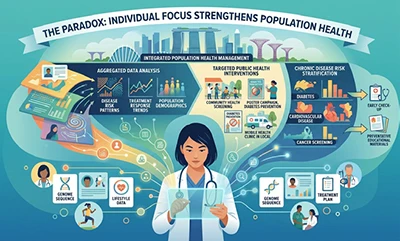
An interesting paradox lies at the heart of personalised medicine.
On the surface, personalisation appears to focus on the individual patient. Yet when implemented effectively, personalised healthcare platforms can significantly strengthen population health strategies.
By analysing aggregated health data across large populations, healthcare systems can identify patterns of disease risk, treatment response, and health outcomes. These insights allow policymakers and healthcare organisations to design more targeted public health interventions.
Singapore’s healthcare system, with its strong emphasis on preventive care and integrated population health management, is particularly well positioned to leverage these insights.
Personalised platforms can support earlier identification of individuals at risk for chronic conditions such as diabetes, cardiovascular disease, or certain cancers. Early intervention programmes can then be tailored to those individuals most likely to benefit.
In this way, personalised medicine and population health are not opposing concepts. Rather, they are complementary strategies within a broader vision of proactive healthcare.
Leadership in an Era of Precision Healthcare
The shift toward personalised healthcare also raises important leadership questions.
Healthcare leaders must balance innovation with governance, ensuring that new technologies are deployed responsibly while maintaining patient trust. Issues surrounding data privacy, ethical use of genomic information, and equitable access to precision therapies must be carefully managed.
Leadership in this space requires both technological literacy and systems thinking.
Throughout my career in healthcare administration and academic teaching, I have often described healthcare leadership using what I call the Swiss Army Knife Theory. Healthcare leaders must develop multiple complementary capabilities: clinical awareness, operational insight, technological understanding, and people leadership.
Just as a Swiss Army knife contains different tools that become useful in different situations, effective healthcare leaders must draw upon diverse competencies to navigate complex challenges.
Personalised healthcare platforms exemplify this complexity. They sit at the intersection of medicine, data science, public policy, and organisational design. No single discipline can implement them successfully in isolation.
Leadership, therefore, becomes less about command and control and more about orchestrating collaboration across diverse expertise.
The Human Dimension of Personalised Medicine
Amid the excitement surrounding genomics and digital platforms, it is easy to overlook the most important dimension of personalised healthcare: the human relationship between patient and clinician.
Personalisation should not reduce patients to data points or genetic profiles. Rather, it should enrich clinical conversations by providing deeper insights into individual health risks and treatment options.
Patients must be supported in understanding what personalised information means for their health. Genetic risk results, for example, can be complex and emotionally challenging to interpret. Effective communication and shared decision-making, therefore, remain central to personalised care.
Healthcare professionals must also maintain humility. Even as technology becomes more sophisticated, uncertainty remains an inherent part of medicine. Personalised healthcare tools should support and not replace clinical judgement.
Looking Ahead
Singapore’s investments in genomics, digital health infrastructure, and integrated care networks signal a strong commitment to the future of personalised healthcare. Over time, personalised platforms will likely become embedded within everyday clinical workflows rather than existing as specialised programmes.
As this transition unfolds, the real challenge will not simply be technological adoption. It will be the design of healthcare systems capable of translating scientific advances into meaningful improvements in patient care.
In my own journey across hospital operations, digital transformation initiatives, and medical education, one lesson has remained constant: healthcare innovation succeeds only when systems, people, and purpose align.
Personalised healthcare platforms represent an extraordinary opportunity to align those elements more closely than ever before.
If implemented thoughtfully, they can help healthcare systems move beyond reactive treatment toward proactive, precise, and patient-centred care, improving not only clinical outcomes but also the experience of healthcare for both patients and professionals.
The promise of personalised medicine is not merely about tailoring treatments. It is about designing healthcare systems that recognise the uniqueness of every individual while maintaining the collective mission of improving health across entire populations.
In that sense, the future of healthcare may well be defined by a simple principle: precision in science must be matched by precision in systems.