



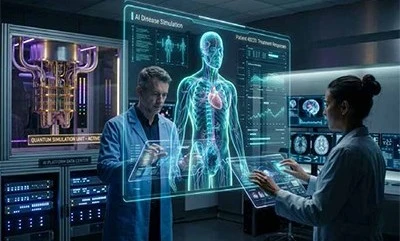
Digital health holds considerable promise, enabling continuous physiological monitoring, artificial intelligence (AI)-assisted clinical decision-making, and personalised therapies tailored to each patient's molecular and genetic profile. Yet beneath this promise lies a fundamental tension; the biological complexity that must be modelled and the computational resources available to process it are deeply mismatched. Healthcare generates data at a scale that strains modern infrastructure. A single genomic sequence spans approximately 3 billion base pairs. A typical intensive care unit (ICU) patient is simultaneously monitored by two dozen or more sensors, each streaming continuous physiological signals. Scaled across millions of patients, these data volumes create computational burdens that current systems cannot fully resolve. The scale of this data challenge has outpaced classical computational capacity, driving digital health from early electronic records and telehealth toward AI diagnostics, genomic medicine, and ultimately the goal of continuously adaptive, personalised care. At the heart, the digital twin (DT) is an active computational profile of the individual patient, continuously refreshed by real-world data, that predicts how a patient's physiology will respond to a proposed therapy.
Despite this leap forward, DTs are still computationally constrained. High-fidelity cardiac models can take hours of high-performance computing (HPC) time to simulate a single heartbeat, far too slow for practical clinical use at the bedside. This article proposes that the integration of DTs, AI, and quantum computing (QC) may establish QDTs as the foundation of simulation-driven precision medicine, where clinicians simulate outcomes before treatment.
Digital Twins: Capabilities and Limits
A DT is a dynamic computational replica of a biological system, continuously updated by real-world data and designed to simulate its physical counterpart with sufficient fidelity to support clinical prediction and intervention. By integrating imaging, genomic, physiological and longitudinal electronic health record (EHR) data into DTs and applying them across clinical domains, DTs model tissue ablation targets (the precise areas destroyed to correct abnormal electrical signals) and haemodynamic responses to pharmacological therapy for cardiology. For oncology, DTs simulate tumour responses to chemotherapy that support treatment planning. Finally, in the ICU, DTs can integrate continuous monitoring streams to anticipate deterioration events (like septic shock or acute kidney injury) and move care from reactive to anticipatory.
A mechanistic cardiac model can take hours of HPC time to simulate a single heartbeat, a timescale that is incompatible with real-time clinical decision support. Multi-scale models connect molecular signalling cascades to tissue-scale mechanics, and capturing these systems holistically is beyond the reach of most health systems outside specialist research centres. The data problem is another challenge; a true patient-specific DT requires dense longitudinal multimodal data of the sort rarely available outside of niche research cohorts. Most clinical DTs use sparse EHR records and population-level statistical priors, producing a meaningful fidelity gap. In addition, DTs predict outcomes under treatments never actually administered, making conventional randomised controlled trial (RCT)-based validation difficult, and there are no existing regulatory standards for acceptable error tolerances. Hybrid approaches, including surrogate models, reduced-order simulation and physics-informed neural networks, have made progress in closing the gap but entail their own fidelity trade-offs, and deployability at scale across heterogeneous real-world health data environments remains an open problem.
Why Quantum Computing Matters
Computational Foundations
Classical computers encode information in binary bits with fixed values of 0 or 1. Quantum computers encode information in qubits, the quantum equivalent of classical bits, capable of representing multiple states simultaneously. Superposition allows a system of N qubits to exist simultaneously across 2ᵏ basis states, enabling quantum gate operations to manipulate outcome probabilities through interference.
Core Advantages and Healthcare Relevance
Healthcare presents precisely the problem classes for which quantum computation offers potential advantage. A single copy of the human genome requires approximately 6.4 × 10⁹ classical bits to encode, yet quantum algorithms can represent equivalent information using approximately 33 qubits. Genomic problems such as variant analysis and drug-target interaction mapping can be expressed as quadratic unconstrained binary optimisation (QUBO) problems for deployment to quantum solvers. Problems such as DNA sequence alignment and genome assembly can be addressed using quantum search algorithms such as Grover’s algorithm, which achieves quadratic speedup. Current QC applications in healthcare include drug discovery, biomarker identification, genomic analytics, and photodynamic therapy (PDT) simulation for cancer treatment. Hybrid quantum-classical algorithms such as the variational quantum eigensolver (VQE) and quantum phase estimation (QPE) can be relied on to estimate molecular ground-state energies for drug discovery problems, informing on the molecular structure, stability, and thermodynamic properties.
Positioning: Accelerator, Not Replacement
Near-term quantum computers should be understood as computational accelerators rather than replacements for classical digital infrastructure. EHRs, AI diagnostic models, and hospital operational systems retain their foundational roles. The most plausible near-term approach is the hybrid quantum-classical architecture, where classical systems handle data preparation and standard analytics while quantum hardware resolves computationally intensive subtasks. Such a complementary architecture is necessary for deployment within the constraints of current noisy intermediate-scale quantum (NISQ) hardware.
Quantum-Enhanced Digital Twins: The Core Concept
Architecture and Capabilities
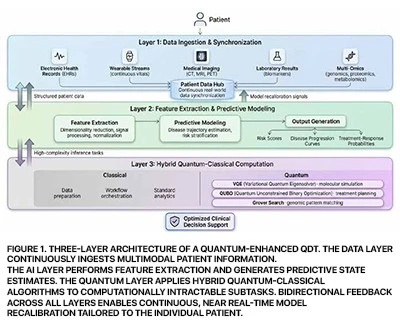
A QDT extends conventional DTs by integrating QC to simulate complex biological systems with higher accuracy and scalability. The QDT architecture operates across three integrated layers (Figure 1). The data layer continuously ingests and synchronises real-time and historical data sources: EHRs, wearable physiological streams, medical imaging, lab results and multi-omics profiles (integrated data from genomics, proteomics, and metabolomics) ground the simulation to the individual patient. The AI layer extracts features, predicts states and estimates disease trajectories, yielding risk scores, progression profiles and treatment-response probabilities. The quantum layer then applies hybrid quantum-classical algorithms to those computationally intensive subtasks classical AI cannot solve efficiently: high-dimensional biological optimisation, quantum search over genomic state spaces, and probabilistic inference under clinical uncertainty.
Clinical Applications
In precision oncology, QDTs can simulate drug response at the molecular and tumour microenvironment level, optimising chemotherapy regimens and immunotherapy combinations before administration. Quantum-based approaches have been reported in the development of new covalent inhibitors for rare diseases such as myotonic dystrophy type I, demonstrating the translational potential of quantum-assisted drug discovery. In cardiology, data from electrocardiogram (ECG) and continuous monitoring of blood pressure, together with genomic risk profiles, enable predictive risk stratification for arrhythmia, heart failure, and perioperative events. In the ICU, QDT simulation in real time allows for optimisation of ventilation parameters, medication titration and resource allocation in critical care, allowing for a switch from reactive to proactive management.
Challenges and Translational Path
Key Challenges
Current quantum hardware operates within the NISQ era, characterised by limited qubit counts, susceptibility to noise, and decoherence (the loss of quantum properties due to environmental interference) that constrains circuit depth and computational fidelity. Fault-tolerant quantum computation at clinically-relevant scales will require progress on both hardware engineering and quantum error correction. On the data side, QDTs would benefit from rich, longitudinal, multimodal patient data currently locked within separate institutions in incompatible formats. Data quality issues, including missing values, noise, and labelling inconsistency, affect both AI model performance and quantum state preparation fidelity. Practically, evaluating the accuracy of QDTs is challenging because they are designed to predict counterfactual events that cannot be directly observed or verified. There are some viable validation strategies for QDTs, which include prospective studies designed for validation, shadow-mode clinical trials and simulation benchmarking against historical cohorts. Although the Food and Drug Administration (FDA) and other regulatory agencies are beginning to establish regulations for AI-enabled medical devices, none have developed any unique regulatory protocols for QDTs. Ethically, QDTs compile especially sensitive genomic, physiological, and longitudinal clinical data with privacy risks that standard data anonymisation techniques may not fully address. Algorithmic bias from the underrepresentation of minority populations in training data risks perpetuating health disparities if not addressed during model development and validation.
Translational Roadmap
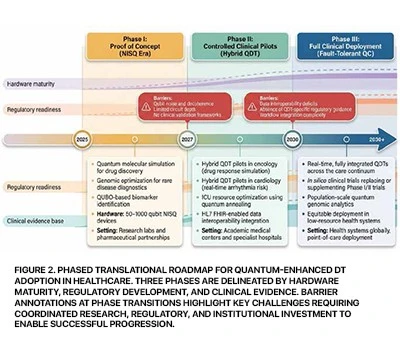
A phased adoption strategy offers the most credible path to clinical translation. In Phase I (2025-2027), quantum advantage should be demonstrated in computationally tractable, high-value domains: molecular simulation for drug discovery and genomic optimisation for rare disease diagnostics. In Phase II (2027-2030), hybrid QDT pilots should be conducted in oncology and cardiology settings, progressing in Phase III (2030+) toward fully integrated real-time deployment across the care continuum as fault-tolerant hardware matures. Figure 2 illustrates this roadmap with annotated barriers at each phase transition.
Conclusion
The convergence of QC, artificial intelligence, and DT technology offers a credible pathway to redefine precision medicine. Growing volumes of genomic, physiological, and clinical data have exceeded what classical computational frameworks can fully apply, limiting the ability to generate timely, personalised clinical insights. QDTs address this gap by enabling real-time, patient-specific simulation through hybrid quantum-classical architectures, shifting medical practice from reactive treatment toward proactive, data-driven care. The principle is simple but powerful: prepare to simulate before prescribing. Serious barriers remain, including NISQ-era hardware, a growing interoperability gap, regulatory uncertainty, and ethical dilemmas surrounding privacy, explainability, and equity of access. Overcoming these barriers will require careful and ongoing collaboration amongst researchers, clinicians, health informaticists, regulators, and health system decision-makers. With sustained translational effort, QDTs can become a new standard of care.
References
[1] Björnsson, B., Borrebaeck, C., Elander, N., Gasslander, T., Gawel, D. R., Gustafsson, M., Jörnsten, R., Lee, E. J., Li, X., Lilja, S., Martínez-Sánchez, M. E., & Nookaew, I. (2020). Digital twins to personalize medicine. Genome Medicine, 12, Article 4. https://doi.org/10.1186/s13073-019-0701-3
[2] Boev, A. S., Rakitko, A. S., Usmanov, S. R., Kobzeva, A. N., Popov, I. V., Ilinsky, V. V., Kiktenko, E. O., & Fedorov, A. K. (2021). Genome assembly using quantum and quantum-inspired annealing. Scientific Reports, 11, Article 13183. https://doi.org/10.1038/s41598-021-88321-5
[3] Ur Rasool, R., Ahmad, H. F., Rafique, W., Qayyum, A., Qadir, J., & Anwar, Z. (2023). Quantum computing for healthcare: A review. Future Internet, 15(3), 94. https://doi.org/10.3390/fi15030094
[4] Moor, M., Banerjee, O., Abad, Z. S. H., Krumholz, H. M., Leskovec, J., Topol, E. J., & Rajpurkar, P. (2023). Foundation models for generalist medical artificial intelligence. Nature, 616(7956), 259–265. https://doi.org/10.1038/s41586-023-05881-4
[5] Obermeyer, Z., Powers, B., Vogeli, C., & Mullainathan, S. (2019). Dissecting racial bias in an algorithm used to manage the health of populations. Science, 366(6464), 447–453. https://doi.org/10.1126/science.aax2342
Read the full article — it's free
Register with AsianHHM to unlock expert insights, research articles and in-depth industry analysis.