

Home to more than 60% of the world’s population, the demand for more personalised and effective healthcare in Asia Pacific (APAC) is surging, bolstered by a burgeoning middle class with higher and growing levels of disposable income. At the same time, the region faces a raft of systemic issues that are evolving APAC’s healthcare needs into increasingly complex, multifaceted challenges.
Access remains one of the single biggest issues facing healthcare in APAC today, with around 700 million people across all age groups unable to take advantage of even the most basic services. This owes to several factors, such as physician disparities between urban and rural areas, as well as critical shortages of healthcare infrastructure and manpower. APAC faces a particularly challenging health conundrum, with a low number of doctors per 1,000 population ration (well below the OECD average).
Meanwhile, medical costs in APAC are rising rapidly, a trend that will continue as the region’s population ages and non-communicable diseases (NCDs) proliferate. As recently as in 2021, NCDs were estimated to cost APAC governments US$250 billion per year, a sum that has risen since. Yet, infectious diseases like malaria and tuberculosis, and infant mortality, remain major concerns in many of APAC’s low-to-middle income economies, straining governments’ resources.
Amid these interlocking challenges, there is enormous potential for intelligent healthcare solutions to address many of these issues. An emerging but potent force in the sector, intelligent healthcare solutions leverage cutting-edge technologies like AI, advanced data analytics, and the Internet of Things to augment existing physicians’ capabilities and empower health systems to meet rising demand for healthcare in the region. Intelligent healthcare builds and expands on the current wave of digital, data-driven health infrastructure by integrating AI advancements across the value chain and care continuum. AI has already emerged as a top health sector investment priority in APAC and, globally, these technologies are becoming increasingly visible within current medical practices. A 2024 survey by the American Medical Association (AMA) revealed that 66% of physicians have reported using healthcare AI across a range of tasks. Meanwhile, between 2013 and 2023, the number of FDA-approved AI/ML-enabled medical devices grew from 18 to 691, while 2024 alone registered the highest number of approvals since the agency began regulating the sector.
Implemented across a range of use cases—from prevention and screening, to diagnosis and post-care monitoring—AI/ML tools have the potential to improve operational efficiency, diagnostic accuracy, and treatment speed.
Now, we are on the precipice of a new wave of AI, that could help accelerate and deliver on the promises of intelligent healthcare. Meet, Agentic AI.

Agentic AI meets healthcare
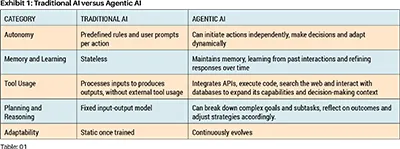
Agentic AI refers to a type of AI system that is goal-oriented, can make decisions and is capable of acting autonomously to achieve complex tasks without constant human intervention. It’s dissimilar from generative AI—which is prompt-driven and focused on new content generation—or traditional discrete AI models that require predefined rules, and are user-driven and static once trained.
These qualities reflect agentic AI’s status as the next step-up in AI technologies, causing many to herald these solutions as the “third wave” of AI innovation, where several existing technologies such as machine learning (ML), natural language processing (NLPs), reinforcement learning, and knowledge representation are brought together in a potent combination. Integrated within healthcare settings, agentic AI has the potential to radically transform the entire health value chain, from providers and patients to producers and payors.
Agentic AI will not replace other forms of AI models in healthcare, instead it will complement and augment existing AI systems and workflows, offering new solutions to emerging challenges. For example, a hospital could integrate an automated workflow to collect patient data, but that information can often be left untouched in a silo. With the help of an AI agent, that data can be autonomously analysed in real time to provide immediate diagnostic suggestions, thus speeding up the entire care process.
Use cases for agentic AI in healthcare
AI agents could address long-standing challenges in APAC’s health systems, by automating routine and time-consuming tasks.
Though the introduction of electronic health records (EHRs) proved to be a landmark moment in the digitalisation of healthcare, the technology also resulted in a surge in administrative responsibilities for clinicians. Globally, physicians spend an average of 15.5 hours per week on administrative tasks like documenting clinical history or insurance claims, leaving them scrambling to keep up with their clinical work.
By turning those tasks over to an AI agent, health systems could free up physicians’ time to focus on actually delivering care. In one study, AI-supported reminders were found to be able to reduce no-show rate from 19.3% to 15.9%, thus contributing to timely intervention and better resource allocation.
Agentic AI could further optimise hospitals’ resource allocation by providing automated care coordination and patient engagement through AI-powered medical assistants. They can also take over repetitive and labour-intensive tasks, such as analysing patient records, scheduling appointments, managing follow ups and ensuring timely interventions.
Healthcare institutions can leverage AI agents to proactively contact patients for critical health screenings, promoting early detection and intervention, especially within underserved communities. A large multi-borough hospital system, on the other hand, deployed an LLM (large language model) to assist physicians and administrators in predicting length of stay, in-hospital mortality, insurance claim denials and predicting readmission risk.
Another area in which agentic AI is poised to make transformational impact is in diagnostics and clinical decision-making. By using AI-powered diagnostics systems, clinicians are already able to achieve more accurate and faster diagnoses, leading to better decision-making. With agentic AI, their abilities can be further augmented by real-world clinical data to generate more tailored and up-to-date recommendations.
We are already seeing how this is occurring in diagnostic imaging, where AI tools have surpassed human radiologists when it comes to certain diseases. In Hong Kong, breast cancer diagnostics tool MOME was developed to distinguish between malignant and benign breast lumps and has already shown to reduce diagnosis time by up to 40% and achieve accuracy levels comparable to an experienced radiologist.
Agentic AI could also help fulfil the ambitions of APAC’s health systems to deliver far more personalised and targeted care and treatment. A multimodal agent, as an example, which aims to simulate various parts of doctor-patient interactions, support clinicians’ diagnostic decisions by collecting and analysing patient information and assist with treatment planning and recommendations. Moreover, such a platform is able to adapt to questioning strategies in real time, thus fostering patience compliance, trust and willingness to follow-up.
These are just some of the real-world potential use cases where agentic AI is being used. But this is a rapidly evolving space with new use cases still being developed. It is likely that agentic AI will have a growing role in automating administrative work and patient engagement within the next three to five years. AI agents could be used to handle non-urgent patient inquiries, leaving clinicians to focus on more critical cases, perhaps evolving into a hybrid triage system where the human and digital capabilities converge.
The use cases for agentic AI also go beyond clinical settings, with potential room for the technology to enhance hospital compliance and risk management by automating regulatory monitoring, audit reporting, and data security. Agentic AI could also supercharge medical research by empowering researchers with the capability to trawl large databases and extract deep insights. Mayo Clinic, for example, has embedded an AI Agent Builder to enable researchers to use its archive of over 50 petabytes of clinical data, thus accelerating information retrieval across multiple languages.
With great opportunity comes great risk
The rapid pace of AI innovation creates an unprecedented opportunity to truly revolutionise healthcare and realise the potential on intelligent healthcare systems. However, we should not be ignorant and turn a blind eye to the unprecedented risks. To underscore the point, in 2024, the WHO published guidance about model-level risks that could impact healthcare ecosystems, such as AI hallucinations or violations of patients’ private information.
While these technological risks do demand attention, it is essential to prioritise system-level risks within the health system that could jeopardise the AI’s transformative potential. One such risk is the issue of bias, stemming from poor quality data or the use of training data that do not feature information on underrepresented or unrepresented groups. Depending on the training data quality and representativeness, models could also further encode current system biases or misinformation or fail to account for regional or local considerations.
In clinical settings, this could be particularly damaging if the models being used have been trained and tested using data that under-represents certain groups, such as those with rare diseases or people from different demographics or socioeconomic backgrounds. Moreover, APAC faces a significant digital skills gap, with an estimated 86 million workers requiring upskilling or reskilling to stay abreast of technological changes. Digital literacy is especially low among healthcare professionals, making this a key stumbling block on the path towards greater AI adoption.
There is also a risk in AI exacerbating the ‘digital divide’ in healthcare, if access to these is limited and there is not sufficient investment in improving digital literacy and infrastructure.
Alternatively, this could lead to ‘over-reliance’ of health systems on AI with the outputs of AI not effectively checked for accuracy. For example, human-in-the-loop controls lacking sufficient knowledge or ‘de-skilling’ of the workforce to effectively check.
While these are risks that are generally associated with AI, their impacts could be amplified by agentic AI. By using this biased training data and algorithms, AI agents could perpetuate those biases, leading to discriminatory healthcare decisions or inaccurate diagnoses. There is also heightened risk of doctors being overly bullish on AI, resulting in them overlooking its risks or over relying on outputs, especially if clinicians lack sufficient usability and knowledge in these technologies.
Given their scale and potential impacts, these are difficult risks to address, but shying away from them could leave health systems flailing as these technologies march forward. By taking a proactive approach while prioritising trust, transparency and sustainability, health systems can set themselves up to successfully ride this wave of agentic AI innovation and realise its full potential for intelligent healthcare.
Realising agentic AI’s potential
Even as we move towards a more intelligent form of healthcare, the fact remains that most AI investments are currently still focused on ideation and proof of concepts. While important to demonstrate value, translating agentic AI’s potential into reality requires focused investments into sustainable initiatives that can bring concepts into the real world with quantifiable results.
APAC’s healthcare leaders are aware of this, as reflected in a marked shift in their priorities towards translating and realising value from their AI investments. In KPMG’s Quarterly AI Pulse Survey, it was found that 88% of executives are already exploring or piloting agentic AI in their organisations, yet only 12% have deployed AI agents. Meanwhile, 79% of executives are more focused on identifying how AI can generate more productivity and ROI.
Realising the true potential of agentic AI will require stakeholders throughout the value chain to balance the undeniable risks of AI against their benefits, a central tension that was revealed in KPMG’s 2025 survey on trust, attitudes and use of AI. Despite growing levels of AI adoption, over half of respondents were wary about trusting AI systems, and there is significant scepticism about the safety, security and ethics of these technologies.
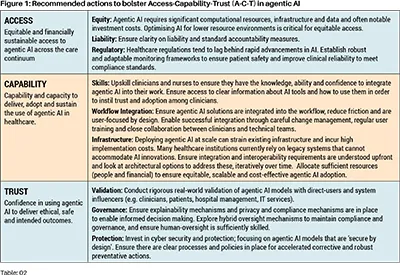
It will be critical for healthcare leaders to shore up internal trust in AI in order to ensure they’re able to gain support from not just clinicians, but also patients. There are tangible actions that can be taken to enable this; improving access, strengthening capabilities, and building trust.
If we proactively tackle the above together, we have an opportunity to transition from a fragmented and disparate healthcare system to an agentic AI-enabled intelligent healthcare system that is personalised, interconnected, and adaptive.
Given the challenging landscape facing the health ecosystem, inaction is not an option.
We must forge forward.
So, let’s and ride this wave of agentic AI, eyes wide open, and realise the potential of AI-enabled intelligent healthcare to deliver a healthier future for everyone, in APAC and beyond!
All References:
1 KPMG, The changing landscape of the medical devices industry in the APAC region, 2020, https://assets.kpmg.com/content/dam/kpmg/jp/pdf/2020/jp-medical-device-apac-en.pdf.
2 APACMed, APACMed Annual Report 2021, 2021, https://apacmed.org/apacmed-annual-report-2021/
3 OECD, Health at a Glance: Asia Pacific 2024, https://www.oecd.org/content/dam/oecd/en/publications/reports/2024/11/health-at-a-glance-asia-pacific-2024_2cea11ae/51fed7e9-en.pdf
4 Healthcare Asia Magazine, Asia Pacific to ramp up investment on healthcare capacity, 2021, https://healthcareasiamagazine.com/healthcare/in-focus/asia-pacific-ramp-investment-healthcare-capacity
5 https://www.wolterskluwer.com/en/expert-insights/the-doctor-shortage-across-asia-pacific-a-growing-crisis
6 https://bmcpublichealth.biomedcentral.com/articles/10.1186/s12889-024-21084-6
7 https://www.oecd.org/en/publications/health-at-a-glance-asia-pacific-2024_51fed7e9-en/full-report.html
8 Healthcare Asia Magazine, APAC medical costs surge prompts employers to optimise spending, 6 March 2025, https://healthcareasiamagazine.com/videos/apac-medical-costs-surge-prompts-employers-optimise-spending
9 APACMed, https://apacmed.org/wp-content/uploads/2022/08/APACMed-Chronic-Disease-Management-The-Case-for-MedTech-Health-Services-Summary-Report.pdf
10 https://www.who.int/docs/default-source/wpro---documents/external-publications/health-at-a-glance-asia-pacific-2022.pdf?sfvrsn=4deb7a76_1&download=true
11 https://healthcareasiamagazine.com/healthcare/news/ai-tops-health-sector-investment-priorities
12 https://www.nature.com/articles/s41746-024-01270-x
13 https://medium.com/@kanerika/why-agentic-ai-in-healthcare-is-the-next-big-breakthrough-27a458f67833
14 http://billingparadise.com/blog/23-physician-specialties-and-the-number-of-hours-spent-on-paperwork/
15 https://www.frontiersin.org/journals/digital-health/articles/10.3389/fdgth.2025.1600216/full
16 https://www.wellspan.org/articles/2024/09/web---hippocratic-ai-launch
17 https://www.nature.com/articles/s41586-023-06160-y
18 https://hkust.edu.hk/news/hkust-spearheads-four-large-ai-models-revolutionize-healthcare
19 https://www.sciencedirect.com/science/article/pii/S2949953425000141#bib92
20 https://cloud.google.com/blog/products/ai-machine-learning/build-generative-ai-experiences-with-vertex-ai-agent-builder
21 https://www.who.int/news/item/18-01-2024-who-releases-ai-ethics-and-governance-guidance-for-large-multi-modal-models
22https://impact.economist.com/perspectives/sites/default/files/bridging_the_skills_gap_fuelling_careers_and_the_economy_in_asia_pacific.pdf
23 https://www.hospitalmanagementasia.com/talent-skills/its-time-we-prioritise-digital-literacy-in-healthcare/
24https://kpmg.com/xx/en/our-insights/ai-and-technology/trust-attitudes-and-use-of-ai.html