
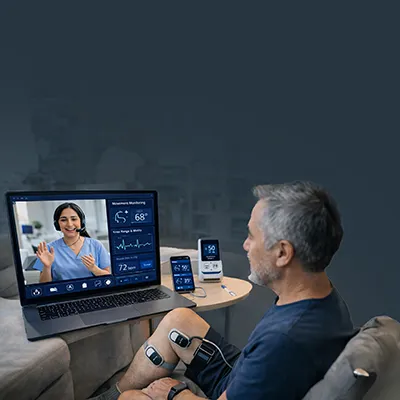
Rehabilitation has long been confined to hospitals and specialist centres. However, advances in telemedicine are extending the continuum of care into homes and communities. Through digital communication and remote monitoring, clinicians can now follow progress, provide feedback, and deliver structured therapy beyond the clinical environment. This shift offers several advantages. Continuity of care is maintained through regular contact after discharge, while telemonitoring enables therapists to support multiple patients efficiently. For those with mobility or geographical limitations, virtual access to care eliminates travel barriers. Equally important, telemedicine encourages patients to take an active role in recovery, aligning with the broader movement toward self-management and preventative health. Within this framework, biofeedback has evolved from a specialist laboratory tool to a practical, home-based technology that bridges professional guidance and patient-led practice.
Biofeedback enables individuals to observe and regulate their own physiological processes through electronic monitoring. It provides real-time information about how the body functions, allowing subtle adjustments that promote balance and well-being. Different forms of Biofeedback target specific physiological systems. Respiratory Biofeedback focuses on the rhythm and depth of breathing, teaching individuals to breathe more efficiently and calmly. Heart Rate Variability (HRV) Biofeedback, a closely related technique, monitors the variation in time between heartbeats and trains individuals to synchronise their breathing with their heart rhythm to achieve optimal autonomic balance.
Electromyographic (EMG) Biofeedback measures muscle activity and is widely used in motor and neurological rehabilitation to restore strength and coordination. Thermal Biofeedback (Temperature BF) monitors skin temperature to assist in stress management and circulatory regulation. Electrodermal Biofeedback, which measures changes in skin conductance, reflects emotional and stress responses and helps patients develop improved control over anxiety. Although each modality serves a specific therapeutic purpose, HRV and Respiratory Biofeedback have gained particular attention in recent years due to their strong connection with the autonomic nervous system. Both are now considered essential tools in contemporary rehabilitation, particularly in cardiac and neurological recovery programmes.
Heart Rate Variability represents the fluctuation in time between heartbeats, reflecting the dynamic balance between the sympathetic (“fight or flight”) and parasympathetic (“rest and digest”) branches of the nervous system. A higher HRV is generally associated with greater physiological adaptability and cardiovascular health, while a lower HRV can indicate stress, fatigue, or reduced resilience. Following cardiac surgery or neurological injury, HRV often decreases due to autonomic disruption. Guiding patients to restore HRV through structured breathing techniques helps to improve cardiovascular recovery, enhance emotional regulation, and strengthen stress tolerance. Because HRV can be accurately measured using wearable sensors, it provides a reliable, quantifiable marker that clinicians can monitor remotely.
In HRV biofeedback training, sensors placed on the body record heart rhythm data, which is displayed on a screen or mobile device. Patients learn to adjust their breathing until heart rate and respiration achieve synchrony, a state known as resonance frequency. Training at this frequency strengthens vagal tone, optimises autonomic balance, and promotes a sense of calm focus. The technique has shown benefits in several clinical contexts. In cardiac rehabilitation, HRV Biofeedback supports stable recovery and blood pressure regulation. In neurological rehabilitation, it assists in restoring emotional control and cognitive flexibility following stroke or brain injury. In pain and fatigue management, it helps to correct an autonomic imbalance. These represent only a few examples; biofeedback is also showing promise in anxiety management, chronic pain, and long-term stress-related conditions, underlining its versatility across health disciplines. In telemedicine settings, HRV biofeedback provides a clear advantage: progress can be tracked remotely, allowing therapists to personalise programmes and maintain ongoing support.
Respiratory Biofeedback complements HRV training by focusing on breathing patterns. Through sensors or camera-based systems, patients receive feedback on rate and depth of breathing, learning to adopt slower, deeper rhythms. This deliberate breathing stimulates parasympathetic activity, helping to regulate stress and stabilise heart rate. For individuals recovering from cardiac conditions, respiratory illness, or stroke, breathing Biofeedback can prevent anxiety-induced tachycardia and promote efficient oxygen exchange. Modern telemedicine platforms allow therapists to guide and review sessions remotely, ensuring safe and consistent practice at home.
Technological advances have made Biofeedback more accessible than ever. Compact, wearable devices now measure HRV or breathing rhythms with clinical accuracy, while mobile applications provide guided exercises and visual feedback. Cloud-based systems securely transmit physiological data to clinicians, who can then adjust therapy programmes based on real-time progress.
Biofeedback is also favoured by many Occupational Therapists because of its simplicity and non-invasive nature. Most devices are small, lightweight, and easy to position on the body, commonly attached to chest strap. The method involves no discomfort or risk, making it highly suitable for home rehabilitation. Patients can typically complete sessions while seated, using only a smartphone or tablet, which are now commonplace in most households. This combination of user comfort, digital accessibility, and clinical supervision makes Biofeedback a particularly attractive tool for long-term self-management. The blend of personal responsibility and professional oversight promotes sustainable engagement and encourages patients to integrate training into everyday routines.
Occupational Therapists play a crucial role in implementing Biofeedback within telemedicine frameworks. During inpatient rehabilitation, they introduce patients and families to Biofeedback devices, such as smart sensors or breathing trainers, and teach correct setup, breathing rhythm, and maintenance. Once patients transition home, therapists can remotely review HRV and respiratory data to evaluate progress and modify interventions when necessary.
Because Biofeedback equipment is compact and intuitive, it fits naturally into Occupational Therapy programmes focused on independence and participation. Patients are able to use their own devices comfortably at home, reducing reliance on hospital visits while maintaining professional supervision through teleconsultations. Families often act as partners in therapy, helping patients incorporate short Biofeedback sessions into daily life, for example, practising breathing before meals or relaxation before sleep. In this way, Occupational Therapists ensure that technology enhances, rather than replaces, human care.
International Perspectives
In Germany, Biofeedback is firmly embedded in Occupational Therapy, especially for stress regulation and neurological rehabilitation. HRV and EMG Biofeedback are widely applied in clinics supporting stroke survivors and individuals with burnout or chronic stress. These programmes reflect Germany’s strong emphasis on interdisciplinary, evidence-based rehabilitation.
In Austria, Biofeedback forms part of self-regulation therapy under the guidance of Ergotherapie Austria. HRV and respiratory training are used to improve attention, emotional balance, and resilience in both physical and psychosocial rehabilitation. Structured professional education ensures consistent clinical application.
Swiss rehabilitation centres integrate Biofeedback into neurological and physical therapy for patients recovering from stroke, multiple sclerosis, or spinal cord injury. EMG and motion feedback are used to refine motor coordination, often combined with telemonitoring systems that enable continuous oversight between sessions.
The Netherlands offers one of the most integrated examples of Biofeedback within Occupational Therapy. HRV, EMG, and respiratory feedback are used to enhance cognitive recovery, manage burnout, and support stress regulation. Practices often align training with daily activities, a reflection of the Dutch focus on functional participation and independence. National professional bodies continue to promote specialist education and research in this field.
Together, these European models illustrate how Biofeedback has evolved from a niche intervention to a standard component of modern rehabilitation.
As telemedicine expands, the responsible use of digital health tools is paramount. Patient data must be securely managed, and both clinicians and patients require digital literacy to operate devices effectively. Consumer-grade tools vary in precision, so clinical validation remains essential. Accessibility also needs attention, as not all patients have equal access to the required technology or reliable internet connections.
Future rehabilitation is expected to merge Biofeedback, artificial intelligence (AI), and immersive technology. AI algorithms are being developed to interpret HRV data and personalise training intensity, while virtual reality environments may soon adapt in real time to physiological changes. Wearable sensors are becoming smaller, more discreet, and integrated into everyday garments, offering continuous monitoring without intrusion. Rather than replacing healthcare professionals, these innovations will augment their capacity to deliver precise, data-driven, and patient-centred care.
Telemedicine and Biofeedback are redefining rehabilitation by extending therapeutic influence far beyond hospital walls. Through real-time physiological monitoring and guided self-regulation, patients can strengthen recovery, improve stress resilience, and maintain emotional balance. Examples from Germany, Austria, Switzerland, and the Netherlands illustrate how Occupational Therapists are leading this transformation by combining digital tools with personalised human support. Applications in stroke recovery and pain management represent only a fraction of Biofeedback’s potential. As healthcare systems evolve towards more sustainable and participatory models, biofeedback stands out as an innovation that combines science, technology, and compassionate practice, reshaping rehabilitation for the connected age.
References
Lehrer, P. M., & Gevirtz, R. (2017). Heart rate variability biofeedback: How and why does it work? Frontiers in Psychology, 8, 943.
Hassett, A. L., et al. (2016). Effects of heart rate variability biofeedback in patients with chronic pain: A randomised controlled trial. Pain, 157(2), 377–385.
Shaffer, F., Meehan, Z. M., & Zerr, C. L. (2020). A critical review of heart rate variability biofeedback: Mechanisms and clinical applications. Frontiers in Neuroscience, 14, 594.
Thayer, J. F., & Lane, R. D. (2019). Autonomic function and resilience: Implications for health and disease. Neuroscience & Biobehavioral Reviews, 99, 310–328.
Siepmann, M., et al. (2018). Biofeedback therapy in cardiac rehabilitation: A systematic review. European Journal of Preventive Cardiology, 25(11), 1229–1241.
Ernst, G. (2017). Heart Rate Variability. Springer International Publishing. Henriques, G., & Keffer, S. (2019). Biofeedback and self-regulation in contemporary rehabilitation.
Applied Psychophysiology and Biofeedback, 44(3), 165–179. Peper, E., Harvey, R., Lin, I. M., & Harvey, M. (2021). Digital biofeedback tools: The future of rehabilitation and self-regulation. Biofeedback, 49(2), 35–42.
Mayer, K., & Egner, T. (2022). Advances in biofeedback for stress and cognitive rehabilitation. Frontiers in Human Neuroscience, 16, 823.
Ergotherapie Deutschland, Ergotherapie Austria, Ergotherapie Schweiz, & Ergotherapie Nederland. (2023). National guidelines for occupational therapy in digital rehabilitation.
--AHHM Issue 71--