
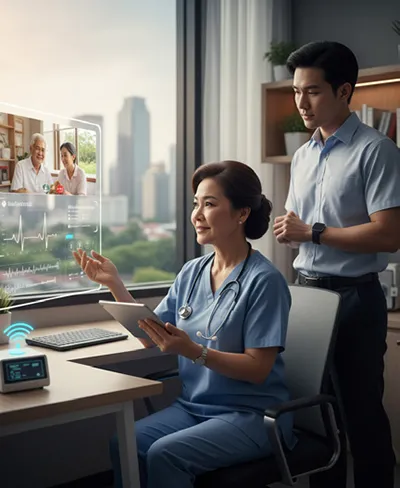
Despite astonishing advancements in medical technology, healthcare today often suffers from a paradox: increasing sophistication with decreasing satisfaction. Patients feel lost in fragmented systems, caregivers are burnt out, and communities remain underserved. At the core of this dissonance lies a fundamental disconnect between people, processes, and technology. This is where Connected Care offers a compelling path forward.
Connected Care is more than a buzzword. It is a healthcare philosophy rooted in the belief that true healing happens when care is coordinated, compassionate, and enabled by purposeful technology. It brings caregivers, patients, and communities together physically, emotionally, and digitally. This is a particularly relevant and urgent transformation for the Asian market, where the digital health sector is projected to reach a valuation of $488.50 billion by 2033, growing at a CAGR of 23.3%.
The Three Dimensions of Connection
To rebuild trust and efficiency in care delivery, healthcare systems must strengthen three core areas of connection:
1. Connection Within the Care Team
A hospital is only as strong as the cohesion of its team. When clinicians communicate seamlessly, when nurses feel respected, and when departments operate in sync, patients benefit directly. Yet too often, silos, miscommunication, and burnout weaken these relationships.
Connected Care calls for internal collaboration not just as a strategy—but as a culture. Trust, transparency, and empowerment must become part of the organisational DNA. Leadership must transition from transactional oversight to relational leadership—where engagement and psychological safety are cornerstones of high-performing teams.
Technology Use Cases:
• Clinical communication platforms (e.g., TigerConnect, Siilo) allow secure, instant messaging and care coordination across shifts and locations.
• Smart dashboards powered by AI support hospital executives in tracking workforce utilisation, stress markers, and clinical efficiency in real time.
• Digital rounding tools guide standardised, collaborative handovers between nursing shifts and medical teams, ensuring continuity and reducing errors.
2. Connection Between Caregivers and Patients
The caregiver-patient relationship lies at the heart of healing. Yet time constraints, paperwork overload, and fragmented digital tools often stand in the way of meaningful interaction. Patients want to be heard, involved, and understood. Caregivers want to give more time, but systems don’t always allow it.
Connected Care uses technology not to create distance, but to bridge it—freeing caregivers to spend more time at the bedside and enabling patients to engage meaningfully in their own care. It shifts from one-way communication to two-way partnerships, where empathy is empowered by data, and trust is built on transparency.
Technology Use Cases:
• AI medical scribes (e.g., Suki, Nuance DAX) handle documentation during consults, reducing administrative time and improving patient face-time.
• Remote patient monitoring (RPM) tools track vitals and symptoms from home, allowing early interventions in chronic disease care.
• Patient portals and education platforms give patients access to their records, videos, instructions, and decision aids, making care truly collaborative.
In Asia, where the AI in the patient engagement market is projected to witness a CAGR of 23.6% through 2030, tech must be adapted to local behaviors and trust patterns. In high-trust digital markets like China and India, direct-to-patient tech is welcomed. In more traditionally structured systems like Singapore and Australia, tech must reinforce, not replace, the familiar care models.
3. Connection With the Community
Care cannot be confined to hospital walls. Communities shape health outcomes through culture, behavior, environment, and access. When hospitals engage with their communities proactively—through education, prevention, and presence—they shift from reactive institutions to trusted health partners.
Connected Care fosters this by extending presence into neighborhoods, workplaces, schools, and homes—through both physical and digital means. The aim is to meet people where they are, in language they understand, and in formats that feel personal. Preventive care becomes more accessible, and health equity becomes more achievable.
Technology Use Cases:
• Mobile health vans equipped with diagnostics and tablets offer chronic disease screening and antenatal care in rural areas, as seen in projects in India for street and slum-dwelling populations.
• Community health apps provide local health updates, wellness challenges, vaccination reminders, and symptom trackers in regional languages, as demonstrated by vaccination platforms in Vietnam and mental health apps in Indonesia.
• AI-assisted triage kiosks in rural India, designed to function offline and with local language support, enhance triage accuracy and ensure faster referrals even in low-literacy, low-connectivity settings.
• Public health integration platforms allow governments to share de-identified community health data for proactive policymaking, a model being pursued with platforms like Indonesia’s SATUSEHAT.
The region is seeing a surge in digitally supported outreach, all of which signals a shift toward connected public health ecosystems.
The Role of Technology: An Enabler, Not a Replacement
The narrative that "AI will replace doctors" is flawed. In Connected Care, technology doesn’t compete with empathy; it fuels it. It gives back time, reduces noise, and brings clarity. It allows healthcare professionals to reconnect with their purpose: to heal, support, and care.
Technology should serve as a silent partner, working in the background, streamlining processes, and elevating the quality of connection at every touchpoint.
Technology Use Cases:
• AI scribes support clinical consultations by documenting interactions, reducing physician burnout and medical errors.
• Patient journey mapping tools identify bottlenecks, missed opportunities, and emotional friction points in the care process.
• Predictive algorithms guide care teams in identifying at-risk patients who may miss follow-ups or experience complications.
• Digital twins simulate personalised health scenarios, supporting precision medicine and decision-making tailored to the patient’s context.
Adoption must always be thoughtful, and every tool should be evaluated by asking:
• Does it improve engagement?
• Does it reduce the burden on staff?
• Does it preserve human dignity?
Equity, Ethics, and Access
As we digitise, we must not deepen the divide. The promise of Connected Care only holds if it includes everyone—urban and rural, tech-savvy and illiterate, rich and poor.
This requires designing for equity, not just efficiency. Multi-language platforms, offline functionality, and culturally relevant interfaces become as important as any algorithm. Technology must enable dignified access, protect privacy, and uphold consent.
Technology Use Cases:
• National cloud EHRs in South Korea and Singapore link public and private care across institutions, ensuring elderly and underserved populations are not left out.
• Inclusive telehealth interfaces in Japan cater to elderly patients with large-font, one-touch video consults, bridging generational gaps in care access.
• AI-assisted triage kiosks in rural areas use local language speech interfaces to guide patients through basic assessments.
Continuous Measurement and Improvement
Transformation doesn’t happen without measurement. Connected Care promotes a culture of feedback, where data is not just collected but also acted upon.
Technology Use Cases:
• Sentiment analytics from survey tools capture not just satisfaction, but the emotional undertones of care experiences.
• Team-based performance dashboards allow department heads to see trends in burnout, collaboration, and morale.
• Usability trackers for digital health apps show where patients drop off or struggle, guiding continuous UX improvement.
What we measure should reflect what we value, not just efficiency and cost, but empathy, equity, and empowerment.
Looking Ahead: AI Agents and Human-Centered Intelligence
The hospital of the future will have virtual agents guiding patients through paperwork, AI chatbots triaging symptoms, and machine learning models forecasting risks. But success will depend on more than tech.
It will depend on culture. On keeping the human being at the center. On ensuring that every algorithm enhances, not replaces, the moments that matter. We are not building smart hospitals. We are building caring hospitals, where intelligence serves healing, not the other way around.
Conclusion: Rebuilding Healthcare, One Connection at a Time
The cost of disconnection is too high. Burnout. Inequity. Mistrust. But within this crisis lies a profound opportunity—to rebuild healthcare around what matters most: connection.
Let us lead with compassion and design with purpose. Let us embrace digital transformation while holding tightly to human dignity. Because every patient wants to be seen. Every caregiver wants to feel supported. Every community wants to be safe. And Connected Care is how we make that happen, together.