
The global healthcare system is at a critical juncture, strained by a dual-front crisis of demographic shifts and a critical workforce shortage. As the World Health Organisation (WHO) highlights, the population aged 60 and older will nearly double by 2050. This demographic shift coincides with a severe workforce deficit; the McKinsey Health Institute projects a global shortfall of at least ten million healthcare workers by 2030.
Closing this gap could avert an estimated 189 million years of life lost while boosting the global economy by $1.1 trillion. This reality demands that leaders move beyond reactiveness and proactively architect the future of care. The most direct path is the strategic adoption of cloud technology. A proactive cloud strategy, specifically leveraging Software-as-a-Service (SaaS), provides the definitive blueprint for this transformation. It forges a cohesive ecosystem that improves patient outcomes and operational efficiency, positioning an organisation at the vanguard of healthcare innovation.

The Problem: Fragmented Data, Reactive Outcomes
For decades, patient health information has been trapped in proprietary silos. Each hospital, clinic, and lab often operates its own isolated system, creating a fragmented and incomplete view of a patient's journey. While Electronic Health Records (EHRs) were a step forward, significant interoperability challenges persist, creating immense risk and inefficiency.
Consider a patient with diabetes, rushed to an emergency room unconscious. The treating physician, unable to access their primary care provider's records or recent lab results, may miss a critical diagnosis of renal impairment. Administering a standard treatment could trigger a dangerous adverse event. This lapse translates directly into increased liability, costs, and eroded patient trust.
• Clinical Gaps and Risks: Physicians lack immediate access to full patient histories, leading to dangerous drug interactions or inappropriate treatments.
• Operational Inefficiencies: Administrative staff waste hours manually reconciling records, increasing operational costs and diverting resources from direct care.
• Hindered Population Health Management: Without a unified data view, officials cannot effectively identify disease trends, severely limiting crisis response.
The reactive system is built on these fragments. It responds to a symptom, an emergency, or a singular diagnosis without considering the patient's entire health narrative. As our healthcare model increases in complexity, persisting with this fragmented approach is not just inefficient — it is dangerous.
The Solution: Forging a Unified Cloud Ecosystem
A proactive cloud strategy is the definitive antidote to fragmentation. It unifies the entire health ecosystem onto a single, secure, and accessible platform, most effectively achieved through the strategic adoption of Software-as-a-Service (SaaS) models.
This approach creates a single source of truth for all patient information, accessible to authorised providers anywhere, from a primary clinic to a hospital ER. This eliminates data silos, ensuring every clinician has a complete, real-time picture of a patient's health. This seamless interoperability is powered by modern Application Programming Interfaces (APIs) and standardised protocols like Fast Healthcare Interoperability Resources (FHIR), which enable different EHR systems to communicate effectively. Crucially, adopting these open standards is a strategic decision that prevents vendor lock-in and ensures long-term flexibility.
• Enhanced Clinical Decision-Making: With comprehensive, instant access to patient history, doctors can make more informed and precise decisions. Cloud-based platforms leverage advanced analytics to provide immediate clinical decision support, including predictive risk scores for conditions like sepsis or heart failure, and deliver critical warnings for potential drug interactions.
• Streamlined Operational Workflows: Integrated systems automate administrative tasks such as scheduling, referrals, and billing, and make them seamless. This liberates healthcare professionals from bureaucracy, freeing them to focus on direct patient care. Research also confirms that cloud computing significantly enhances key managerial processes and organisational efficiency.

The 3C Framework for Proactive Health
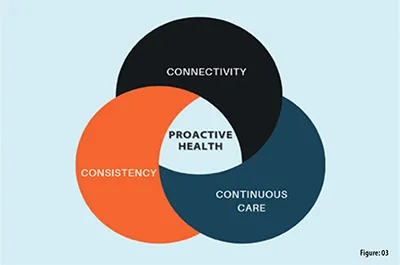
To unlock the full value of a proactive cloud strategy, executives must focus on three interdependent principles: Connectivity, Consistency, and Continuous Care. This framework provides a clear pathway for implementation.
1. Connectivity: The first step is to establish seamless, secure connections across all disparate data sources. This involves integrating electronic health records (EHRs) with laboratory systems (LIS), radiology platforms, telehealth applications, and patient-generated data from wearable devices. A cloud-based clinical informatics system acts as the central hub, aggregating this information into a single, unified patient view. This integration is the essential foundation for all proactive efforts.
2. Consistency: Data integrity is highly important when connecting a vast amount of data. Information must be standardised to ensure a blood pressure reading from a home monitor is interpreted with the same clinical validity as one from a cardiologist's office. Cloud platforms can automate this standardisation through robust data governance features, creating a consistent and reliable stream of information. This consistency is critical for accurate analytics, machine learning models, and dependable clinical decision support.
3. Continuous Care: With connected and consistent data, healthcare delivery can transcend episodic encounters to become a continuous, longitudinal relationship. This enables ongoing remote patient monitoring (RPM), timely interventions based on data trends, and comprehensive long-term management of chronic conditions. Cloud-powered telehealth solutions excel here, extending the reach of care beyond the clinic walls and into patients' daily lives, creating a truly patient-centric model.
Clinical Informatics and Telehealth: The Drivers of Proactive Care
Clinical informatics transforms raw health data into actionable, predictive intelligence. In a cloud-based system, it evolves into a powerful engine for prevention and personalisation.
1. Connectivity: The first step is to establish seamless, secure connections across all disparate data sources. This involves integrating electronic health records (EHRs) with laboratory systems (LIS), radiology platforms, telehealth applications, and patient-generated data from wearable devices. A cloud-based clinical informatics system acts as the central hub, aggregating this information into a single, unified patient view. This integration is the essential foundation for all proactive efforts.
2. Consistency: Data integrity is highly important when connecting a vast amount of data. Information must be standardised to ensure a blood pressure reading from a home monitor is interpreted with the same clinical validity as one from a cardiologist's office. Cloud platforms can automate this standardisation through robust data governance features, creating a consistent and reliable stream of information. This consistency is critical for accurate analytics, machine learning models, and dependable clinical decision support.
3. Continuous Care: With connected and consistent data, healthcare delivery can transcend episodic encounters to become a continuous, longitudinal relationship. This enables ongoing remote patient monitoring (RPM), timely interventions based on data trends, and comprehensive long-term management of chronic conditions. Cloud-powered telehealth solutions excel here, extending the reach of care beyond the clinic walls and into patients' daily lives, creating a truly patient-centric model.
Clinical Informatics and Telehealth: The Drivers of Proactive Care
Clinical informatics transforms raw health data into actionable, predictive intelligence. In a cloud-based system, it evolves into a powerful engine for prevention and personalisation.
• Predictive Analytics: Cloud platforms provide the vast computational power to analyse massive datasets—spanning EHRs, genomic information, social determinants of health, and real-time IoT data. This enables precise predictions of patient cohorts at highest risk for specific conditions, such as diabetes complications or cardiovascular events. This capability is critical for addressing the rising burden of Non-Communicable Diseases (NCDs) in aging populations, as detailed in studies from high-income countries like Singapore.
• Personalised Care Plans: By leveraging unique patient data profiles, clinical informatics tools dynamically generate and adjust highly personalised care plans. Clinicians can offer tailored, evidence-based advice on diet, exercise, and medication, significantly improving patient engagement and adherence to drive better health outcomes.
• Population Health Management: Analysing aggregated, anonymised data across a population provides unprecedented insights into community-level disease patterns and social drivers of health. This enables precise targeting of preventative campaigns and optimal allocation of scarce resources, moving public health from a reactive to a predictive and preventive stance.
Telehealth is the critical delivery mechanism that brings this proactive intelligence directly to the patient. A recent study on cloud-based telemedicine demonstrated its profound impact, showing such platforms could improve healthcare access in rural areas by up to 57% and provide significantly more timely consultations, directly addressing care delivery inequities.

Embracing SaaS
For executives, the choice of technology infrastructure is a definitive strategic decision. The traditional model, defined by massive upfront capital expenditure (CAPEX) for on-premise servers, is inflexible, costly, and slow. The strategic alternative, SaaS, transforms this CAPEX into a predictable operational expenditure (OPEX).
SaaS fundamentally changes technology acquisition. It abstracts away the resource-intensive burden of managing IT infrastructure, allowing providers to access world-class, secure tools via subscription. Leading providers invest billions in state-of-the-art security, disaster recovery, and compliance with standards like HIPAA and GDPR, often exceeding the capabilities of individual organisations. This model delivers compelling advantages:
• Accelerated Deployment and Innovation: SaaS eliminates protracted hardware procurement and installation cycles. This democratizes access to powerful tools, enabling rapid deployment and iteration for organisations of any size, allowing them to innovate at pace.
• Dynamic, Elastic Scalability: Platforms can scale resources up or down instantly to meet fluctuating demand. A telehealth system can seamlessly handle a 300% surge during a health crisis without new hardware or performance loss.
• Continuous Innovation and built-in Obsolescence Protection: Providers continuously update platforms with new features, security patches, and advanced capabilities like AI. Organisations continuously benefit from these innovations, ensuring they remain at the technological forefront without the constant risk of obsolescence or requiring expensive upgrades.
• Financial Predictability and Efficiency: The subscription-based OPEX model transforms unpredictable capital expenditures into manageable operating costs. This predictability aids budgeting and allows executives to reallocate resources from IT maintenance directly into patient care and strategic growth.

Navigating Implementation Challenges and Measuring Success
While the benefits are clear, a cloud transformation presents significant hurdles that leaders must anticipate. Key barriers include concerns over long-term cost-effectiveness, the complexity of data migration, a lack of internal cloud skills, and the cultural shift required to trust external services.
• Change Management and Cultural Adoption: Shifting clinical and administrative staff from familiar, decades-old legacy systems to a new, cloud-based model can face significant resistance. The solution is unwavering leadership from the top down. Involve key staff early as champions and provide clear, continuous communication about the daily workflow benefits to overcome inertia.
• Data Migration and Integrity: Migrating vast archives of sensitive patient data is a complex, high-stakes endeavour. It demands a meticulous, phased approach with rigorous validation at every step to ensure no data is lost or corrupted and that integrity is maintained.
• Security, Compliance, and Governance: While providers offer advanced security, the ultimate responsibility for data governance, access control, and regulatory compliance (e.g., HIPAA) remains with the organisation. A robust, well-documented plan for managing user roles, encryption protocols, and audit trails is non-negotiable to maintain patient privacy and meet all compliance obligations.
To clearly demonstrate its Return on Investment (ROI) to stakeholders, leaders must track a balanced scorecard of Key Performance Indicators (KPIs) tied to tangible outcomes:
• Clinical Results: Reduction in 30-day readmission rates, decrease in medication errors, and improvement in preventative screening rates.
• Operational Efficiency: Reduction in administrative costs per patient, percentage of staff time redirected to direct patient care, and a faster billing cycle.
• Population Health: Improvement in chronic disease metrics (e.g., HbA1c levels), increased patient engagement scores, and reduction in emergency department visits for ambulatory-care-sensitive conditions.
Combining a proactive approach to mitigating challenges with a relentless focus on these measurable results transforms a complex technical initiative into a demonstrable strategic success.

A Blueprint for Leading the Future of Health
Healthcare’s evolution is inevitable. The critical choice for executives is no longer if they will change, but how—whether to simply react to mounting pressures or to proactively seize the opportunity to forge a more effective, efficient, and humane future of care.
A cloud strategy, strategically anchored in clinical informatics and telehealth, provides the definitive blueprint for this leadership. It is the key to unlocking a unified data ecosystem, empowering clinicians with predictive insights, and extending high-quality, continuous care directly to the patient, on their terms.
As demonstrated by early adopters, this approach yields tangible returns, including significant reductions in avoidable readmissions and administrative overhead. This strategic pivot from reactive sickness care to proactive health management is the most significant opportunity in a generation to create a more resilient, accessible, and sustainable system for all.
The time for deliberation is over. The time for strategic action is now.
Citations
[1] World. (2025, May 15). WHO warns of slowing global health gains in new statistics report. Who.int; World Health Organization: WHO. https://www.who.int/news/item/15-05-2025-who-warns-of-slowing-global-health-gains-in-new-statistics-report
[2] WHO. (2024, October 1). Ageing and health. World Health Organization. https://www.who.int/news-room/fact-sheets/detail/ageing-and-health
[3] Song, X., Zhou, B., Baird, S., Lu, C., Song, Z., Zhang, Y., Wang, R., Jiang, J., Chen, L., Liu, J., Yuan, W., Liu, Y., Dang, J., Hu, P., Ma, J., Dong, Y., Song, Y., Majid Ezzati, & Sawyer, S. M. (2025). Trends and predictions to 2030 in demographic structures and metabolic health for children and adolescents in China: analysis of national school health surveys from 2000 to 2019. The Lancet Child & Adolescent Health, 9(8), 530–543. https://doi.org/10.1016/s2352-4642(25)00140-3
[4] Guo, X., Tysinger, B., Wee, H. L., Subramaniam, M., Ma, S., Ng, T. P., & Chen, C. (2025). Disease burden, lifetime healthcare cost and long-term intervention impact projections among older adults in Singapore. Nature Aging. https://doi.org/10.1038/s43587-025-00915-0
[5] Chang, S.-C., Lu, M.-T., Pan, T.-H., & Chen, C.-S. (2021). Evaluating the E-Health Cloud Computing Systems Adoption in Taiwan’s Healthcare Industry. Life, 11(4), 310. https://doi.org/10.3390/life11040310
[6] Cresswell, K., Domínguez Hernández, A., Williams, R., & Sheikh, A. (2021). Cloud technology in healthcare: a qualitative study exploring key challenges and opportunities (Preprint). JMIR Human Factors, 9(1). https://doi.org/10.2196/31246
[7] Kumar, P., Holt, T., & Wong, Y. (2025, May 14). Heartbeat of health: Reimagining the healthcare workforce of the future. McKinsey & Company. https://www.mckinsey.com/mhi/our-insights/heartbeat-of-health-reimagining-the-healthcare-workforce-of-the-future#/
[8] Abughazalah, M., Alsaggaf, W., Saifuddin, S., & Sarhan, S. (2024). Centralized vs. Decentralized Cloud Computing in Healthcare. Applied Sciences, 14(17), 7765–7765. https://doi.org/10.3390/app14177765
[9] Dan, M.-V., & Pop, M.-D. (2025). Mobile Applications and Cloud Computing in Healthcare. Procedia Computer Science, 256, 1208–1215. https://doi.org/10.1016/j.procs.2025.02.230
[10] Mauro, M., Noto, G., Prenestini, A., & Sarto, F. (2024). Digital transformation in healthcare: Assessing the role of digital technologies for managerial support processes. Technological Forecasting and Social Change, 209(123781), 123781. https://doi.org/10.1016/j.techfore.2024.123781
[11] Global Health and Healthcare Strategic Outlook | L.E.K. Consulting and the World Economic Forum | L.E.K. Consulting. (2023, February 16). Lek.com. https://www.lek.com/insights/hea/us/po/global-health-and-healthcare-strategic-outlook-lek-consulting-and-world-economic
[12] Sinha, R. (2024). The Role and Impact of New Technologies on Healthcare Systems. Discover Health Systems, 3(1), 1–14. https://doi.org/10.1007/s44250-024-00163-w
[13] Felician Andrew Kitole, & Shukla, S. (2024). Cloud Horizons: Strengthening Rural Healthcare Through Telemedicine’s Digital Canopy. Health Services Insights, 17. https://doi.org/10.1177/11786329241284401