Widespread installation of automated defibrillation devices could save thousands of cardiac patients, according to Professor V Anantharaman, chairman, ambulatory and clinical support services division, Singapore General Hospital.
Heart disease is the second most common cause of death in Singapore today, comprising about 20 per cent of all deaths in the country in the year 2004. Of these, at least 1800 are a result of patients who collapse out of hospital; in addition, there are a few hundred every year who collapse in the hospital environment. The most common cardiac rhythm at the point of collapse is believed to be a chaotic and irregular rhythm referred to as ventricular fibrillation (VF)
The Chain of Survival
VF, if untreated, uniformly results in death. However, if treated immediately the chances of survival are good. The chain of survival for cardiac arrest, as we know it today, spells out four links: early access, early CPR, early defibrillation and early advanced care.
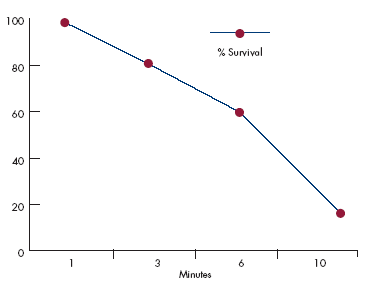
The key word in each of these links is ‘early’, because if any them is not provided in a timely manner, the chances of survival are reduced. Of these, defibrillation is said to have had the greatest impact on survivals from cardiac arrest over the last 30 years. For early defibrillation to be effective, the other two links – early access and early CPR – should be carried out promptly and effectively. Survival in cases of VF cardiac arrest decreases at the rate of 7 to 10 per cent for each minute of delay in instituting definitive resuscitative measures. Correct and efficient administration of CPR helps to extend the survival time somewhat, but does not negate the need for early defibrillation.
History of Defibrillation in Singapore
The first pilot programme in Singapore on the use of automated external defibrillators (AEDs) was with two defibrillators in the emergency ambulances of the Singapore Civil Defence Force (SCDF) in 1989. The first successful defibrillation occurred within two weeks of the start of the programme in a 37-year-old man who suffered a cardiac arrest after being electrocuted. The fast-thinking SCDF ambulance officer responded quickly and administered the shocks that saved this young man’s life. This patient was discharged alive and well from hospital a few days later. Because of consistent successes over the next few years, the programme was extended to all ambulances of the SCDF in 1994.Since then some groups in Singapore have installed AEDs at their premises,including Singapore Airlines, which today has one AED on each flight. The proportion of lives saved (based on figures of the SCDF Heartsave programme) has increased from almost nil in the pre-1989 era to about 4.5 percent. Defibrillation of the bulk of our outof-hospital cardiac arrest victims often reaches the bulk of the victims too late for benefit.
In 1999, the National Resuscitation Council was set up with the support of the Ministry of Health to aid the practice of CPR and similar resuscitative skills in the country. The council was able to draw up and release the first national guidelines on defibrillation in 2001.
International Success Stories for AEDs
The challenge for us is to improve the survival rate of cardiac arrest victims in our country. Other communities have done so effectively. Chicago O’Hare Airport, after implementing an AED programme, which included locating AEDs in the public concourse areas at roughly one-minute intervals, and training all their ground staff in the skills of CPR and AED use, has been able to demonstrate survival rates in the region of 60 per cent. A similar programme in the casinos of Las Vegas, which saw the training of their bouncers in these skills and the availability of AEDs, resulted in a survival rate of about 72 per cent. The communities of King County (Seattle), Rochester (Minnesota) and Gothenburg, Sweden have demonstrated survival rates in excess of 30 per cent as a result of very active public CPR programmes combined with easy availability of AEDs, usually within the first four minutes of collapse. In addition to these, public access defibrillation programmes in certain communities in the US have been able to demonstrate at least a doubling of survival rates.
Just a decade ago, the common feedback that it would be expensive to implement an AED program in Singapore had some merit. Then, such defibrillators would have cost at lest $10,000 per unit. Since then, however, with further miniaturisation of these gadgets, and their more ready availability, costs have spiralled downwards to between $2000 and $5000 per unit. In addition to this basic cost, there is an average cost of $20 to $70 per pair of defibrillator pads and about $300 to $500 for each AED battery. The average life expectancy of an AED battery would be two years.
Low Survival Rates in Singapore
The generally low survival rates in Singapore may be attributed to the following factors:
- Low public take-up rate of CPR training in the community. Even though about 30,000 people are trained annually in various forms of CPR, the by-stander CPR rate in the community is only about 25 per cent.
- Poor penetration of AEDs in the community. Only a few areas are covered by AEDs: SCDF ambulances, a handful of GPs, SCDF fire engines and camps, military camps, a few police units and a few private establishments. Generally, in areas where collapses from heart attacks occur, AEDs are rarely available within the first few minutes of collapse.
- An average reaction time of three minutes after onset of collapse and before any attempt at either calling for help or initiating CPR is undertaken. Knowing this, we can expect that, on average, we have already lost a 30 per cent chance of survival at the time the ambulance is called for. We are thus beginning from a reduced chance of success.Communities such as Las Vegas and Chicago O'Hare airport would have already responded within that time period and initiated defibrillation.
- An average time of eight to ten minutes from time of call to arrival of an emergency ambulance. Ambulances are generally quick off the mark and out of their stations within one minute of activation. This delay is due to traffic between the station and the patient, and,since more than 80 per cent of the population live and work in high-rise buildings, it takes a few additional minutes to reach the appropriate floor and locate the patient.
Action Needed
Early use of AEDs in the initial phase of VF can be life-saving if done in conjunction with early and efficient CPR. The key to saving the lives of a large proportion of the patients who currently collapse and die from heart attacks is to get the defibrillator to the patient in the shortest possible time, preferably within the first minute or two after collapse. This can only be achieved by getting various organisations and communities to obtain AEDs, making them easily accessible to trained users, and also training them in the skill of CPR. AED costs have decreased tremendously over the last decade. Users may be healthcare workers and trained lay people. It does not take more than four hours to train someone in the skills of both CPR and AED use. What is required today is the political will of individuals and community organisations to do their bit and be prepared to save a life when the need arises. Then, we will be able to make Singapore a safer community for heart disease patients.