
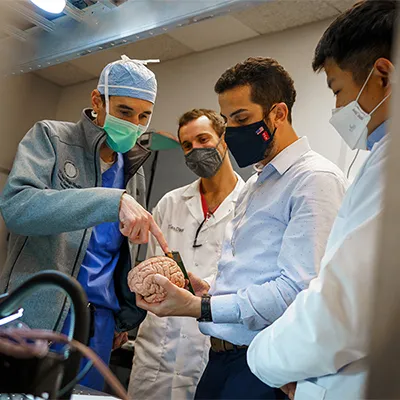
Neurosurgery is a very technological specialty that used to be a challenging frontier of medicine a long time ago. Having its origins with ancient civilizations, nowadays neurosurgery has taken a place at the cross of invention, accuracy, and overall patient care. Surgery on the brain whether it is brain tumor or spine tumor or the disorder of your vascular disorder or functional neurological defects, is a broad scale of life changing procedures. The current developments in neuroimaging, robotics, artificial intelligence (AI), and minimally invasive procedures are not only transforming the surgical practice; they are also revising the patient outcomes and quality of life.
This article takes a closer look at novel technologies that drive neurosurgery to the next level, the changing nature of neurosurgery, and the paradigm shift in the patient care field to the contemporary health care system.
The Evolution of Neurosurgery: From Craniotomy to Robotic-Assisted Procedures
Neurosurgery in the past was riddled with crude equipment, little knowledge of the anatomy of the brain and the likelihood of morbidity was enormous. Real-time imaging, computer-based navigation, and precision-guided instrumentation are the default features behind the area today. The adoption of conceptual changes of open craniotomy to endoscopic and robotic aided surgical processes has literally cut down surgical trauma and recovery time.
Stereotactic surgery, a 3D coordinate based technique to identify targets in the brain with great accuracy is one of the greatest achievements in the path. Combined with intraoperative MRI and CT scanning, these allow the surgeon to perform with a microscope-like accuracy of harm incurred by collateral damage, improved post surgery outcomes.
The other step is the robotic-assisted neurosurgery. ROSA, Mazor X, renaissance system are some robots, which can help with dexterity, stability, and access to inaccessible lesions.
It not only enhances the accuracy of surgical tasks but also decreases the error rate during the surgery hence safer practices with reduced hospital association.
Neurosurgical procedures and their developments
1. Tumor Resection (Craniotomy and Endoscopic Approaches)
The presence of tumors; both malignant ones and benign ones in the brain, and in the spine, is one of the greatest indications of neurosurgical treatment. Conventional open craniotomies are being augmented with minimally invasive endoscopic procedures that enable the removal of the tumour using small cuts. With help of high-definition cameras, the use of tubular retractors and real-time navigation, the surgeons can reach deeply located tumors causing minimal disturbance to the healthy tissues.
An additional property is that 5-ALA (5-aminolevulinic acid)-based fluorescent guided surgery helps visualize tumors better so that it is possible to remove the entire tumor without damaging the functional organs.
2. Functional Neurosurgery (DBS and Ablation Techniques)
Neurosurgery Functional Neurosurgery treats movement disorders including Parkinson disease, tremor, dystonia and even some mental illnesses. The Deep Brain Stimulation (DBS) has become a breakthrough in which small electrodes are placed in specific brain areas and linked to a pulse box to regulate distorted activity.
More recent developments are systems that are able to alter the level of stimulation according to the neural feedback in real time (adaptive DBS (aDBS)). In like manner, MR-guided focused ultrasound (MRgFUS) can provide an effective non-invasive solution to conventional tremor-controlling ablation treatment.
3. Spinal Neurosurgery
Spinal disorder is treated using decompression, fusion with instrumentation treatment combination. Some of the innovations like the minimally invasive surgery on spine (MISS) and robotic supported spinal instrumentation have radically minimized post-operative complications.
Biomechanical outcomes are also being improved with artificial disc replacement and 3D-printed spinal implants which increase mobility and quality of life.
4. Vascular Neurosurgery
The intricate vascular interventions are necessary to treat aneurysms, arteriovenous malformations (AVMs), and the conditions of stroke. Endovascular coiling and microsurgical clipping have been the long holders but flow diverters, embolization, and stent-assisted procedures are fast catching up.
State-of-art angiographic suites that can obtain 3D rotational imaging now provides extensive planning capability before operations, as well as real-time intraoperative navigation, which ensure more safe and effective procedures.
Innovations Transforming Neurosurgical Practice
1. Artificial Intelligence (AI) and Machine Learning
The diagnostic tools are changing the preoperative planning and outcome predictions using AI. The ability to discover subtle imaging biomarkers that can be used to detect the presence of tumor, risk of stroke or degeneration of the brain early has now been enabled by the use of algorithms that have been trained on extensive datasets.
AI can be used intraoperatively to help with real-time picture segmentation, navigation path planning, and even robots. Another way that predictive analytics may benefit is the ability to individualize the treatment process due to the personal data of a patient, maximizing the effect.
2. Augmented and Virtual Reality (AR/VR)
Training and surgery currently incorporate AR and VR technologies. VR is used with neurosurgeons who can practice complicated procedures before conducting them in reality, and AR overlays offer real-time navigation and anatomical imagery to help visualization under anaesthesia.
An example of this is that surgeons with the help of AR glasses can see beyond tissues to vital blood vessels or the edge of a tumor - in effect a surgical GPS.
3. Neuro-Navigation and Intraoperative Imaging
Now modern operating rooms already have a neuro-navigation system, according to which they work like GPS in the brain to localize in the sub-millimeter and help surgeons find the way out by using the system. These systems when coupled with intraoperative MRI and CT help to ensure that tumor resections are complete and that there is no damage to the critical areas.
Real-time tissue distinction is also provided by intraoperative ultrasound and fluorescing agents to eliminate the danger of residual pathology.
4. 3D Printing and Bioprinting
CT /MRI based patient-specific 3D models help in personalizing the surgical planning of patients and helps in personalizing the design of the implants. The surgeons are able to practice operations on the copy of anatomy, predict difficulties and adjust tools or implants to them.
In addition to that, bioprinting technologies are under development that aim to regenerate neural tissues and create complex vascularized constructs and open a new wave of neuroregeneration.
The Shift in Patient-Centric Neurosurgical Care
1. Multidisciplinary Treatment Models
Neurosurgical care is also becoming teamwork. Neurosurgeons liaise with neurologists, radiologists, oncologists, rehabilitation therapists and psychologists to develop a complete care continuum. The model guarantees an all-round treatment- diagnosing, surgery, recovery and follow-ups on a prolonged basis.
Examples of multidisciplinary arrangements that are designed to assist clinical decision-making and improve patient outcomes are neurovascular teams and tumor boards, as well as functional disorder units.
2. Enhanced Recovery after Surgery (ERAS) Protocols
ERAS practices are targeted at the best perioperative experience. They include prehabilitation, nutrition optimization, and minimal invasive surgery, opioid-sparing anesthetic, and early-mobility approaches. These protocols decrease the length of stay of the hospital, post-operative pain and rate of complication with increased rate of functional recovery.
3. Telemedicine and Remote Monitoring
In particular, due to COVID, telemedicine has become the standard mode of preoperative consultation, postoperative follow-ups, and second opinion. These tools such as mobile based motor assessment and wearable EEGs have provided neurosurgeons with important information on patient recovery and progression of symptoms without hospital visits.
4. Neurorehabilitation and Quality of Life
Nevertheless, post-surgical care no longer implies merely a bodily recovery, but it covers the cognitive, emotional and social recovery. The rehabilitation hospitals specialize in treating disorders of the nervous system and have programs that are personalized depending on the aspect of the nervous system that is affected such as programs dealing with physical therapy, speech therapy, occupation therapy and neuropsychological treatment. Recovery of independence and the improvement of global quality of life (QoL) of recipients of complex neurosurgery are important roles that this type of intervention should play.
Ethical, Regulatory, and Future Perspectives
The improved neurosurgical technology comes with a series of ethical dilemmas in particular, improvement of brain-computer interfaces, the insertion of neural implants, and the application of AI-coordinated treatment. The issue of informed consent has been raised particularly among cognitively impaired patients and the long-term effects amongst neuro-enhancement technologies that have drawn a lot of debate.
These innovations have to be met through regulatory structures that guarantee patient security without hampering development. Coincidentally, the demand to be more accessible would be as essential, particularly in poor-resource contexts. Efforts to provide cost-effective neurosurgical services via mobile, teleconsultation and transportable imaging equipment are just starting to fill this gap.
The prospective of connectomics (mapping of brain networks), personalized genomics and stem cell-based regenerative neurosurgery using stem cells and neural scaffolds promise to transform the paradigm of treatment. Its end objective is still not just prolonging life but ensuring that this life is made better using safe, effective and humane neurosurgical services.
Conclusion
Neurosurgery which was categorized as a risky field has become a very precise, innovative and patient-oriented field. Be it the generation of reconstructive plastic surgeons or complex neuro-vascular malformations or spine degenerative diseases, neurosurgeons are in practice hand in hand with high technology and the sharp clinical expertise.
The path that brought the open brain surgery to the opportunities of the AI-assisted robotics and virtual planning illustrates not only technological progress but also a long-term tradition of trying to make human life better. With further transformation of the field, the theme about fair access, life-long education, and ethical integrity should be placed at the center of attention - making this miracle of contemporary neurosurgery accessible to anyone who requires the practice.