
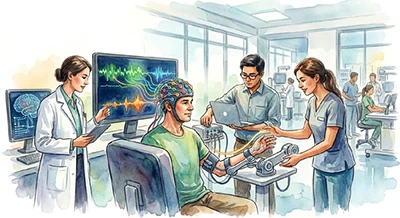
The Expanding Rehabilitation Challenge in Asia
Stroke has become one of the defining neurological health challenges of the twenty-first century, and nowhere is this more evident than across Asia. As survival rates improve due to advances in acute stroke care, a rapidly expanding population of survivors now requires sustained neurorehabilitation. This article argues that the next generation of stroke rehabilitation in Asia will be driven by predictive neuromodulation platforms that integrate EMG intent-decoding, adaptive Functional Electrical Stimulation, and augmented reality–based sensorimotor environments.
The region carries a substantial share of the global stroke burden, driven by large populations, rapidly aging societies, and the increasing prevalence of vascular risk factors such as hypertension, diabetes, and sedentary lifestyles. Epidemiological research shows that stroke incidence across Asian countries ranges from approximately 116 to 483 cases per 100,000 people annually, reflecting one of the highest regional burdens of cerebrovascular disease worldwide. Analyses from the Global Burden of Disease Study further confirm that stroke remains among the leading causes of death and disability across the region. Recent studies also indicate that ischemic stroke incidence among adults aged 15 to 49 in Asia has increased substantially over the past three decades, highlighting the growing impact of neurological disability among working-age populations.
This epidemiological shift is creating intense pressure on rehabilitation systems. Hospitals and rehabilitation centers must deliver effective therapy to a growing population of stroke survivors while operating within constrained clinical workforces. The World Health Organisation estimates that more than half of people worldwide who require rehabilitation services do not receive adequate care, with the largest gaps occurring in low- and middle-income regions.
These structural limitations are driving interest in technologies capable of scaling rehabilitation delivery while preserving clinical quality and patient engagement. Computational neuromodulation platforms that interpret electrophysiological signals and dynamically adapt therapy are emerging as a promising response to this challenge.
Limitations of Conventional Neuromuscular Stimulation
Neuromuscular Electrical Stimulation and Functional Electrical Stimulation have long been used to support recovery following neurological injury. These technologies activate peripheral motor nerves through controlled electrical impulses, allowing weakened or paralysed muscles to contract and assist functional movement. In stroke rehabilitation, electrical stimulation is frequently applied to restore gait patterns, hand function, and other motor activities.
Despite their clinical value, most conventional stimulation systems operate using fixed stimulation parameters. Pulse amplitude, frequency, and timing are typically configured at the beginning of a therapy session and remain largely unchanged during treatment. Even systems incorporating electromyographic triggering often rely on static activation thresholds.
This design presents several limitations in neurological rehabilitation. Surface electromyographic signals are frequently weak during early recovery stages, particularly following severe stroke. When EMG signals fail to exceed predefined thresholds, stimulation is not triggered, preventing the system from reinforcing the patient’s attempted movement.
These limitations have motivated the development of adaptive rehabilitation systems capable of interpreting neuromotor signals and dynamically adjusting therapy in real time. These constraints are especially pronounced across many Asian healthcare systems, where therapist-to-patient ratios are low, and access to specialised neurorehabilitation expertise varies widely between urban and rural areas. Static stimulation systems require continuous manual oversight, making them difficult to deploy at scale in settings with limited rehabilitation staff. This further underscores the need for intelligent, adaptive stimulation architectures capable of operating reliably in resource-constrained environments.
Emergence of AI-Driven Neuroadaptive Rehabilitation
Recent advances in artificial intelligence, electrophysiological sensing, and real-time signal processing have enabled the development of neuroadaptive rehabilitation platforms. These systems combine surface electromyography sensors, machine learning algorithms, and closed-loop stimulation architectures to create an interactive relationship between patient effort and therapeutic neuromodulation.
Surface EMG sensors detect electrical potentials produced by motor unit activation within skeletal muscle. These signals represent the peripheral expression of neural commands originating from cortical motor planning and descending motor pathways. Although EMG signals are often low amplitude and susceptible to noise, modern computational pipelines enable meaningful neuromotor patterns to be extracted in real time.
Machine learning models analyse EMG signals during therapy sessions to estimate whether activity corresponds to voluntary motor intent. When intent is detected, stimulation parameters can be adjusted dynamically to assist the attempted movement. This closed-loop interaction allows electrical stimulation to reinforce voluntary neural activity rather than replace it. Synchronising neuromodulation with the patient’s own motor intent strengthens neural circuits responsible for voluntary movement and supports more effective motor relearning.
Early clinical research has shown that EMG triggered FES can enhance upper-limb recovery compared with passive stimulation, particularly when stimulation is synchronised with voluntary effort. Similarly, pilot studies on adaptive closed-loop FES systems demonstrate improvements in task engagement, muscle activation patterns, and motor relearning compared to fixed-parameter stimulation. While predictive intent-decoding is still emerging, initial feasibility studies suggest that anticipatory EMG patterns can be detected reliably enough to guide timing-sensitive neuromodulation.
EMG Signal Intelligence and Motor Intent Detection
Interpreting surface electromyographic signals requires advanced computational analysis. EMG recordings contain complex interference patterns generated by the combined activity of multiple motor units within the muscle. Signal characteristics are influenced by electrode placement, tissue conductivity, movement artefacts, and environmental electrical noise.
Modern EMG analysis pipelines use signal conditioning to remove artifacts, extract features such as amplitude and spectral characteristics, and apply machine learning classifiers to determine whether the signal reflects voluntary motor activation.
As therapy progresses, longitudinal datasets allow algorithms to learn patient-specific neuromotor signatures. Adaptive learning models continuously recalibrate detection parameters based on observed performance trends. This enables the system to remain sensitive to motor intent even when EMG signals remain weak or inconsistent.
Augmented Reality and Sensorimotor Reinforcement
Augmented reality enhances motor learning by strengthening visual-proprioceptive integration and providing real-time error feedback essential for cortical remapping. Visual dominance in human motor learning means that enriched AR cues can accelerate corrective motor strategies, while reward-based progression mechanics increase motivation and repetition volume - two critical drivers of neuroplasticity. Compared with 2D screens, AR environments provide spatially anchored feedback that more closely mimics real-world movement conditions.
Motor learning depends strongly on multisensory feedback mechanisms. Visual feedback helps reinforce neural pathways responsible for coordinated movement and improves the patient’s understanding of task objectives. Augmented reality environments enable patients to observe their attempted movements in real time while interacting with visually guided therapeutic tasks.
When combined with EMG-driven neuromodulation, augmented reality environments activate multiple neural pathways simultaneously. Patients receive visual reinforcement of movement goals, electrophysiological biofeedback from EMG signals, and assisted muscle activation through electrical stimulation. This multimodal feedback loop strengthens sensorimotor integration and may accelerate neuroplastic adaptation.
In many Asian countries, rising rehabilitation demand coincides with rapid digital adoption and widespread availability of AR-capable devices, enabling scalable delivery of visually guided therapy even outside specialised rehabilitation centers.
For healthcare systems where therapist availability is limited, immersive rehabilitation environments also provide operational advantages. Interactive therapy platforms can sustain patient engagement while reducing the need for constant therapist supervision, enabling hospitals to deliver higher therapy intensity using existing clinical staff.
Toward Predictive Neuromodulation
The next stage in neurorehabilitation technology involves predictive neuromodulation architectures capable of identifying motor intent before substantial muscle activation occurs. Machine learning models trained on longitudinal neuromotor datasets can detect subtle electrophysiological patterns that precede voluntary movement attempts.
Predictive stimulation systems synchronise neuromodulation with early signals of motor planning, reinforcing the natural timing of voluntary movement and strengthening neural pathways responsible for motor control.
Intent decoding architectures rely on continuous monitoring of EMG activity across repeated therapy sessions. As datasets expand, machine-learning models refine their understanding of each patient’s unique neuromotor patterns. Over time, the system becomes increasingly capable of anticipating movement attempts and delivering stimulation at the optimal neurophysiological moment.
This transition from reactive stimulation toward predictive neuromodulation represents a fundamental shift in rehabilitation technology. Instead of merely assisting movement after it occurs, intelligent systems begin to interact directly with the neural processes responsible for initiating movement.
For Asia, where rehabilitation access can vary dramatically by geography, predictive neuromodulation platforms offer a pathway toward standardised, high-intensity therapy that can be delivered across distributed networks. Early intent detection reduces dependence on therapist intervention and supports semi-autonomous therapy models suitable for both large urban hospitals and smaller regional centers.
Implications for Healthcare Systems in Asia
The rising neurological disease burden across Asia requires scalable and efficient rehabilitation strategies. Hospitals must deliver high-quality therapy to growing patient populations while operating within constrained clinical workforces.
Intelligent rehabilitation platforms provide a pathway toward more efficient care delivery. By integrating EMG analytics, adaptive neuromodulation, and immersive therapy environments, these systems enable personalised rehabilitation without requiring continuous manual parameter adjustments by clinicians.
Digital rehabilitation platforms also generate continuous physiological datasets that support objective outcome measurement. Clinicians can analyse patient progress across sessions, identify recovery trajectories, and refine therapy programs using data-driven insights.
Hybrid rehabilitation models that combine hospital-based therapy with supervised home-based training are also becoming increasingly feasible. Remote monitoring systems allow clinicians to track therapy adherence and performance while expanding rehabilitation access beyond hospital environments.
For many countries across Asia, distributed rehabilitation networks supported by intelligent therapy platforms may become essential for addressing the growing demand for neurological recovery services.
Future Outlook
By combining EMG signal intelligence, adaptive neuromodulation, and augmented reality-based sensorimotor training, these systems transform rehabilitation into a responsive interaction between patient and technology. As predictive neuromodulation models continue to evolve, rehabilitation platforms may increasingly support restoration of voluntary movement by reinforcing the brain’s natural motor control mechanisms.
For Asian healthcare systems facing rapid demographic aging and widening rehabilitation demand, predictive neuromodulation platforms represent not only a technological advance but also a structural solution. By combining intent decoding, adaptive stimulation, and immersive environments, these systems create the foundation for distributed rehabilitation networks capable of maintaining therapeutic intensity at scale. Asia’s rehabilitation burden makes the region uniquely positioned to pioneer these architectures and define a global blueprint for next generation neurorehabilitation.
References
1. Venketasubramanian N, Yoon BW, Pandian J, Navarro JC. Stroke epidemiology in Asia. Cerebrovasc Dis Extra. 2017;7(1):17-22.
2. Han Z, Liu T, Wang S, Sun W, Qiao W. The burden of ischemic stroke among people aged 15-49 years in Asia, 1990-2021. Neurol Sci. 2025.
3. GBD 2021 Stroke Risk Factor Collaborators. Global, regional, and national burden of stroke and its risk factors, 1990-2021. Lancet Neurol. 2023;22(7):627-647.
4. Cieza A, Causey K, Kamenov K, Hanson S, Chatterji S, Vos T. Global estimates of the need for rehabilitation based on the Global Burden of Disease study. Lancet. 2020;396(10267):2006-2017.