
The AI Revolution in Middle Eastern Healthcare
AI, machine learning, and data analytics are transforming global healthcare, enabling automation of routine tasks, personalized treatment, and predictive insights. In the Middle East, nations like the UAE and Saudi Arabia are spearheading adoption through national strategies (e.g., UAE AI Strategy 2031) and sovereign investments. These initiatives mark a shift in regional healthcare economics and policy frameworks.
Economic Landscape: Macro Gains and National Strategies
According to PwC, AI is expected to contribute US$320 billion to Middle Eastern economies by 2030 , 2% of global AI gains, with Saudi Arabia and UAE benefitting most: approximately US $135.2 billion and ~14% of GDP, respectively. This broad economic impact supports healthcare system modernization and cost containment.

AI Economic Impacts in Healthcare Facilities
Operational Cost Reduction & Productivity
AI-driven tools like workflow automation, clinical-administrative robotics, and intelligent scheduling can lower labor costs and enhance bed utilization—resulting in system-wide savings and faster throughput. In GCC hospitals, these applications reduce inefficiencies and free up clinical staff to focus on higher-value work.
Diagnostic Precision & Error Reduction
AI-powered imaging diagnostics (e.g. radiology for cancer detection) significantly decrease misreads. These improvements lead to earlier interventions, lower morbidity, and financial savings in high-cost cases.
Remote Monitoring and Chronic Disease Management
AI systems integrating wearables and sensors enable remote patient monitoring, improving management of conditions like diabetes or cardiovascular disease, and reducing avoidable hospital visits and readmissions.

Market Insights: Applied AI in the Region
Precision Health & Analytics
The Middle East is witnessing a growing investment in precision health driven by the increasing demand for personalized care and early disease detection. AI-powered analytics enable deeper population health insights and predictive risk modeling, improving outcomes while reducing costs. Governments are supporting data-driven strategies through national genomics and health data initiatives. This shift is transforming care models from reactive to preventive, enhancing overall healthcare efficiency.
Healthcare‑Grade AI Solutions
Adoption of healthcare-grade AI is accelerating across hospitals and health systems in the region, particularly in diagnostics, radiology, and clinical decision support. These AI tools meet rigorous standards for safety, accuracy, and regulatory compliance, making them viable for frontline use. As digital maturity improves, healthcare providers are integrating AI into daily workflows to increase productivity and reduce human error. This integration is paving the way for scalable, value-based care delivery.
Case Examples from GCC Facilities
Robotic Medicine & Genomics
A leading hospital in the Gulf area successfully performed a complex organ transplant using robotic-assisted surgical technology, marking a significant milestone in minimally invasive procedures in the region. The operation resulted in reduced blood loss, shorter hospital stay, and faster patient recovery compared to traditional methods. This case highlights the region’s growing adoption of advanced surgical robotics to enhance precision and patient outcomes.
Regional Digital Health Platforms
Several Platforms in the region successfully implemented (AI voice-transcription, vitals via camera) demonstrate scalable telehealth with immediate resource savings and expanded access, which served a lot of cost & time specially these technologies don’t depend on user experience & much scalable for the utilization of any bandwidth for the data transmission.
Challenges to Economic Realization
Regulatory & Governance Frameworks
GCC countries typically follow “soft regulation” ethics guidelines rather than binding law. As AI scales across healthcare, there is increasing momentum for robust regulatory frameworks in line with global standards.
Data Quality, Infrastructure & Talent
Successful AI deployment demands high-quality, interoperable data, strong digital infrastructure, and skilled professionals—areas where many regional facilities still lag.

Policy & Operational Recommendations
1. Invest in Data Architecture: Build national EHRs, secure data lakes, and API-based interoperability to support AI use and efficiency.
2. Strengthen Regulation: Harmonize GCC-wide ethical and data protection standards using frameworks such as WHO’s AI guidance.
3. Develop Talent: Scale up regional AI education, promote regional centers of excellence and adopt public‑private training schemes.
4. Pilot and Scale: Start with high-impact applications such as chronic disease monitoring and robotics then expand to system-wide use.
5. Measure & Monetize Value: Healthcare facilities should quantify efficiency gains (e.g., cost per visit, diagnosis speed) to support ROI cases.
Regional Use Cases for the AI Deployment
AI-driven solutions from diagnostic imaging in radiology and AI-enabled triage in emergency care to predictive analytics in chronic disease management are now integral to major Middle Eastern Hospitals. These deployments not only streamline workflows and enhance patient outcomes but also advance national agendas such as Saudi Vision 2030 by fostering a data-driven, preventive, and value-based health ecosystem. As regional investment in digital health and AI continues to rise, healthcare systems across the Gulf are poised for sustained economic and operational transformation.
Use Case #1 (Clinical Research Hospital)
Implementing AI in radiology, genomics, clinical decision support, and capacity management, reducing turnaround times and enhancing diagnostics through its Healthcare Intelligence Centre
Use Case #2 (Governmental Hospital)
Utilizes AI-driven patient flow optimization through tools like the Virtual Command Center and adaptive AI-powered radiotherapy systems.
Use Case #3 (University Hospital)
While specific AI initiatives are less widely published, one of the hospitals was known for employing AI in emergency triage and diagnostics as part of their innovation agenda, like other Gulf tertiary centers.
Use Case #4 (Medical City)
Launched digital operating theatres with robotic surgery and interventional radiology as part of its 2025 digital transformation.
Use Case #5 (Private Hospital)
Deploys AI for pediatric genomics, rare disease analysis, precision medicine, and AI-led masterclasses in bioinformatics and generative AI.
Use Case #6 (Private University Hospital)
It Known regionally as a “digital hospital,” it integrates AI into electronic health records, diagnostics, and patient monitoring consistent with digital transformation trends across advanced UAE facilities.
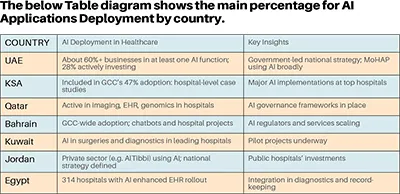
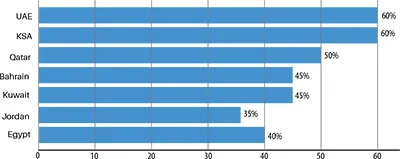
Major Deployments for Healthcare AI Applications in the Middle East countries ranked respectively
Key Strengths in AI Healthcare Adoption for Middle East Countries:
United Arab Emirates (UAE) - National AI strategy, hospital systems, LLMs
• Pioneer in AI with a dedicated Minister of AI since 2017.
• Hosts AI-driven smart hospitals (e.g., SEHA, PureHealth).
• Leading telehealth, robotics-assisted surgery, and predictive analytics.
Saudi Arabia (KSA) - Vision 2030, AI clinics, public health digitization
• Major AI push under Vision 2030.
• Opened the first AI doctor clinic (May 2025).
• AI used in radiology, EHRs, and national health data registries (NPHIES).
• Expected to gain $ 135 billion in AI value by 2030.
Qatar - Genomics, diagnostics, national initiatives
• Strong investments in precision medicine and AI genomics (Qatar Genome Program).
• Institutions like Sidra Medicine use AI in pediatric diagnostics and imaging.
• AI embedded in research hospitals and national health strategy.
Bahrain - AI in triage, startup-friendly regulations
• Investing in AI and telemedicine integration.
• Partnering with the private sector to introduce AI triage and hospital automation.
• Focused on regulatory support for digital health startups.
Kuwait - Chronic care AI tools, GCC initiatives
• Member of the GCC digital transformation effort.
• AI used in public health surveillance and primary care digitization.
• Exploring AI in early diagnosis, especially for chronic diseases.
Jordan - AI telehealth, academic innovation
• Home to Altibbi, an AI-driven regional telehealth platform.
• Strong academic sector piloting AI in diagnostics and clinical decision support.
•Gradual integration in public-sector facilities.
Egypt – National Unified Platform & Insurance Program
• Government-led pilots in AI radiology and automated EHR systems.
• Local universities and startups experimenting with AI-enabled platforms.
• Early stages of adoption, mainly through academic–private sector collaboration.
Main Implementations for the AI Application in the Middle East Countries
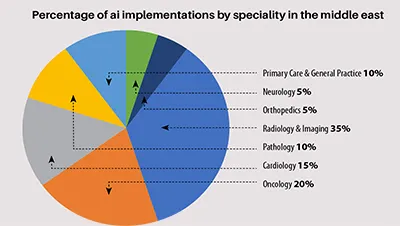
The below diagram shows the main percentage for AI Applications implementations by specialty.
As we observe the maximum concentration would be for the Radiology & Imaging followed by the Oncology, this this is aligned with the above statistics.
Deep use case for KSA
Alignment with Vision 2030: Transforming Saudi Healthcare through AI

Saudi Arabia’s Vision 2030 outlines a comprehensive reform plan to diversify the economy and improve the quality of life for citizens. One of its central pillars is enhancing the efficiency and effectiveness of healthcare services. AI is emerging as a key enabler of this transformation, particularly under the Health Sector Transformation Program (HSTP).
Improving Healthcare Access and Quality
AI solutions such as virtual clinics, robotic diagnostics, and AI-enabled triage systems align directly with Vision 2030’s goals to improve accessibility, patient experience, and clinical outcomes.
Enabling Preventive and Value-Based Care
Vision 2030 emphasizes a shift from reactive to preventive care models. AI supports this by identifying at-risk populations through predictive analytics, enabling early interventions that reduce hospital admissions and costs. Platforms powered by AI also help track non-communicable disease trends, which is crucial in tackling obesity, diabetes, and heart disease three major burdens in the Kingdom.
Building a Thriving Digital Health Sector
AI supports Saudi Arabia’s ambitions to create a thriving digital economy and localize innovation. By investing in AI-based medical startups, local data centers, and training programs (such as the SDAIA’s collaborations with academic institutions), the country fosters homegrown talent and intellectual property in health AI reducing dependency on imported technology and boosting national economic output.
Operational Efficiency in Government Hospitals
AI is also being deployed in government hospitals to automate administrative tasks, optimize workforce allocation, and integrate disparate data systems. These gains contribute directly to Vision 2030’s target of raising hospital operational efficiency by 25%, enhancing resource utilization and lowering the financial burden on the public health system.
In summary, the integration of AI technologies across the Saudi healthcare system is not only a technological advancement but a strategic alignment with Vision 2030’s broader ambitions economic diversification, healthcare excellence, and national innovation leadership.
Conclusion:
Economic Resilience through AI
AI adoption in Middle Eastern healthcare is already generating value from cost savings in diagnostics and care delivery to broader economic gains. With GCC countries projected to claim US $320 billion in AI‑derived benefits by 2030, region-wide healthcare systems must prioritize investment in data, governance, and talent. These strategic actions promise lower costs, improved access, and stronger health outcomes supporting both Vision 2030 goals and sustainable economic development.
References
https://www.iqvia.com/locations/middle-east-and-africa/blogs/2025/04/ai-driven-healthcare-leveraging-multimodal-data-for-precision-health
https://www.gbo.com/en-int/company/preanalytics/digital-preanalytics
https://www.uipath.com/resources/automation-whitepapers/turn-ai-potential-into-ai-results-in-healthcare
https://www.iqvia.com/solutions/innovative-models/artificial-intelligence-and-machine-learning
https://www.pwc.com/m1/en/publications/potential-impact-artificial-intelligence-middle-east.html
https://arxiv.org/abs/2505.02174
https://arxiv.org/abs/2406.08695
https://www.vision2030.gov.sa/en/explore/programs
https://www.pif.gov.sa/en/