The relevance gap in healthcare innovation
Healthcare technology has advanced at a remarkable speed, yet a persistent disconnect remains between what is invented and what improves patient care. Many promising technologies never reach clinical practice, not because the underlying science is flawed, but because the problem they solve was never the problem clinicians most needed solved. This relevance gap represents one of the costliest inefficiencies in modern healthcare innovation.
The reasons are structural. Innovation frequently begins in laboratories, engineering departments or start-up environments where technical feasibility drives the agenda. The question asked is often what a technology can do rather than what the patient or clinician actually needs. When development proceeds without clinical grounding, the result is sophisticated solutions in search of a problem: products that perform impressively in controlled settings but falter in the messy reality of clinical workflows.
Bridging this gap requires positioning clinicians not as end-users consulted late in development, but as partners embedded from the earliest stages of ideation.
Clinicians as identifiers of unmet need
Clinicians occupy a privileged vantage point. Working at the point of care, they witness daily the inefficiencies, diagnostic uncertainties and treatment limitations that define real-world practice. They understand which problems carry the greatest clinical weight, where current tools fail, and what a meaningful improvement would look like in practice.
In critical care medicine, this perspective is particularly acute. Intensive care units generate enormous volumes of data and demand rapid, high-stakes decisions under uncertainty. A clinician working in this environment can distinguish between a technology that produces interesting information and one that genuinely changes a decision at the bedside. That distinction, obvious to the practitioner, is frequently invisible to developers without clinical experience.
Early clinician involvement, therefore, sharpens the focus of innovation. It ensures that development effort concentrates on problems whose solution would deliver tangible value, rather than on technically elegant features that add complexity without improving outcomes. The most successful health technologies tend to originate from a clearly articulated clinical need rather than from a technology seeking application.
From discovery to patient impact: the overlooked journey
A common misconception holds that scientific discovery leads directly and inevitably to patient benefit. In reality, the path from a validated concept to routine clinical use is long, non-linear and littered with obstacles that have little to do with the original science.
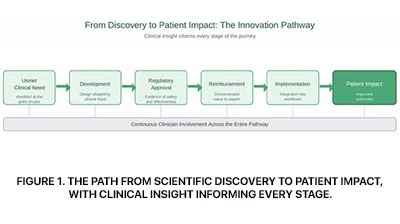
Three challenges dominate this journey:
Regulatory requirements demand rigorous evidence of safety and effectiveness, often through studies designed and interpreted with clinical expertise. A technology developed without anticipating regulatory expectations may require costly redesign, or may generate evidence that fails to convince regulators of clinical relevance.
Reimbursement determines whether a technology is financially viable in practice. A device may be approved and clinically useful yet still fail if health systems will not pay for it. Demonstrating value to payers requires evidence framed around clinical and economic outcomes that matter to decision-makers, evidence that clinicians are well placed to define.
Implementation is frequently the most underestimated barrier. A technology must integrate into existing workflows, fit the realities of staffing and training, and earn the trust of the professionals expected to use it. Many innovations stall at this stage because they were never designed with the operational realities of clinical environments in mind.
Each of these stages benefits from clinical insight. A development strategy that anticipates regulatory, reimbursement and implementation demands from the outset is far more likely to translate discovery into impact than one that treats them as afterthoughts.
The diagnostics example
Diagnostic technology illustrates these principles clearly. A novel diagnostic test must do more than detect a biomarker accurately. To be useful, it must answer a question clinicians are actually asking, deliver results within a clinically actionable timeframe, and produce information that changes management.
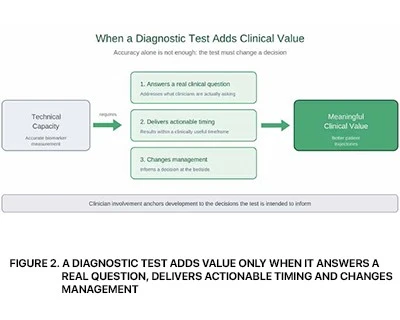
Consider the challenge of identifying serious infection early. The scientific capacity to measure relevant biological signals may exist, though translating that capacity into a tool that improves outcomes requires clinical judgement at every step: defining the population in which the test adds value, establishing the decision threshold, determining how results integrate with existing assessments, and demonstrating that earlier or more accurate diagnosis genuinely improves patient trajectories.
Without clinician involvement, a diagnostic risk measures something measurable rather than something meaningful. With it, development is anchored to the clinical decisions the test is intended to inform.
Building effective collaboration
If clinician involvement is essential, the practical question becomes how to structure collaboration that works. An effective partnership between clinicians, engineers, entrepreneurs and industry depends on several conditions.
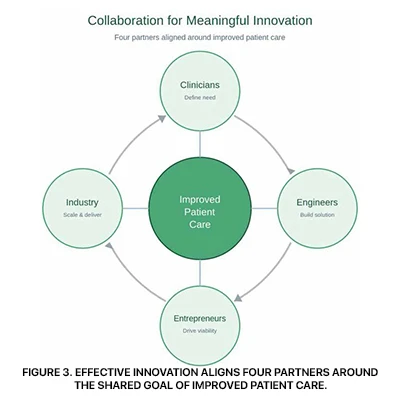
Shared language and mutual respect. Clinicians and engineers approach problems differently, and productive collaboration requires each to understand the other's constraints and priorities. Clinicians must appreciate technical limitations and development timelines; technical teams must grasp clinical realities and the consequences of design choices for patient care.
Involvement from the outset. Consulting clinicians only to validate a near-finished product wastes their most valuable contribution. Their insight is most powerful at the stage of problem definition, when fundamental decisions about what to build are still open.
Sustained engagement. Clinical input should not be a single consultation but a continuous dialogue throughout development, testing and refinement, allowing the technology to evolve in response to real-world feedback.
Aligned incentives. Healthcare innovation involves stakeholders with differing motivations. Sustainable collaboration requires recognising these differences and aligning efforts around the shared goal of improved patient care.
Innovation programmes that deliberately bring clinicians, technologists and commercial partners together have shown that structured collaboration accelerates the development of relevant solutions. Such programmes work because they institutionalise the dialogue that ad hoc development leaves to chance.
The role of clinician-innovators
A distinct and growing contribution comes from clinicians who step directly into innovation roles. Practitioners who develop the skills to work at the interface of medicine, technology and enterprise can translate between worlds that otherwise struggle to communicate. They carry clinical credibility into technical discussions and technical understanding back into clinical settings.
This dual fluency is increasingly valuable. As healthcare technologies grow more complex, the ability to bridge disciplines becomes a critical asset. Encouraging and supporting clinicians who wish to engage in innovation, through training, protected time and recognition, strengthens the entire ecosystem.
For Asian health systems experiencing rapid expansion in healthcare infrastructure and digital adoption, cultivating clinician-innovators offers a particular opportunity. Solutions developed with local clinical input are more likely to fit local needs, workflows and resource realities than technologies imported without adaptation.
Implications for the region
The argument for clinician involvement carries specific weight across Asia's diverse healthcare landscape. The region encompasses systems at very different stages of development, from highly advanced urban centres to resource-constrained rural settings. Technologies designed without attention to these realities risk widening rather than narrowing gaps in care.
Embedding clinicians in innovation helps ensure that new technologies are appropriate to the contexts in which they will be deployed. It also supports the development of homegrown solutions tailored to regional disease patterns, health system structures and patient populations. As investment in health technology across Asia accelerates, prioritising clinical relevance over technical novelty will determine which innovations deliver lasting value.
Health systems, academic institutions and industry can act on this by creating formal mechanisms for clinical engagement: advisory roles in development, clinician-led innovation hubs, and partnerships that bring practitioners into the earliest stages of design. Such structures convert the principle of clinician involvement into routine practice.
Conclusion
Healthcare innovation succeeds when it solves problems that matter, in ways that work within the realities of clinical care. Clinicians are uniquely positioned to identify those problems, shape solutions, and guide technologies through the complex journey from discovery to bedside. Their involvement is not a courtesy or a final checkpoint but a foundational requirement for innovation that improves lives.
The most meaningful advances will come not from technology developed in isolation, nor from clinical need expressed without technical means to address it, but from genuine collaboration in which clinicians, engineers, entrepreneurs and industry work as partners. Building the structures, incentives and culture that support this collaboration is among the most important tasks facing healthcare innovation today, and one in which the Asian region has much to gain by leading.
References
1. Asch DA, Terwiesch C, Mahoney KB, Rosin R. Insourcing health care innovation. N Engl J Med. 2014;370(19):1775-1777.
2. Greenhalgh T, et al. Beyond adoption: a framework for theorising and evaluating non-adoption, abandonment, and challenges to scale-up of health technologies. J Med Internet Res. 2017;19(11):e367.
3. Herzlinger RE. Why innovation in health care is so hard. Harvard Business Review. 2006;84(5):58-66.
4. Bates DW, et al. The potential of artificial intelligence to improve patient safety. NPJ Digit Med. 2021;4:54.
Read the full article — it's free
Register with AsianHHM to unlock expert insights, research articles and in-depth industry analysis.