
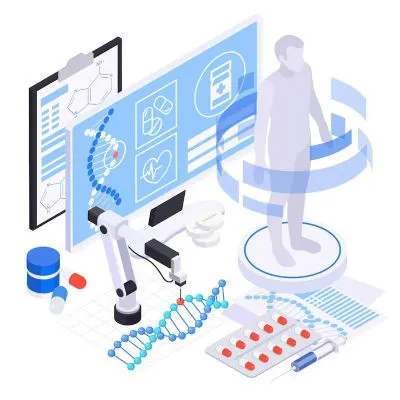
The convergence of AI and medicine is catalysing a paradigm shift in healthcare delivery. Driven by robust data analytics, machine learning algorithms, and generative AI models, healthcare is transitioning from conventional one-size-fits-all approaches to precision, individualised interventions. This article evaluates the transformative impact of AI on precision healthcare, with an emphasis on the utilisation of real-time data to address variability in patient demographics, genetics, and regional health determinants.
The Evolution of AI in Healthcare:
AI's journey in healthcare has evolved through several phases:
1. Early Automation (1950s-1990s): Rule-based systems were used for clinical decision support, but they lacked adaptability.
2. Machine Learning Advancements (2000s-2010s): Statistical modeling and deep learning paved the way for better diagnostics.
3. Modern AI and Precision Medicine (2020s-Present): AI models now process vast datasets in real time, enabling precision diagnostics, personalized treatments, and AI-assisted robotic procedures.
Today, AI is not only assisting physicians in decision-making but is also reducing human error, optimizing healthcare resources, and ensuring that treatments are tailored based on patient-specific data rather than generalized protocols.
Some landmark AI-driven healthcare advancements include:
1. IBM Watson Health :
AI-powered oncology decision-making (Somashekhar et al., 2018).
2. Google’s DeepMind :
AI predicting kidney failure and retinal diseases (De Fauw et al., 2018).
3. AI-assisted robotic surgery :
Improving surgical precision beyond human capabilities (Moustris et al., 2011).
By integrating AI with electronic health records (EHRs) and real-time monitoring systems, healthcare is moving toward data-driven personalized medicine.
Generative AI in Healthcare: The Next Frontier:
Generative AI, a subset of machine learning, is now being leveraged for:
1. Drug Discovery and Development:
Traditional drug discovery takes years, but AI is shortening this timeline by:
• Simulating molecular interactions to identify promising drug candidates.
• Predicting drug toxicity before clinical trials.
• Using AI-generated synthetic datasets to test drug efficacy.
2. AI-Assisted Diagnostics:
AI models are capable of detecting cancers, neurodegenerative disorders, and infectious diseases with higher accuracy than traditional diagnostics.
Generative AI enables AI-powered pathology, where histopathological slides are analyzed for hidden disease markers.
3. AI-Driven Personalized Treatment:
AI analyzes patient data, lifestyle, and genetics to develop custom treatment plans.
AI-driven chatbots and virtual health assistants provide 24/7 monitoring and medication reminders.
4. AI in Medical Imaging:
Generative models reconstruct missing MRI and CT scan data (Schlemper et al., 2018).
5. AI-Powered Chatbots:
Automating preliminary diagnosis and patient triage (Cohen et al., 2020).
Generative AI holds promise in customizing treatment strategies based on genetics, real-time vitals, and environmental factors.
AI-Powered Robotic Surgery: Precision Beyond Human Hands:
AI-driven robotic surgery systems like the da Vinci Surgical System enable microscopic precision, real-time feedback, and enhanced visualization (Yang et al., 2017).
Advantages of AI in Surgery:
• Reduced surgical errors – AI enhances minimally invasive surgeries.
• Real-time AI-assisted navigation – Increases accuracy in complex procedures.
• Improved patient recovery – Less trauma, faster healing.
The future of AI in surgery includes automated robotic procedures, where AI predicts complications and assists surgeons in real-time.
The Role of AI in ICU and Emergency Medicine:
AI plays a crucial role in real-time patient monitoring in ICUs and emergency departments. AI algorithms analyze vital signs, oxygen levels, and early warning scores to detect sepsis, cardiac arrest, and respiratory failure (Luo et al., 2020).
AI Applications in Critical Care:
• Predictive analytics – AI anticipates clinical deterioration.
• Automated ventilator management – AI optimizes oxygen therapy (Ghassemi et al., 2018).
• Sepsis detection – AI flags early warning signs for timely intervention.
By leveraging continuous monitoring, AI improves survival rates and reduces ICU mortality.
Real-Time Data Integration and Heterogeneity
Advancements in data acquisition and processing have enabled the collection of extensive datasets that encompass both homogeneous and heterogeneous information sources. Key data categories include:
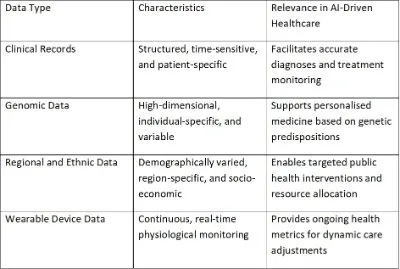
The integration of these datasets enables AI systems to offer comprehensive analyses that reflect the multifaceted nature of human health. Algorithms that process real-time data can identify subtle patterns, predict outcomes, and recommend precise interventions that account for individual differences.
How Generative AI is Revolutionising Data Interpretation:
Generative AI, a recent and rapidly evolving concept, plays a critical role in advancing precision healthcare. By synthesising complex datasets and generating new insights, generative AI enhances decision-making in several ways:
1. Data Augmentation: Generative models can simulate patient data to address imbalances in datasets (needs specific monitoring to have a minimal correctional addendum of such simulation in order to avoid skewing the final values), thus improving the robustness of predictive models.
2. Diagnostic Support: AI-powered systems can propose differential diagnoses by recognising patterns that may be missed by conventional analytic methods.
3. Personalised Treatment Planning: The capability to generate tailored treatment protocols based on patient-specific data has the potential to optimise therapeutic outcomes (most relevant example is in cancer patients).
4. Predictive Analytics: Generative AI enables forecasting of disease progression by simulating various scenarios, thereby informing proactive interventions.
5. These applications underscore the importance of a deep and accurate understanding of AI technologies.
"Ensuring the fidelity of such systems relies on rigorous validation against real-world data and continuous refinement to accommodate emerging patterns."
Future Perspectives and Challenges
While the potential of AI in precision healthcare is substantial, several challenges remain:
1. Data Privacy and Security: The utilisation of real-time, sensitive health data necessitates stringent data governance frameworks to protect patient confidentiality.
2. Interoperability: Seamless integration of diverse data sources is critical. Future efforts must focus on standardising data formats and ensuring interoperability among systems. This along with the focus on ease of usage of individual's datasets via standardised process.
3. Bias and Equity: AI models must be designed to mitigate biases that arise from uneven data representation. Emphasis on region-specific and demographically diverse datasets is essential.
4. Regulatory Compliance: The rapid evolution of AI technologies requires dynamic regulatory frameworks that can keep pace with innovation while ensuring patient safety.
Ongoing collaboration among technologists, clinicians, and regulatory bodies is imperative to address these challenges. Continuous research and innovation will further refine AI tools, paving the way for a future where healthcare delivery is both precise and individualised.
Conclusion
AI is redefining the landscape of healthcare by enabling precision delivery and individualised medicine. The integration of heterogeneous, real-time data—spanning clinical, genomic, and demographic domains—allows for nuanced, tailored interventions that improve patient outcomes. Generative AI stands out as a pivotal technology in this transformation, offering novel approaches to data synthesis, diagnostic accuracy, and personalised treatment planning. Although challenges such as data privacy, interoperability, bias, and regulatory compliance remain, the continued evolution of AI promises a future where healthcare is as unique as the individuals it serves.
Acknowledgements:
All data and insights presented in this article are based on contemporary research and industry developments. Proper acknowledgements have been made to the sources of clinical data, genomic studies, and technological innovations that inform these findings.