


Chatbots Deployment in the Asian Mental Health Sector: Agency and Trust Considerations
Chatbots are now, rather than just the future. These incredible tools are increasingly being used all around the world, particularly in Asia, for various organisational and individual uses. One of the many settings includes the growing use of chatbots in the Asian mental health sector, which is a development relevant for clinics, health systems, hospitals, and other institutions directly providing or serving as conduits to mental health services. However, there are potential barriers. Trust and perceptions of agency are two key factors impacting the continued growth, business effectiveness, and ultimate clinical efficacy of chatbots.
In a recent Academy of Review article, Vanneste and Puranam provide excellent guidance to both academics and practitioners, including those in healthcare, regarding the challenges and opportunities in instilling agency and trust for users towards artificial intelligence. This analysis is particularly applicable to the mental health setting because of the crucial role that consumer/patient trust and their perceptions of chatbot agency play in utilisation. In this brief article, we examine the growing use of chatbots for mental health in Asia and consider the role of trust/agency, particularly in terms of the Vanneste and Puranam analysis, which contains several counter-intuitive ideas.

Chatbots and Trust
What is a chatbot? AI chatbots process input using a language model that analyses context and generates conversational replies. These apps manage chat history, tone, structure, and the user interface to hopefully create an engaging, smooth experience. Some apps use multiple models or extra instructions, so responses can display incredible diversity even with the same underlying technology. Key capabilities include accurately interpreting user intent, conducting coherent and adaptive dialogues, delivering personalised responses, and continuously improving through ongoing interactions. As such, AI chatbots are sophisticated automated communication tools that use natural language processing (NLP), machine learning (ML), and integration with business systems. They accurately interpret intent, maintain adaptive conversations, personalise responses, and improve through continuous interactions. One great feature is that chatbots are typically built with the capability to learn from prior interactions, so, somewhat akin to humans, they can potentially become more effective over time as they gain experience.
In addition to the technological element, chatbot effectiveness has a strong relationship element (i.e., the need for trust between human and machine). Human faith in a chatbot, whether for business transactions, mental health, or various other uses, does depend on trust. The user has to trust that the chatbot is providing accurate, comprehensive, and timely information, knowledge, and perhaps even “wisdom”. The human interfacing with the AI needs to trust that the chatbot will perform at least as effectively as a fellow human would. If their users do not trust chatbots, they will stop using chatbots. This is why trust is so integral to chatbot adoption and utilisation.
Trust differs from perceived trustworthiness. Trust is a willingness to be vulnerable based on positive expectations about another, while perceived trustworthiness refers to beliefs about the trustee’s reliability. Since trustworthiness cannot be directly observed, the trustor can only form perceptions about it. Perceived trustworthiness is based on judgments of ability, benevolence, and integrity. Ability relates to the trustee’s relevant skills, benevolence is acting in the trustor's best interests, and integrity means adhering to moral principles. Ability reflects "can-do," while benevolence and integrity signal "will-do" for the task. Chatbots, especially those used as mental health agents, depend on both trust and trustworthiness.
Chatbot Use in Asia
Chatbots are rapidly gaining popularity in many parts of Asia, driven by widespread smartphone use and the prominence of messaging platforms. BCG estimates AI and genAI will add $120 billion to the region’s GDP by 2027. The report notes the potential of AI to redefine key business processes and unlock significant new revenue streams for organisations, including those in healthcare. Chatbot use in Asia is diverse and widespread. The region is a major hub for AI conceptualisation, development, adoption, and implementation. As noted, this is driven by high smartphone penetration in many nations and a strong mobile-primary consumer base. Asia is a leader in key applications such as companionship/dating, customer service, e-commerce, financial services, and social interaction. AI chatbots are transforming customer experiences, operational efficiency, and strategic thinking across several industries in Asia.
More specifically, Southeast Asia stands out as one of the world's most mobile, social, and chat-oriented regions. With over 400 million social media users who expect fast replies, and considering the region's variety of languages, booming e-commerce sector, and tech-savvy consumers, businesses are under increasing pressure to offer responsive, multilingual support around the clock. Many of the sophisticated chatbots being deployed in Asia readily pass the Turing Test, which assesses if a machine can mimic human intelligence in conversation: A human judge questions both a person and a computer, unaware of which is which, and if the judge cannot consistently tell them apart, the machine passes the test.
Due to various cultural factors, Chinese users have displayed a surprising willingness to form emotional connections with AI companions. The use of AI chatbots is also rapidly growing in countries such as Indonesia, Malaysia, the Philippines, Singapore, and South Korea. In Japan, social robots are used for elder care and as companion “pets”, with these technologies especially popular in East Asia. Over the next five years, India is on track to register the highest growth rate (CAGR) in the Asia-Pacific chatbot market. Interestingly, there seem to be cultural/geographic variations in attitudes toward chatbots. Thus, as they design and implement mental health chatbots, healthcare companies and organisations should keep that in mind, given the sometimes significant cultural differences even within Asia.
Mental Health Chatbots for Asian Consumers and Patients
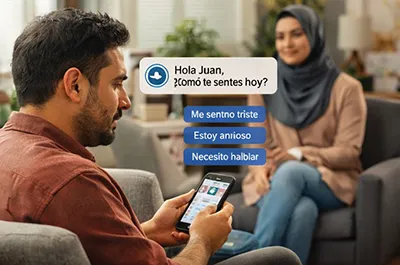
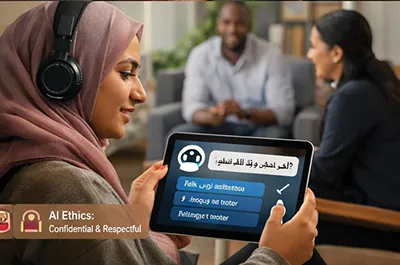
A mental health chatbot, or virtual conversational agent, is a system that mimics human conversation, similar to a clinical therapist. Rule-based chatbots use set rules for responses, while AI-powered ones leverage machine learning for more adaptable interactions with both spoken and written language. Chatbots can communicate verbally and in writing, while some can even interpret visual cues like body movements or facial expressions. Recent reviews suggest chatbots are effective, feasible, and safe tools to support mental health, particularly in reducing depression and other prominent psychological concerns.
An estimated 970 million people, or one out of every eight individuals globally, have a relatively serious mental disorder that in some way impacts their effective functioning in life. This is certainly a major public health issue in Asia. For example, there are increasing rates of mental illness in China and Taiwan among younger people. Access to mental health services in China is not keeping pace with demand. Conversational artificial intelligence has been adopted by hundreds of millions of individuals globally. While chatbots can enhance productivity and address search queries, there is a notable trend of users engaging with AI systems specifically developed to offer emotional support and connection.
Because of social stigma and the overall shortage of clinical providers, young people in Asia are increasingly turning to AI chatbots as a cheaper, easier, more private form of mental health support. Of all the regional markets in the world, the Asia Pacific chatbot market is the fastest-growing, with a projected $7.3 billion plus in annual revenue by 2030. Because Asia is home to a vast array of languages and dialects, a major trend and ongoing challenge involves developing highly capable chatbots that leverage advanced natural language processing to effectively support multiple regions linguistically.
Research indicates that individuals from East Asia demonstrate a greater willingness to develop emotional attachments to chatbots compared to those from Western regions, potentially accounting for the increased prevalence of AI companions in East Asian countries. For example, increasing groups of Chinese speakers are choosing generative AI chatbots over human therapists. A recent study found that East Asian participants anticipated enjoying AI chatbot interactions more than Western participants, revealing cultural differences in attitudes toward AI companionship. Researchers have also found that cultural differences in attitudes toward social chatbots are influenced by how much technology is seen as human-like. This may explain the faster adoption of technologies in East Asian countries like Japan and China compared to the United States. Further research is needed to understand why East Asian cultures are more open to and embracing of AI than Western ones, but studies show that anthropomorphism affects cultural acceptance of digital companionship with social chatbots.
More and more people are forming relationships with AI chatbots. Forming strong emotional attachments to chatbots is called anthropomorphising. Anthropomorphism is the tendency to attribute human-like characteristics and qualities to non-human entities like chatbots. Some of those with mental health needs find it easier to “tell the truth” to a chatbot rather than a real person. Stigma and limited psychiatric staff in Asian countries often prevent people from seeking treatment. Chatbots may help overcome these barriers. Psychological assistance is now a leading driver for adult use of AI chatbots. Users value chatbots for the relatively low cost, providing rapid on-demand answers, and allowing for discretion. Chatbots never sleep, never get tired, and never ask for higher compensation.
Agency, Efficacy, and Trust with Chatbots
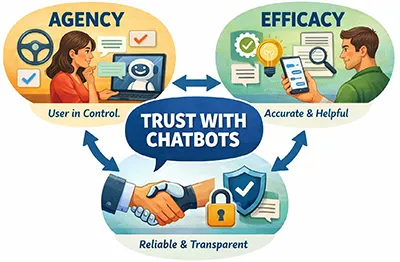
Just as the effectiveness of the relationship between a patient and a mental health professional (e.g., physiatrists, psychologists, counselors, and clinical social workers) is heavily dependent on the establishment of trust and perceptions of agency, the same is true to some large extent between human users and mental health chatbots. As Vanneste and Puranam note, modern deep learning-based AI is often seen as more agent-like than other technologies, but less so than humans. Traditional theories of interpersonal trust assume that trustees act freely, but human trust in AI challenges this idea. People may perceive AI agency on a spectrum, which affects how trust develops.
Vanneste and Puranam counterintuitively argue that designing AI with more perceived agency does not guarantee increased trust. If users see no agency in an AI system, trust shifts to its designer; if seen as fully agentic, focus moves away from the designer. At moderate levels of perceived agency, both the system and the designer impact trust decisions. Their insightful paper examines how perceptions of AI agency influence human trust in AI through three main pathways. First, viewing AI as more agentic boosts perceptions of both its ability and that of its designer, enhancing trustworthiness. Second, as AI is seen as more agentic, trust shifts from the designer to the AI itself. Third, higher perceived agency raises psychological costs if trust is violated, reducing overall trust in AI.
Thus, perceptions of agency in AI may affect patient trust in the chatbot, either positively or negatively, depending on how trustworthy people find the designer or the AI itself. Making AI appear more human may not always increase trust; due to the "uncanny valley," a near-human appearance can actually reduce trust before recovering as the resemblance becomes almost perfect. In sum, the Vanneste and Puranam analysis suggests that human trust in AI relates non-monotonically to perceived agency, though more research is needed to understand this dynamic and its underlying causes.
Conclusion
Because of their computational power and perceptions of agency, chatbots used to address mental health in Asia is growing rapidly. Asia's chatbot usage is driven by mobile-first consumers. AI chatbots offer accessible, often lower-cost mental health support, especially for depression, helping address social stigma and limited clinical resources. Trust is crucial, though, to continue effectiveness in applying chatbots to the mental health setting. Trust means being willing to be vulnerable based on expectations; perceived trustworthiness relates to beliefs about reliability, judged through ability, benevolence, and integrity. Trust in AI depends on perceived capability and agency, but ironically, too much human-like behavior could actually reduce trust. Healthcare companies and organisations in Asia should remain aware that further research is needed to optimise mental health chatbot design for trust, trustworthiness, and agency.