
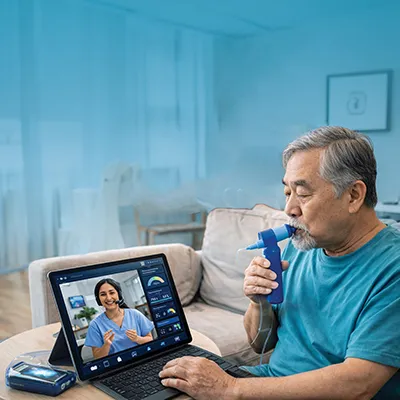
When Every Breath Counts, Connection Becomes Care
For people living with chronic lung disease, every breath is an effort. Simple acts such as walking, bathing, or talking can feel exhausting. Across the world, over 550 million people live with chronic respiratory diseases (CRDs) such as COPD, ILD, asthma, and bronchiectasis. Pulmonary Rehabilitation (PR) is an evidence-based, multidisciplinary intervention designed to reduce symptoms, optimise functional capacity, and enhance quality of life in people with chronic respiratory disease through individually tailored exercise training, education, and behaviour change strategies. Yet pulmonary rehabilitation, one of the most effective non-pharmacological interventions, remains inaccessible to many due to geography, cost, and limited infrastructure.
Tele-Pulmonary Rehabilitation (Tele-PR) bridges that gap. It delivers exercise training, education, and psychosocial support directly into patients’ homes through secure digital platforms. The goal is not to replace traditional rehabilitation but to extend it, bringing the science of recovery and the art of connection together.
From Hospital Corridors to Digital Clinics
When the pandemic restricted in-person care, physiotherapists across the world reimagined delivery models. What began as a necessity soon became an innovation. Tele-PR retained all the core components of traditional PR: comprehensive assessment, exercise prescription, patient education, and psychological support, while delivering them through virtual means.
The AACVPR 2025 Consensus Statement defines Tele-Rehabilitation as programs that can be delivered either through synchronous formats, involving real-time, interactive audiovisual sessions between clinicians and patients, or through asynchronous formats, where education, exercise, or feedback occur via recorded or app-based modules completed independently by the patient. Both models must maintain equivalent quality, safety, and outcome tracking compared with hospital-based programs.
Thousands of successful sessions conducted across continents now demonstrate Tele-PR’s feasibility, safety, and patient satisfaction. International studies confirm similar improvements in functional capacity, dyspnea, and quality of life compared with conventional PR. The evolution of these models, including their practical frameworks and early clinical implementations, has been described in published literature.
Case 1: From Isolation to Independence
A 37-year-old individual with ILD joined a Tele-PR program with significant breathlessness and dependence in daily activities. His baseline six-minute walk distance was 180 m with oxygen desaturation. Through pacing, strength training, and breathing control, he gradually built endurance. After twelve weeks, his walking distance improved by 60%, and he regained independence in routine tasks, evidence that recovery can begin right at home.
Case 2: A Child Who Learned to Breathe Freely Again
A ten-year-old with asthma participated in a family-inclusive Tele-PR program. Play-based breathing games, posture correction, and relaxation practices turned therapy into enjoyment. Over time, her episodes reduced, confidence increased, and she returned to sports. The program became more than rehabilitation; it became freedom from fear.
The Multidisciplinary Team Behind Tele-PR
At the heart of every Tele-PR program lies a coordinated multidisciplinary team working seamlessly across virtual boundaries. The pulmonologist confirms diagnosis, optimises medication, ensures medical safety, while the pulmonary physiotherapist leads assessments, prescribes exercise, and supervises patients remotely. Nutritionists design meal plans supporting muscle function, weight management, and immune health. Psychologists and counsellors address anxiety, depression, and motivation. Respiratory nurses guide oxygen use, inhaler technique, and symptom tracking. Occupational therapists teach pacing, energy conservation, and ergonomics to improve daily performance. Yoga and mind-body specialists introduce mindful breathing, relaxation, and flexibility, while social workers or coordinators connect caregivers and ensure continuity of care. Together, they create a connected web of expertise and empathy that restores breath, strength, and confidence.
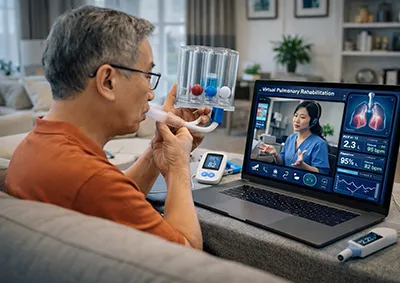
Building a 360° Framework for Lung Wellness
Modern Pulmonary Rehabilitation has evolved beyond exercise sessions to become an ecosystem of education, empowerment, and empathy. A comprehensive Tele-PR program interweaves multiple components that sustain wellness. Individualised exercise training with real-time feedback builds stamina, while group sessions foster motivation and social connection. Breathing retraining and mindfulness reduce anxiety and breathlessness, creating calm control over symptoms. Patient-education modules reinforce medication use, energy conservation, infection control, and nutrition strategies. Virtual peer-support communities unite patients and caregivers across geographies, transforming isolation into inclusion. This multidimensional framework builds a continuum of care that extends far beyond therapy sessions, nurturing autonomy, confidence, and lifelong self-management.
Monitoring Outcomes: Turning Data into Decisions
Outcome tracking is central to Tele-PR. Clinicians use validated, reproducible tools consistent with AACVPR and ERS/ATS recommendations to track progress and personalise care. Functional capacity is assessed through the Six-Minute Walk Test (6MWT) or One-Minute Sit-to-Stand Test (1MSTS), reliable indicators of endurance and progress. Physiological data such as oxygen saturation, heart rate, and step count are captured via wearables. Symptom scores, including mMRC Dyspnea Scale, Borg RPE, and fatigue ratings, reflect patient effort, while health-related quality of life is gauged using HADS, CAT, or SGRQ questionnaires. Adherence data from attendance logs and self-reports reveal motivation and engagement. AI-enabled dashboards convert these numbers into trends and insights, allowing clinicians to adjust exercise intensity, detect early decline, and ensure both safety and progress.
Ensuring Quality and Safety in Virtual Care
Quality assurance in Tele-PR is grounded in the same principles that govern in-person programs. Baseline screening, risk stratification, and caregiver orientation confirm suitability for remote training. Emergency protocols, oxygen monitoring, and professional supervision maintain safety. The AACVPR 2025 framework affirms that when Tele-PR is delivered by trained professionals using validated tools, clinical outcomes and safety are equivalent to centre-based programs.
Technology with a Human Pulse
Digital rehabilitation has matured into an intelligent ecosystem blending wearable sensors, mobile applications, and AI-driven analytics. Smartwatches, pulse oximeters, and fitness trackers continuously record oxygen levels, heart rate, and activity. Bluetooth-enabled spirometers and peak-flow meters transmit lung-function data securely to clinicians, enabling real-time monitoring, progress tracking and timely adjustment. Mobile applications such as myCOPD, Wellinks, and ResApp offer exercise videos, symptom logs, reminders, and chat support. In multilingual contexts, even WhatsApp-based systems like Respira Health extend reach to semi-urban and rural users. Artificial Intelligence enhances these tools by detecting early changes in oxygen or activity patterns, predicting flare-ups, adjusting exercise intensity, and analysing voice or cough signals for signs of exacerbation. These innovations transform rehabilitation from reactive to proactive care, turning data into foresight and foresight into confidence while keeping the essence of compassion intact.
Why Tele-PR Works Better for Today’s World
Although centre-based PR remains the gold standard, Tele-PR addresses barriers that often limit participation. It brings care to rural and mobility-restricted patients, offers flexible scheduling for working individuals, and enables families to engage as active partners. For those using oxygen or living with immune compromise, virtual sessions provide a safe, convenient environment. The model is also cost-effective, reducing travel, wage loss, and infrastructure expenses while maintaining comparable outcomes.
Ultimately, Tele-PR meets patients where they are, making Pulmonary Rehabilitation (PR) a part of life, not apart from it.
Institutional, Academic and Global Impact
Hospitals adopting hybrid Tele-PR models report fewer readmissions, stronger adherence, and greater satisfaction. Aligned with AACVPR guidelines, these programs ensure consistent quality and measurable outcomes. Medical universities now teach Tele-PR as an essential skill. Digital rehabilitation, AI analytics, and remote communication are reshaping physiotherapy education. Early clinical and academic experience with Tele-PR has been detailed in published frameworks that continue to guide practice.
Globally, Tele-PR has become a scalable, affordable solution for low- and middle-income countries (LMICs), bridging long-standing inequities in lung-health access.
Breathing into Tomorrow
Tele-Pulmonary Rehabilitation has moved from being an emergency workaround to an enduring pillar of modern care. It brings precision through wearables, prediction through AI, and personalisation through empathy.
Imagine a person with a lung condition walking at home. Their oxygen level dips slightly, and an alert prompts them to slow down while simultaneously notifying their physiotherapist, who adjusts the next PR session plan. That is not futuristic; that is Tele-PR today.
It replaces distance with dialogue, dependence with empowerment, and isolation with inclusion. By merging science and humanity, Tele-PR redefines how the world breathes better, one connection at a time.
Key Takeaways
Tele-Pulmonary Rehabilitation represents the future of integrated respiratory care. It unites multidisciplinary collaboration, digital innovation, and patient-centred practice to enhance access, adherence, and outcomes. By leveraging wearables, AI, and education, Tele-PR delivers measurable results while restoring confidence and quality of life, showing that technology and compassion can co-create a healthier world.
References
1. World Health Organization. Global report on trends in prevalence of chronic respiratory diseases 2023. Geneva: WHO; 2023.
2. GBD Chronic Respiratory Disease Collaborators. Global, regional, and national burden of chronic respiratory diseases, 1990–2020: a systematic analysis. Lancet Respir Med. 2022;10(6):585–606.
3. Holland AE, Hill CJ, Jones AY, McDonald CF. Breathing easier: The benefits of pulmonary rehabilitation in chronic lung disease. Lancet Respir Med. 2013;1(7):510–521.
4. Hughes JW, Berry R, Brown TM, et al. Consensus Statement on the Virtual and Remote Delivery of Cardiac and Pulmonary Rehabilitation and Their Components. J Cardiopulm Rehabil Prev. 2025;45(5):387–396.
5. Spruit MA, Singh SJ, Garvey C, et al. An official ATS/ERS statement: Key concepts and advances in pulmonary rehabilitation. Am J Respir Crit Care Med. 2013;188(8):e13–e64.
6. Garvey C, Bayles MP, Holland AE, et al. Pulmonary Rehabilitation: An Official American Thoracic Society Policy Statement. Am J Respir Crit Care Med. 2021;203(9):e29–e40.
7. Cox NS, Dal Corso S, Hansen H, et al. Telerehabilitation for chronic respiratory disease: a Cochrane systematic review and meta-analysis. Thorax. 2021;76(5):489–499.
8. Polastri M, Nava S, Clini E. Telemedicine in respiratory rehabilitation: expanding horizons. Respir Care.2020;65(8):1226–1234.
9. Steiner MC, McNarry MA, Singh SJ. Measuring exercise performance in pulmonary rehabilitation: Beyond the six-minute walk test. Eur Respir Rev. 2020;29(155):190165.
10. Bourne S, DeVos R, North M, et al. Online versus face-to-face pulmonary rehabilitation for COPD: randomised controlled trial. BMJ Open. 2017;7(7):e014580.
11. World Health Organization. Digital health guidelines: Recommendations on digital interventions for health-system strengthening. Geneva: WHO; 2022.
12. Koltharkar M, et al. TeleRehabilitation: Physiotherapy in cardiopulmonary conditions. Chapter 45. New Delhi: Jaypee Brothers Medical Publishers; 2022. p. 627–639.
--AHHM Issue 71--