Efficient Organ Transplantation: Strategies for Improved Procurement and Allocation

Kate Williamson
Editorial Team, Asian Hospital & Healthcare Management
Better procurement and allocation are the critical performance indicators to look at if one wants to have efficient organ transplantation. They are denoted as improving identification of the donors, identification of huge donor numbers, using sophisticated matching technology, improved transport and storage facilities, and improved co-ordination of various stakeholders. Such plans have the noble goal to increase the supply of organs and optimize procedures with the ultimate purpose of saving more lives.
Introduction:
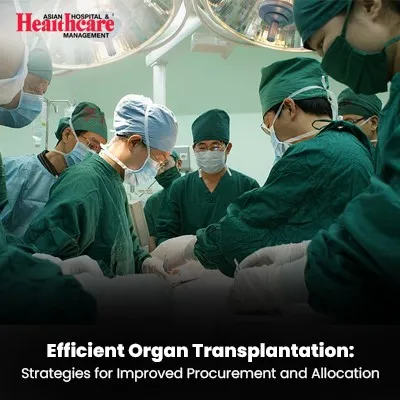
Organ transplantation is a significant opportunity in medical treatment since replaces damaged or non-functioning organs with functional ones from the donors. However, the process of organ transplantation involves complex logistics and coordination; this may affect the success of the transplant. In this article, we would like to discuss some of the approaches enabling one to optimize the necessity and results of organ transplantation, based on the aspects of procurement and allocation.
Understanding the Challenges
1. Organ Shortage: Organ transplantation faces several issues, but arguably the most pressing one is the scarcity of the available organs. Sadly, the overall demand significantly exceeds the supply because only forty percent of patients actually receive their desired organs in due time; waiting lists may take years to be addressed.
2. Coordination Complexity: Organ transplantation calls for several strategies that encompass many parties such as the donor, the recipient, hospitals, and the organ procurement organizations (OPOs). Thus, there are daunting tasks in terms of the coordination of these parties involved in timely and effective organ recovery and transplantation.
3. Transportation and Preservation: After an organ has been procured, it has to be transported and kept in a way that makes it still functional for transplantation. Problems in the course of transportation can result in organ damage, and consequently, lower chances of transplantation success.
Strategies for Improved Procurement
1. Enhancing Donor Identification and Referral
Implement Advanced Screening: Modern technological tools should therefore be employed in order to shorten the screening time in order to find more potential donors among hospital and the healthcare providers. In this process, employees are motivated on patient identification that may be prospective organ donors and how to refer such patients to OPOs.
Leverage Data Analytics: Data can also be used in anticipating possible cases of a donor and in the proper channeling of referrals. Through comprehensive data analysis of patients and previous donations, doctors will be able to determine persons more suitable for donating organs.
2. Expanding Donor Pools
Promote Donor Registration: Public awareness campaigns can inculcate the need in the hearts of people to register to be organ donors. It is noteworthy that the rise of the registered donor’s number can be an effective way to improve the situation with the lack of organs.
Explore Innovative Donor Sources: The number of organs can be increased with the help of non-traditional donor sources even for transplantation from living persons or those who have certain abnormalities, that were previously regarded as contraindications for becoming potential donors.
Strategies for Improved Allocation
1. Utilizing Advanced Matching Systems
Implement AI and Machine Learning: Advanced algorithms and artificial intelligence (AI) can be useful in organ matching as they are able to understand the patient data such as medical history, genetic profile and compatibility of the organ. This enables the guarantee of right match between the organs and the required recipients.
Enhance Data Sharing: Proper organ allocation requires the availability of real time information exchange among the hospitals, OPOs and the transplant centers. Efficient communication among the different healthcare center departments and automating the exchange of information and referral can ease the process.
2. Optimizing Transportation and Preservation
Use Advanced Preservation Techniques: Some unforeseen advancements such as: machine perfusion systems aid in maintaining the organ well supplied with oxygen and nutrients to help in organ transportation. This can enhance the chances of success and rates of organs transplants.
Improve Transportation Logistics: Organ procurement requires that a transportation system be put in place and tracked; effective communication on transport conditions will make sure that organs are collected on time and in the best condition. It is equally important to work with transport service providers with specifics with regards to the nature of organ transportation.
3. Enhancing Coordination and Communication
Foster Collaboration among Stakeholders: Enhancing the threshold of working relations and cooperation between hospitals, OPOs, and transplant centers may prove useful for enhancing the efficiency of the transplantation. It is possible to easily solve all the problems that may occur during procurement and further procedure of allocation with the help of an organization of meetings, using similar protocols and having evident channels of interaction.
Develop Standardized Protocols: Minimizing the variation and enhancing the process in regard to organ procurement and transplantation means that standardization of the processes is a possible solution. There should be extensive guidelines when it comes to this process for instance in the selection of donors, in organ recovery, and transplantation.
Conclusion
There is no single blueprint that can fit organ transplantation organization as it faces numerous challenges which have to do with procurement and proper allocation. Therefore, through augmenting and integrating technologies, increasing the population database of potential donors, and synchronizing and improving relations among all stakeholders, transplant efficiency can be increased as a result of the ability to save more lives. Frequent mechanization and cooperation with other facilities are essential factors in reducing certain obstacles to an organ transplantation process which in turn, makes it possible for more patients to be treated with the valuable transplant.
.webp "From AI Tools to Workflow Transformation in Healthcare")





-(1).webp)