Healthcare Industry Trends 2026: Predictions Shaping the Future of Care, Technology, and Operations
.webp)
Kate Williamson
Editorial Team, Asian Hospital & Healthcare Management
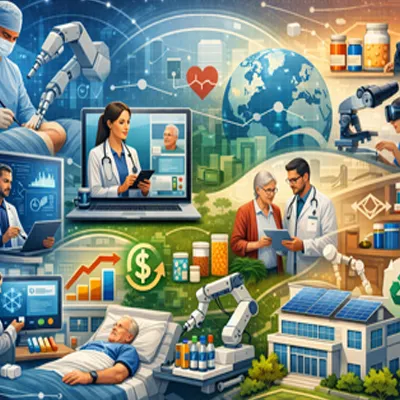
The healthcare sector that will exist in the year 2026 will be characterized by fast digitalization, incorporation of AI, hybrid designs of care, operational effectiveness and value-based care. Delivery and operations are transforming because of the innovations in advanced technologies, data interoperability, sustainability, and life sciences. To be competitive, B2B stakeholders must bring together solutions to strategic priorities, ROI, and compliance.
Introduction:
The healthcare sector in the global context is going into 2026 at a landmark point. The past years of accelerated digitalization, functional distress, staffing issues, regulatory changes, and cost increase have transformed the functioning of healthcare systems. What was formerly the “future-ready” is now the baseline.
By 2026, the question of whether it is needed to transform healthcare organizations is no longer present, as they are busy considering the speed at which they can change without jeopardizing quality, compliance, and financial health.
Artificial intelligence turning into infrastructure, value-based models of care reshaping reimbursement, the trends in the healthcare industry in 2026 show that the sector is walking the fine line between innovation and stability. This article examines the most effective healthcare industry predictions in 2026, and it provides a B2B look for healthcare leaders, technology providers, manufacturers, and policymakers.
1. Artificial Intelligence Moves from Innovation to Infrastructure
Among the most characteristic healthcare industry trends of 2026, the transition of artificial intelligence (AI) to experimental uses to enterprise-wide applications is likely to take place.
AI is no longer a pilot project or innovation laboratory. Rather, it is getting integrated into fundamental healthcare operations such as:
- Clinical documentation and ambient AI scribing
- Medical coding and billing automation
- Diagnostic decision support
- Predictive analytics for patient risk stratification
- Workforce scheduling and capacity planning
The use of AI as a new infrastructure is being viewed by healthcare organizations as being on par with electronic health records (EHRs) or hospital information systems.
2026 Prediction:
Healthcare providers that do not use AI in their day-to-day work will be disadvantaged in efficiencies, clinical satisfaction, and cost control by the end of 2026.
B2B Opportunity:
The hospitals, health systems, and payers will have high demand on AI vendors as an interoperable, scalable and regulation compliant solution.
2. Hybrid Care Models Become the Standard of Healthcare Delivery
The future of healthcare in 2026 is not virtual and physical, but hybrid.
Telehealth, remote patient monitoring (RPM) and virtual care solutions are at their peak. In 2026, these tools will be incorporated in the regular care delivery as opposed to their operation as distinct services.
Key developments include:
- Virtual-first care pathways for chronic disease management
- Hospital-at-home programs supported by connected devices
- Remote diagnostics combined with in-person interventions
- Digital front doors for patient engagement and triage
2026 Prediction:
Non-emergency and chronic care services will be the default conditions as a hybrid care model, will enhance access and decrease the facility load.
B2B Opportunity:
There will be a strong role of technology providers in the modernization of the healthcare system as they offer services to support RPM, digital care coordination, and virtual hospital infrastructure.
3. Financial Pressure Drives Operational Efficiency and Automation
One of the biggest issues that determine the trends of healthcare industry in 2026 is financial sustainability. The increasing labor rates, pressure on reimbursement, volatility in the supply chain, and the pressure of regulatory compliance are striking healthcare organizations.
Health systems and hospitals are responding by:
- Automating administrative workflows
- Optimizing revenue cycle management (RCM)
- Reducing manual billing and claims errors
- Leveraging analytics to detect inefficiencies
The focus of healthcare leaders is on operational resilience since efficiency is no longer a choice.
2026 Prediction:
Companies that invest in automation and operational analytics will be in a better place to overcome economic unpredictability and regulatory changes.
B2B Opportunity:
Investments in solutions, which focus on the optimization of RCM, the automation of workflows, and financial analytics will also stay on the top of the priority list.
4. Value-Based Care Accelerates Across Global Markets
Value-based care (VBC) is not a vision of the future anymore, it is a trend of the healthcare industry in 2026.
The healthcare systems are shifting the volume-based models to the outcome-based reimbursement systems rewarding quality, efficiency, and patient outcomes.
Key drivers include:
- Payer incentives tied to performance metrics
- Employer-driven healthcare purchasing strategies
- Government initiatives focused on cost containment
- Data availability enabling outcome measurement
2026 Prediction:
Implementation of value-based care will not be limited to pilot initiatives but as a part of mainstream healthcare delivery, especially in the chronic care and population health management.
B2B Opportunity:
The partners that will be critical in value-based ecosystems are companies that provide outcome measurement tools, real-world evidence analytics, and population health platforms.
5. Life Sciences and Pharma Embrace AI-Led Innovation
Pharmaceutical and life sciences organizations are growing to use AI in 2026 to solve the challenge of increasing the cost of R&D, development time, and regulatory complexity.
AI is being applied to:
- Drug discovery and molecular modeling
- Clinical trial design and patient recruitment
- Real-world evidence generation
- Pharmacovigilance and safety monitoring
Mergers and acquisitions are also growing at a faster pace as firms strive to consolidate pipelines and diversify therapeutic portfolios.
2026 Prediction:
The R&D based on AI will mean the end of the long time-frames of the early life-science drug development, and competitive forces will redefine themselves.
B2B Opportunity:
Pharma and biotech will adopt AI platforms to a large extent designed to meet regulatory compliance and data integrity and clinical research requirements.
6. Robotics, AR/VR, and Advanced Technologies Gain Practical Use
In addition to AI, a number of new technologies are finding applications in the real world in 2026.
These include:
- Robotics for surgery, logistics, and pharmacy automation
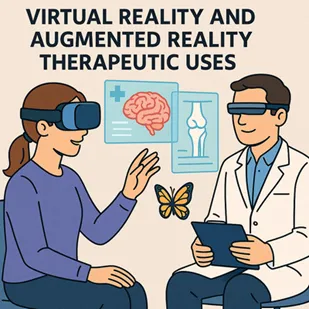
- Augmented reality (AR) for clinical training and surgical guidance
- Virtual reality (VR) for rehabilitation and medical education
- Predictive analytics for resource planning and patient outcomes
What sets 2026 apart is the shift from experimental use to measurable ROI.
2026 Prediction:
Advanced technologies with demonstrated operational or clinical value will be embraced more by the healthcare organizations instead of innovation per se.
B2B Opportunity:
Vendors with well-defined ROI measurement and integration facilitation will become leadership buy-in quicker.
7. Interoperability and Data Governance Remain Critical
With the shift to a digital sphere of healthcare, data interoperability and governance are the highest priorities in 2026.
The healthcare systems are paying attention to:
- Seamless data exchange across care settings
- Integration of EHRs, imaging, lab, and IoT data
- Privacy-preserving data sharing models
- Compliance with evolving data protection regulations
Interoperability ceases to be a technical challenge in itself but a strategic need.
2026 Prediction:
The companies that cannot provide interoperability will have difficulties with care coordination, analytics, and value-based care programs.
B2B Opportunity:
Healthcare ecosystems will be based on platforms that allow standards-based data exchange in a secure manner.
8. Sustainability and ESG Take Center Stage in Healthcare Strategy
Sustainability is an emerging trend in the healthcare industry by 2026 as a result of the influence of regulatory pressure, investor expectations, and responsibility of organizations.
Key focus areas include:
- Energy-efficient hospital infrastructure
- Sustainable medical packaging
- Waste reduction and circular economy practices
- ESG reporting and compliance
Healthcare organizations are becoming more consistent with sustainability and cost-effectiveness and brand confidence.
2026 Prediction:
Sustainability efforts will cease to be an optional program, but one that is part of the healthcare strategy.
B2B Opportunity:
The demand of sustainable material suppliers, energy solutions, and ESG advisory will increase.
Conclusion: What the Healthcare Industry Outlook for 2026 Means for B2B Leaders
Convergence of the healthcare industry in 2026 will be defined in terms of both technology and data, and models of care and business strategy. We have AI as foundation, hybrid care as the norm, value care models as growth and sustainability as non-negotiable.
To the B2B stakeholders, success in 2026 will be dictated by:
- Aligning solutions with real operational challenges
- Demonstrating measurable ROI and compliance readiness
- Supporting interoperability and scalability
- Understanding the evolving priorities of healthcare decision-makers
Healthcare organizations are not only purchasing goods but they are also seeking strategic partners in the long term.







.webp)