Smart Medical Devices and Connected Diagnostics: 2026 Outlook
.webp)
Kate Williamson
Editorial Team, Asian Hospital & Healthcare Management
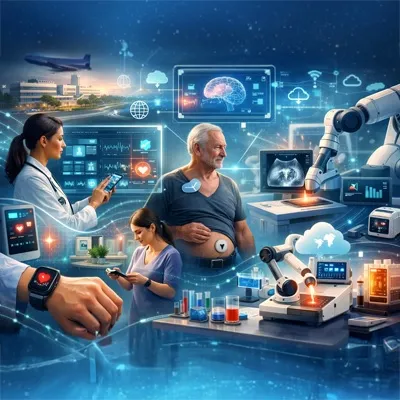
Connected diagnostics and smart medical devices are changing the nature of healthcare as it allows real-time monitoring and decision-making with the use of data, and personal care. The world is changing faster in terms of connectivity, artificial intelligence, and interoperability, which are enhancing preventive care, diagnostic accuracy, and optimizing clinical processes and value-based healthcare models.
Introduction:
The world of healthcare delivery is undergoing a transformation as smart medical devices and related diagnostics continue to dominate the future of healthcare delivery into 2026. Much more than marginal improvements, however, these technologies are transforming the nature of care delivery, data sharing and monitoring of health outcomes. This change is not restricted to the high-income nations but is becoming more apparent in the emerging markets, where connectivity and reduced-cost solutions allow novel models of preventive and personalized care. Although digital health solutions have been changing throughout the last 10 years, the year 2026 is a pivotal point of change, with smart devices and connected diagnostics becoming fully integrated in clinical practice, patient self-management, and health system planning.
What We Mean by Smart Devices and Connected Diagnostics
Smart medical devices, simply put, are instruments or equipment that have sensors and microprocessors integrated into them and which are networked. These devices have the ability to acquire physiological information, to wirelessly communicate with other systems and in most instances they also implement real time analytics at the edge - that is the device itself processes data prior to sending it elsewhere. From the wearable glucose monitors to the implantable cardiac sensors, the smart inhalers to the point-of-care ultrasound probes that connect to the mobile phones are some examples.
Connected diagnostics is a type of diagnostic processes that are networked over devices, platforms and information systems. Connective diagnostic may automatically transmit results to electronic health records (EHRs), provide alerts when critical values are observed, or interface with tools of artificial intelligence (AI) run on clouds to be interpreted. This interconnection allows diagnostic information to have inter-silos transfer to ecosystems in which clinicians, patients, and care teams can respond to the insights more quickly and efficiently.
These definitions are not only important in terms of academic context, but since they highlight the course of innovation in 2026: continuous, anticipatory, and data-driven healthcare. The future of care is not an episodic care service delivered through limited visits to the clinic, but instead real-time tracking and clinical awareness-driven services taking place virtually everywhere.
The Market Forces Driving Adoption
Several converging market forces drive the high rate of adoption of smart medical devices and connected diagnostics by 2026. First, it is the push towards value-based care, in which clinicians and payers are motivated to avoid complications instead of managing them once they have occurred. The existence of smart devices constantly tracking patient condition contributes to the timely identification of the worsening of state and avoids hospitalization and decreases the expenses in the long term.
Second, the ubiquitous smartphones and wireless connectivity, even in remote areas has established a network of digital health infrastructure. Mobile networks can be utilized to deploy technologies that were previously only accessible using specialized equipment, coupled with consumer electronics. This trend supports scalability faster with a small fraction of the cost incurred when using the traditional medical devices.
Third, the regulatory framework of large markets - especially the United States, Europe, and certain regions of Asia - has changed to better facilitate software-as-a-medical-device (SaMD) approvals, remote-monitoring solutions, and digital health platforms. A regulatory system that balances between innovation and patient safety denotes trust to both investors and manufacturers.
Lastly, there is the changing patient expectations. The modern healthcare customers are seeking the right to their health information, a convenient way to track it, and the visibility of the results. This cultural change contributes to the necessity of those devices that can help a patient to get into contact with his/her clinical team that is not on the other side of hospital or clinic walls.
Clinical Impact: From Chronic Disease to Acute Care
Among the most concrete advantages of smart medical devices and connected diagnostics is the possibility to use them in the management of chronic diseases. Most of healthcare expenditures in the world are related to chronic diseases including diabetes, heart failure, chronic obstructive pulmonary disease (COPD), and high blood pressure. The common care models are inadequate because they are based on the measurement of measures that are infrequent and reverse adjustments.
Contrary to it, smart glucose monitors which update the readings in real-time allow patients and clinicians to interpret the glucose variability patterns, correlate them with diet and activity, and optimize the treatment plans in a much more dynamic way. Such real time insights minimise cases of hypo- or hyper-glycemia and complications in the long run. Similar devices connected to blood pressure can also be used to assess cardiovascular health regularly without the necessity to visit a clinic on a regular basis.
Linked diagnostics is also involved in acute care. As an illustration, AI ultrasound devices can be used to deliver high-quality imaging services to emergency areas and remote clinics to promptly diagnose and treat patients by connecting point-of-care ultrasound equipment with AI interpretation devices.
Laboratory diagnostics are also developing, with networked analyzers able to post their results in cloud environments, which reduces turnaround time and eliminates errors in manual transcription.
Even though connected diagnostics and smart devices are groundbreaking, they are not complete systems. They have the most significant effect when incorporated into clinical pathways, decision support, and care coordination platforms. When data flows through devices to clinicians to any care team, it is used as actionable intelligence and not as individual measurements.
Integration with Artificial Intelligence and Machine Learning
The development of intelligent and connected diagnostics is connected with the art of artificial intelligence. Machine learning models that can identify patterns that are not readily observable by a human clinician become fertile soil because devices that receive large amounts of physiological and behavioral data allow the use of machine learning models to identify such patterns. Algorithms are capable of identifying abnormalities, forecasting negative outcomes before they happen, and segmenting the risk of patients to personalized intervention.
An example that can be achieved in practice is the use of AI in cardiac monitoring. Wearable ECG trackers are able to identify minor arrhythmias, but when linked to AI solutions, even able to predict the potential occurrence of more severe heart-related events days or weeks before they happen. This predictive allows pre-emptive care, which has decreased emergency admissions and enhanced the quality of life of patients.
AI also helps in the accuracy of the diagnosis. Radiology and pathology image interpretation services on the cloud enhance clinical knowledge, decrease variability, and enhance diagnosis consistency. These systems can provide more information to clinicians in near real time when linked to streams of device data.
It is a feedback loop: as many devices become smarter and connected, and AI becomes more improved and informed, it will result in the development of improved devices and clinical protocols. This loop narrows through 2026, making the possibility of the precision health, health care tailored to the biology, behavior and environment of a person, one step closer to reality.
Challenges on the Path to Implementation
Although the use of smart devices and connected diagnostics is optimistic, there are some issues. There is a problem of data interoperability. In spite of the fact that the electronic health records have been adopted in many health systems, the absence of uniform data format and protocols hinders the smooth flow of information. Proprietary systems can easily isolate data and require clinicians to work across multiple interfaces or need to do manual reconciliation.
Another important issue is cybersecurity. Potential victims of the cyberattack are the medical devices which are interconnected and transmit patient data to networks. There have been high profile attacks on the health data, in several cases in the last few years, which has highlighted the susceptibility of the associated systems. In protecting the privacy and integrity of systems, patient privacy, and the security of the machine, robust encryption, and authentication protocols along with continuous surveillance are required.
There are opportunities and constraints of regulatory oversight. Although the frameworks have now become mature to aid the digital health innovation, the adherence of different international standards is not straightforward. The developers are faced with divergent requirements of software updates, data security, and clinical validation. These issues might raise the cost and time of introducing innovations to the market.
Last but not least, there is the digital divide. Despite the diffusion of connectivity, the inequity in the access to devices, broadband networks and digital literacy still exists. The strategies should cover these gaps in order to bring equitable benefit to the smart and connected devices to suit cultural, linguistic and economic backgrounds.
Economic Implications for Healthcare Stakeholders
The financial aspect of intelligent medical equipment and related diagnostics is far-reaching. To healthcare providers, these technologies have the chance of moving on the volume-based care towards outcome-based care, which involves the use of resources in maximizing their use and enhancing patient satisfaction. Preventive monitoring can help to minimize emergency visits and hospitalizations and release the capacity to more complex care needs.
The payers and the insurers are also refocusing their models. With the growing evidence on the cost-efficiency of remote monitoring and related diagnostics, a significant number of insurers are broadening their reimbursement plans by covering digital health services. Such a change stimulates provider uptake and reduces patient obstacles.
The competitive environment in 2026 is going to be fast-paced in device manufacturers and digital health companies. Those companies which are able to show clinical efficacy, achieve interoperability and scalable integration into health systems are ready to be the leaders. Cases of strategic alliances between technology companies, medical devices manufacturers, and healthcare facilities are on the rise that makes the traditional boundaries of the industry diffuse.
The most important economic stakeholders are, perhaps, patients. Patients have become more involved in their health experience due to the growing availability of data and self-management resources. Empowered patients are able to make more informed judgments, better comply with care plans and demand increased quality care - forcing the entire healthcare ecosystem to evolve with economic incentives.
Regulatory and Ethical Considerations in a Connected Era
With the rise in the number of smart devices and connected diagnostics, regulatory authorities are confronted with the issue of balancing innovation and patient safety. Regulators are also paying more attention to post-market surveillance - monitoring actual execution of devices after it has been approved. This strategy recognizes the fact that, in many cases, the full effect of interrelated technologies can be realized only when the technologies are widely deployed.
Questions of ethics are also present. Linking devices produce large amounts of patient data. Who owns this data? In what manner is it distributed, and according to what permission system? These are both legal and moral questions. The basis of trust building is to have transparent data governance, patient-centered consenting procedures, and clear policies on third party access to health data.
Simultaneously, to ethically apply AI in diagnostics, biases in algorithms should be taken into account. Models can be trained on datasets that are not diverse, and therefore will not be effective with underrepresented groups. As such, the deployment of this ethically must be continuously validated, involve all-inclusive datasets, and decision-making be done by humans.
What Lies Ahead: A Vision for 2030
Answering the question of the future of smart medical devices and connected diagnostics further than 2026, the gravity of this trend is more personalized healthcare and autonomy. It is possible to imagine that by 2030 health monitoring will go beyond the sporadic to continuous and will be integrated into everyday life through devices. The frontier of connected health will open up new areas of engaging biometric tattoos that can detect biochemical markers, ingestible sensors that detect internal physiology and more.
Diagnostic ecosystems will be connected to enable real-time epidemiological surveillance, response to outbreaks faster, and better planning of the health of the people. Clinicians and patients will be able to investigate trends, correlations, and predictions at intuitive levels with the help of data visualization platforms.
This vision can only be achieved with the combined efforts of innovators, clinicians, regulators and patients. Teamwork and moral responsibility will be the key used to steer this development.
Concluding Thoughts
Connected diagnostics and smart medical devices are not the fancies of the future, but they are currently reshaping the landscape of healthcare in 2026 and the future. They have an effect on clinical outcomes, economic models, patient engagement, and health equity. Although the interoperability, regulation, security, and access issues still exist, the possibilities of the life and system performance improvements are unmatched.
The concept of healthcare as we understand it is moving towards being proactive rather than reactive, more than quarterly check-ins to lifelong learning, 1-off clinics to biomark-networked ecosystems. The center of this change is smart device and the connected diagnostics not as long-standing tools, but as a facilitator of the more connected, data-driven and caring future of health.