Blockchain Enabled Cybersecurity - a Solution for Secure Interoperable Healthcare Data
-Bodasingu-Vijaya-Kumar.webp)
Surg Capt (Dr) Bodasingu Vijaya Kumar
Member, FICCI, Telangana Healthcare Panel, Former Executive Director, KIMS Group of Hospitals.
Digital transformation in healthcare using EHRs, telemedicine, and wearables has improved access and efficiency but increased cybersecurity risks such as data breaches and ransomware. Blockchain offers a decentralized, secure, and transparent solution to enhance data integrity, interoperability, and patient control. However, scalability, regulation, governance, and integration challenges remain significant barriers.
Introduction
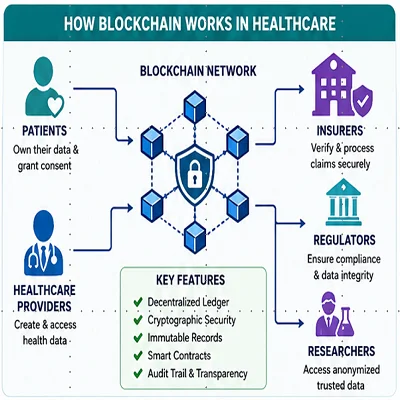
The healthcare sector is undergoing a profound transformation driven by rapid advances in digital technologies. Electronic health records (EHRs), telemedicine platforms, wearable health devices, and digital health applications have fundamentally reshaped how healthcare services are delivered and managed. These technologies have improved healthcare accessibility, enhanced clinical decision-making, and enabled more personalized patient care. However, the increasing digitization of healthcare data has also introduced significant cybersecurity risks. Healthcare organizations store vast amounts of sensitive patient information, including medical histories, diagnostic results, insurance details, and personal identification data. This information is extremely valuable on black markets, making healthcare systems frequent targets for cybercriminals. Recent years have witnessed a surge in cyberattacks targeting healthcare institutions worldwide. Ransomware attacks, data breaches, and unauthorized access incidents have disrupted hospital operations and compromised patient confidentiality. In some cases, cyberattacks have forced hospitals to delay surgeries, divert emergency services, and shut down critical information systems. These incidents highlight the urgent need for stronger cybersecurity frameworks in healthcare. Traditional healthcare data management systems rely heavily on centralized databases, which create single points of failure. When centralized systems are compromised, large volumes of patient data can be exposed or manipulated. Furthermore, interoperability challenges between different healthcare information systems often hinder effective data sharing among healthcare providers, insurers, and regulatory agencies. Blockchain technology offers a potential solution to these challenges. By using decentralized ledgers, cryptographic encryption, and distributed consensus mechanisms, blockchain can provide a secure and transparent infrastructure for managing healthcare data. Unlike traditional databases, blockchain systems distribute data across multiple nodes, making them highly resistant to tampering and cyberattacks.
Blockchain Technology Overview
Blockchain is a distributed ledger technology that records transactions across a decentralized network of computers. Each transaction is verified by network participants through consensus mechanisms and stored in blocks that are linked together in chronological order. One of the defining characteristics of blockchain is immutability. Once data is recorded on the blockchain, it cannot be altered or deleted without network consensus. This feature ensures the integrity and transparency of recorded transactions.
Blockchain systems also use cryptographic encryption to secure data and verify user identities. Transactions are digitally signed, ensuring that only authorized participants can access or modify data. There are several types of blockchain networks, including public blockchains, private blockchains, and consortium blockchains. In healthcare applications, private or consortium blockchains are often preferred because they allow controlled access to sensitive medical data. Smart contracts are another key feature of blockchain technology. These are self-executing digital agreements that automatically enforce predefined rules when specific conditions are met. In healthcare, smart contracts can automate processes such as insurance claims processing, patient consent management, and billing verification.
Evolution of Blockchain in Healthcare and Current Evidence
Blockchain technology, originally introduced by Satoshi Nakamoto in 2008 as the foundation of Bitcoin, has evolved beyond cryptocurrency applications and is increasingly being explored across multiple sectors, including healthcare. Researchers have identified blockchain as a transformative technology capable of addressing critical challenges related to healthcare data security, interoperability, and governance. The developed MedRec is a blockchain-based framework for electronic medical records that demonstrated secure, decentralized access to patient data while preserving privacy and data integrity. Similarly, Kuo, Kim, and Ohno-Machado (2017) highlighted blockchain’s potential to enhance transparency, interoperability, and cybersecurity within healthcare information systems. The emphasized its role in reducing data fragmentation and empowering patients through greater control over health information access. The further expanded blockchain’s applicability to pharmaceutical supply chains, clinical trial verification, insurance claims processing, and patient identity management. Recent studies have also demonstrated blockchain’s ability to combat counterfeit drugs by enabling immutable and traceable transaction records throughout the pharmaceutical supply chain. Despite these advantages, concerns regarding scalability, computational requirements, regulatory uncertainties, and integration with existing healthcare infrastructure continue to present significant implementation challenges.
Study Focus and Analytical Approach
Against this backdrop, the present study investigates the role of blockchain technology in strengthening healthcare cybersecurity and enabling secure health data sharing within increasingly digital healthcare ecosystems. Specifically, the study examines key cybersecurity challenges confronting healthcare organizations, analyzes the potential of blockchain to enhance data security and interoperability, explores blockchain-enabled models for trusted healthcare data exchange, and evaluates the policy, regulatory, and governance implications of its adoption.
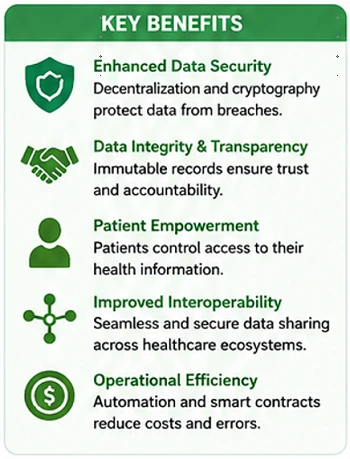
To achieve these objectives, a qualitative research approach based on a systematic review of peer-reviewed literature, industry reports, healthcare technology publications, and policy documents published between 2016 and 2025 was employed. The analysis is organized around three interconnected themes: cybersecurity vulnerabilities in healthcare information systems, technical features of blockchain relevant to healthcare applications, and the strategic implications of blockchain adoption for healthcare organizations. By synthesizing evidence from interdisciplinary sources, the study develops a conceptual understanding of how blockchain can contribute to secure, transparent, and patient-centered healthcare data governance.
Applications of Blockchain in Healthcare
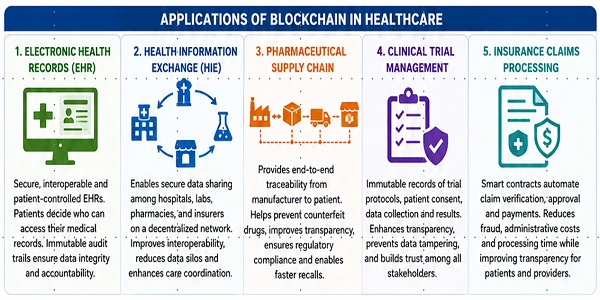
Electronic Health Records (EHR) Management
Electronic Health Records (EHRs) form the backbone of modern digital healthcare; however, they often remain fragmented across multiple healthcare providers and systems. Blockchain technology can enable the creation of secure, interoperable, and patient-centric EHR ecosystems by providing a decentralized ledger that stores cryptographic references to patient records while maintaining data integrity and confidentiality. Patients can control access permissions to their medical information through blockchain-enabled consent mechanisms, ensuring that only authorized healthcare professionals can access their records. Additionally, blockchain's immutable audit trail enhances accountability by recording every access, modification, or transaction related to patient data. This improves trust, reduces the risk of unauthorized access, and facilitates seamless continuity of care across healthcare institutions.
Health Information Exchange (HIE)
Efficient healthcare delivery requires the timely exchange of patient information among hospitals, clinics, laboratories, pharmacies, insurers, and public health agencies. Traditional Health Information Exchange (HIE) systems often face challenges related to interoperability, data silos, and inconsistent data standards. Blockchain can serve as a trusted platform for secure and real-time information sharing among stakeholders without relying on a centralized authority. By enabling a single source of truth, blockchain improves data accuracy, reduces duplication of records, minimizes administrative inefficiencies, and enhances care coordination. The technology also supports patient consent management, ensuring compliance with privacy regulations while facilitating secure cross-organizational collaboration.
Pharmaceutical Supply Chain Management
Counterfeit medicines and lack of supply chain transparency remain significant global healthcare challenges. Blockchain technology offers end-to-end traceability by recording every transaction and movement of pharmaceutical products from manufacturing to distribution and ultimately to the patient. Each stakeholder in the supply chain—including manufacturers, distributors, wholesalers, pharmacies, and regulators—can access a shared and immutable ledger that verifies product authenticity. This enhanced visibility helps prevent counterfeit drug infiltration, improves inventory management, accelerates product recalls when necessary, and strengthens regulatory compliance. Furthermore, blockchain-enabled supply chains can improve patient safety and public confidence in pharmaceutical products.
Clinical Trial Management
Clinical research depends on the integrity, accuracy, and transparency of data throughout the trial lifecycle. Blockchain technology can enhance clinical trial management by creating immutable records of study protocols, patient consent forms, data collection processes, and research outcomes. Since records stored on a blockchain cannot be altered without authorization, the risk of data manipulation, selective reporting, or research fraud is significantly reduced. Blockchain can also facilitate secure collaboration among researchers, sponsors, ethics committees, and regulatory agencies while ensuring data provenance and auditability. These capabilities improve trust in research findings, accelerate regulatory review processes, and contribute to more reliable evidence-based medicine.
Insurance Claims Processing
Healthcare insurance claims processing is often complex, time-consuming, and susceptible to fraud, errors, and administrative inefficiencies. Blockchain technology, combined with smart contracts, can automate claim verification, adjudication, and payment workflows. Smart contracts execute predefined conditions automatically when specific criteria are met, reducing manual intervention and administrative burden. For example, once treatment records, provider credentials, and policy eligibility are verified on the blockchain, payments can be triggered automatically. This leads to faster claim settlements, lower operational costs, improved transparency, and reduced fraud. Blockchain-based claims management also enhances trust among patients, healthcare providers, and insurers by creating a verifiable and tamper-proof record of all transactions.
Discussion
Despite its potential benefits, blockchain adoption in healthcare faces several challenges.
One major challenge is scalability. Blockchain networks may struggle to process large volumes of healthcare data efficiently. Additionally, storing large medical files directly on blockchain networks is often impractical. Regulatory compliance is another critical issue. Healthcare organizations must comply with strict data protection regulations related to patient privacy and data security. Blockchain systems must be designed to align with these regulatory requirements. Integration with legacy healthcare systems also presents technical challenges. Many hospitals rely on outdated information systems that may not easily integrate with blockchain infrastructure. Finally, governance frameworks must be established to define data ownership, access rights, and accountability within blockchain-based healthcare networks.
Policy and Strategic Implications
For blockchain technology to be successfully adopted in healthcare, supportive policy frameworks and strategic implementation plans are essential. Governments and healthcare regulators must develop clear guidelines for blockchain-based healthcare data systems. Standardization efforts will also be necessary to ensure interoperability across different blockchain platforms. Healthcare organizations should adopt phased implementation strategies, starting with pilot projects in specific areas such as supply chain management or patient identity verification. Investment in workforce training and digital literacy will also be essential to ensure that healthcare professionals can effectively use blockchain-enabled systems.
Conclusion
The digital transformation of healthcare has created unprecedented opportunities for improving patient care, operational efficiency, and data-driven decision-making. However, it has also introduced serious cybersecurity risks and data governance challenges. Blockchain technology offers a promising solution for addressing these challenges by providing decentralized, transparent, and tamper-resistant infrastructure for managing healthcare data. By enabling secure and trusted data sharing among healthcare stakeholders, blockchain can strengthen healthcare cybersecurity, enhance interoperability, and empower patients with greater control over their personal health information. While several technical and regulatory challenges remain, strategic collaboration among healthcare organizations, technology developers, and policymakers can unlock the full potential of blockchain in healthcare. Ultimately, blockchain technology has the potential to play a transformative role in building secure, resilient, and patient-centered digital health ecosystems.
References
- Azaria, A., Ekblaw, A., Vieira, T., & Lippman, A. (2016). MedRec: Using Blockchain for Medical Data Access and Permission Management.
- Kuo, T., Kim, H., & Ohno-Machado, L. (2017). Blockchain distributed ledger technologies for biomedical and healthcare applications.
- Engelhardt, M. (2017). Hitching Healthcare to the Chain.
- Zhang, P., et al. (2018). Blockchain Technology Use Cases in Healthcare.
- World Health Organization. (2021). Global Strategy on Digital Health.


.webp "From AI Tools to Workflow Transformation in Healthcare")