From AI Tools to Workflow Transformation in Healthcare
.webp)
Dr Vaikunthan Rajaratnam
Senior Consultant Hand and Reconstructive Microsurgeon, Medical Educator, Centre for Healthcare Innovation
Healthcare AI creates value when it is integrated into real work rather than adopted as a collection of disconnected tools. This article examines how healthcare teams can identify repetitive tasks, prototype AI-enabled workflows, evaluate safety and usability, and plan professional oversight before implementation. It offers a practical framework for responsible, human-centred workflow transformation.
.webp)
Introduction:
Healthcare organisations face a practical question: how can enthusiasm for artificial intelligence become dependable improvement in everyday work? A convincing demonstration may generate interest, but implementation requires decisions about people, information, responsibility and failure. The appropriate unit of change is the workflow: the sequence of activities through which a team delivers a service.
An AI application may draft a document quickly while creating additional checking, correction and coordination elsewhere. Its value therefore depends on the complete process. Responsible transformation begins by understanding the work, deciding what should change and establishing how the redesigned process will be evaluated. This article proposes a practical approach for healthcare leaders, educators and clinical teams. The examples are illustrative, rather than reports of evaluated deployments.
Start with the work
A useful starting point is a recurring problem that staff can describe precisely. Examples include preparing teaching materials, organising approved administrative information or drafting routine internal documents. The team should identify who performs each step, which information is required, where delays occur and what happens when information is incomplete.
Before introducing AI, the team should ask whether the activity is necessary. Removing duplicate documentation or simplifying an approval process may offer greater benefit than automating an inefficient arrangement. Where a fixed template or conventional software can solve the problem reliably, these options deserve consideration. AI should have a defined purpose within the process.
A workflow map should record the trigger, inputs, activities, decisions, handovers and final output. It should also identify the people affected, including those who receive the result. A faster drafting stage is of limited value if another team inherits an unmanageable verification burden. Baseline measures should capture total completion time, quality, rework and staff effort before any prototype is introduced.
Choose a bounded task
Early projects benefit from a narrow purpose and clear limits. A team preparing a staff education session, for example, could test whether AI helps organise an outline from approved learning objectives and selected references. The permitted task would be drafting educational material for expert review. Patient-specific advice and changes to clinical records would remain outside that project’s scope.
The team should describe both intended use and foreseeable misuse. A draft teaching aid might later be mistaken for approved clinical guidance. A summary prepared for administration might influence a care decision. Risk assessment should follow the consequences of the output, including these possible extensions, rather than relying solely on labels such as administrative or educational.
Task selection also requires an honest assessment of reviewability. Staff must be able to recognise important errors using accessible source material and appropriate expertise. If reliable checking is difficult, the apparent simplicity of generating an answer may conceal a demanding assurance problem. A task should not progress merely because the system can produce plausible text.
Design the information environment
A useful instruction describes the purpose, audience, permitted sources, output structure and limits of the task. It should explain how the system must handle missing or conflicting information. For example, a prototype can be instructed to identify gaps explicitly rather than fill them with invented details. Such instructions support testing; they do not guarantee compliance.
Context design extends beyond writing a prompt. Teams must decide which documents are authoritative, who maintains them and how outdated versions are withdrawn. They should distinguish supplied evidence from generated interpretation. Where the output includes factual assertions, reviewers need a practical route back to the underlying material. A reference generated by the system should itself be checked.
Information governance must precede the use of sensitive data. Teams should establish which environments and data categories their organisation permits, who can access information and how storage and retention are managed. Removing names alone should not be treated as proof that a record is anonymous. Synthetic examples can support early learning while reducing unnecessary exposure of real information.
Prototype for learning
An educational prototype tests an idea. An operational system affects real work and requires a different level of assurance. Organisations should make that distinction visible through access controls, labels and approval processes. Success in a classroom exercise does not establish suitability for patient care or routine service delivery.
A prototype should be tested against ordinary cases, difficult cases and foreseeable failures. For a teaching-material workflow, this could include contradictory source documents, ambiguous objectives and requests that fall outside the agreed topic. The team should examine whether the system flags uncertainty, preserves important qualifications and avoids presenting unsupported information as established fact.
Testing should include the people expected to use and review the output. A technically acceptable result may be hard to check, badly timed or unsuitable for the intended audience. Short observation sessions can reveal where staff misunderstand the system’s role. These findings should inform changes to the workflow, not simply changes to the wording of instructions.
Make oversight workable
Human oversight requires an operating design. A named reviewer needs relevant expertise, access to source material, enough time to assess the result and authority to reject it. The workflow should specify what must be checked, which discrepancies require escalation and who makes the final decision. Responsibility cannot be transferred to a reviewer through a vague approval box.
The World Health Organization’s 2024 guidance on large multimodal models identifies risks including inaccurate outputs, bias, privacy concerns and automation bias. The last describes a tendency to overlook errors or delegate judgement inappropriately when using automated systems. These concerns make the conditions of review especially important: confident language and polished presentation should never substitute for evidence.
One practical approach is to define separate checks for factual accuracy, completeness, suitability and permitted use. A reviewer might confirm that an educational draft matches the approved objectives, that clinical assertions have supporting sources and that no confidential information appears. Records of recurrent corrections can guide improvement. Review should produce learning as well as a decision on an individual output.
Evaluate the complete workflow
Evaluation should compare the redesigned process with the existing one. Generation speed is only one component. Teams should measure the time spent preparing inputs, reviewing outputs, correcting errors, seeking clarification and handling exceptions. Apparent savings can disappear when these activities are included.
Quality measures should match the task and the seriousness of possible failure. An educational drafting project could assess factual accuracy, coverage of objectives, readability and the amount of substantive correction required. A workflow affecting care would require an evaluation appropriate to its intended clinical use, alongside applicable institutional and regulatory requirements. Findings from a low-risk exercise should not be generalised to a different setting.
Acceptance criteria should be agreed before the team reviews the results. These criteria should distinguish minor presentational defects from consequential errors and identify conditions that require stopping the pilot. Teams should also test the combined performance of staff and system: an output that contains a detectable error can still create harm if the actual review process consistently misses it.
Build capability around roles
AI education should help professionals make defensible decisions about real tasks. Understanding how to request an output is useful, but practical competence also includes recognising unsuitable uses, protecting information, evaluating evidence and explaining why an output should be accepted, revised or rejected.
Different roles need different capabilities. A frontline professional needs to understand task limits and escalation routes. A workflow owner must coordinate process changes and monitor results. Educators need to design learning activities that assess judgement. Governance and technical teams need sufficient understanding of clinical work to interpret the consequences of system behaviour.
Assessment can use realistic scenarios with deliberately flawed outputs. Participants can identify omissions, check sources, explain risks and decide whether a task should proceed. Their reasoning matters more than the elegance of a generated document. Organisations should provide protected learning time and accessible support so that capability extends beyond a small group of enthusiastic early adopters.
Govern the workflow throughout its life
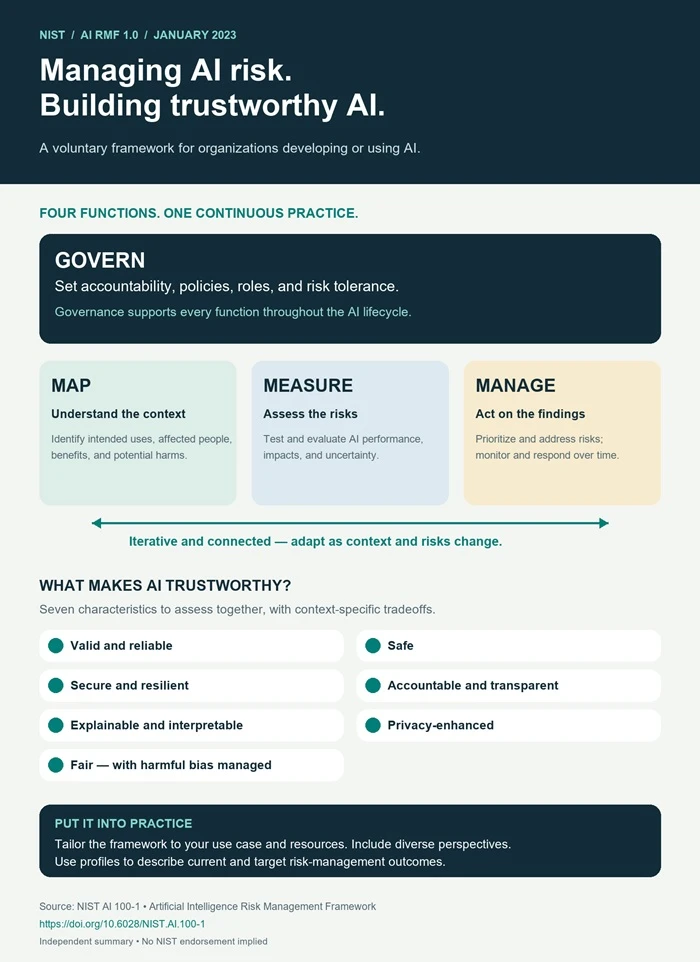
The NIST AI Risk Management Framework organises risk management around four functions: govern, map, measure and manage. It treats governance as a continuing activity across the system lifecycle. For healthcare organisations, this offers a useful structure for connecting project decisions with institutional accountability, rather than treating approval as the end of risk management.
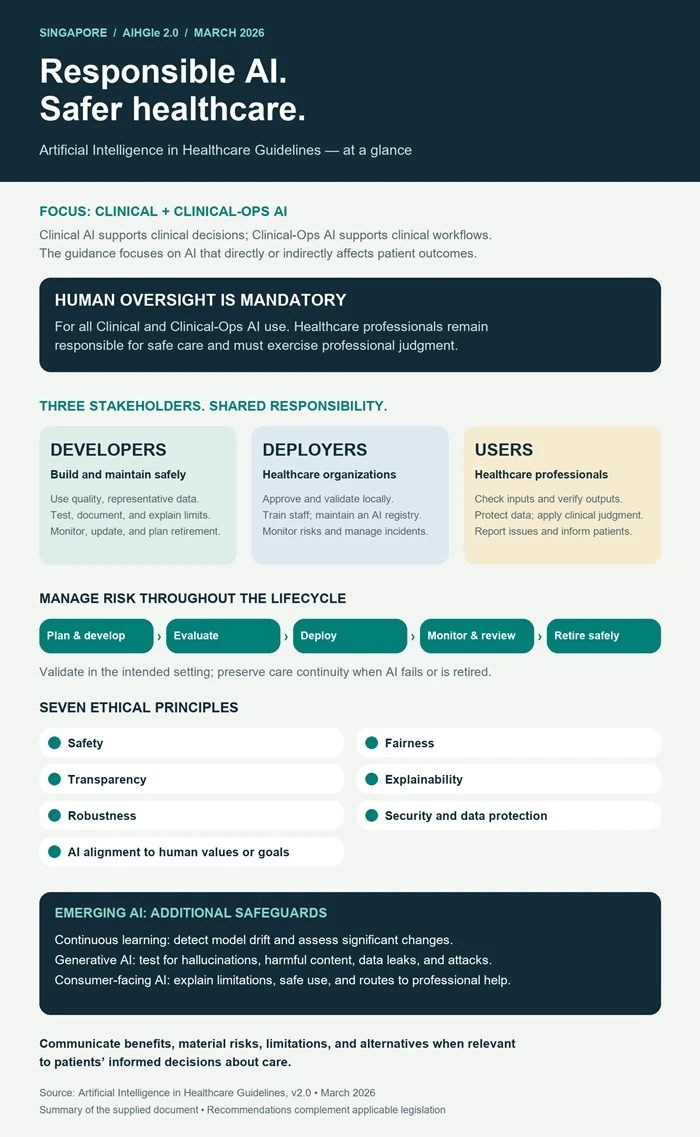
Singapore’s Artificial Intelligence in Healthcare Guidelines (AIHGle 2.0), published in March 2026, place patient safety and human oversight at the heart of responsible AI adoption. The guidelines outline shared responsibilities for developers, healthcare organisations, and healthcare professionals across the AI lifecycle, from design and validation to deployment, monitoring, and retirement. They emphasise fairness, transparency, explainability, robustness, security and data protection, and alignment with human values and goals. They also address emerging risks associated with generative AI, continuously learning models, and consumer-facing applications. Throughout, healthcare professionals remain accountable for patient care, with AI supporting their clinical judgment.
A practical project record should state the purpose, owner, permitted users, approved information sources, known limitations and evaluation results. It should document residual risks and the decision to accept, reduce or avoid them. The organisation also needs a way to identify its AI-enabled workflows, review changes and retire systems that no longer meet their intended purpose.
Agentic AI adds a further design question. Systems that can use tools and perform sequences of actions need explicit limits on permissions. Preparing a proposed action differs materially from carrying it out. Teams should decide which actions require prior human approval, retain suitable activity records and provide a tested way to interrupt the process and return to an established alternative.
Scale through evidence
Expansion should follow a documented review of benefit, risk and operational readiness. A successful pilot in one department does not establish that the workflow will perform equally well with different staff, languages, information sources or service pressures. Each extension should examine what has changed and which assumptions need to be tested again.
Monitoring should include errors, near misses, review workload, user feedback and changes in the underlying system or source material. Staff need a straightforward route to report concerns and obtain a response. Leaders should budget for ongoing review and maintenance alongside initial implementation. A workflow that cannot be supported reliably should be reconsidered, even when its demonstration was impressive.
Responsible healthcare AI transformation is an organisational capability. It grows when professionals can identify worthwhile problems, design bounded workflows, evaluate outcomes and exercise meaningful judgement. Sustainable progress depends on making these practices part of ordinary service improvement. The goal is a better process whose benefits and limitations the institution can explain, monitor and take responsibility for.
REFERENCES FOR ONLINE PUBLICATION
1. World Health Organization. WHO releases AI ethics and governance guidance for large multi-modal models. 18 January 2024. https://www.who.int/news/item/18-01-2024-who-releases-ai-ethics-and-governance-guidance-for-large-multi-modal-models
2. National Institute of Standards and Technology. Artificial Intelligence Risk Management Framework 1.0: AI RMF Core. 2023. https://airc.nist.gov/airmf-resources/airmf/5-sec-core/