Hospital Gas Safety, Compliance, Maintenance & Installation: Medical Gas Safety Standards Explained

Kate Williamson
Editorial Team, Asian Hospital & Healthcare Management
Introduction:
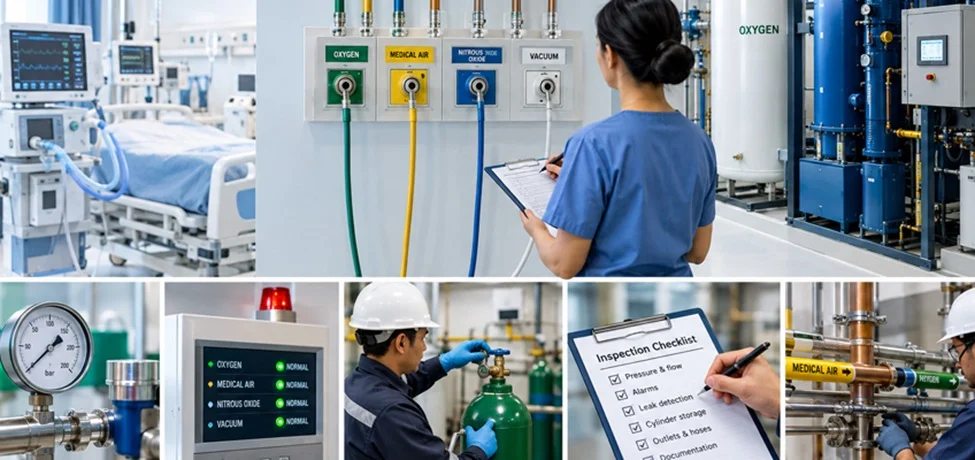
Every ventilator, anaesthesia machine and operation theatre in your hospital depends on one thing most people never see: the medical gas system running behind the walls. Oxygen, medical air, nitrous oxide and vacuum have to arrive at the right pressure, at the right outlet, every single time.
So, what happens when something goes wrong? A pressure drop, a cross-connected outlet or a loose cylinder can turn into a patient safety event or a fire within minutes. The good news is that most of these incidents are preventable with the right standards, checks and habits.
This article walks through medical gas safety standards in plain language: what they require, how to stay compliant, and what to inspect, test and maintain. Use it as a working reference, not just a read-and-forget article.
Quick Answer: What Are Medical Gas Safety Standards?
Medical gas safety standards are the codes and technical rules that govern how hospitals design, install, test, operate and maintain systems carrying oxygen, medical air, nitrous oxide, vacuum and other gases. The most widely referenced are:
- NFPA 99 (Health Care Facilities Code), widely used in the US and referenced globally
- ISO 7396-1, the international standard for pipeline systems for compressed medical gases and vacuum
- HTM 02-01, the UK's guidance for medical gas pipeline systems
- Local rules, such as NABH and the National Building Code in India, or your state fire and licensing authority
They all share one goal: the right gas, at the right pressure, to the right outlet, with no leaks and no mix-ups.
Standards and editions differ by country and get updated. Always confirm the current edition and local requirements with your authority having jurisdiction (AHJ).
Why Compliance Isn't Just Paperwork
Many facility teams treat compliance as an audit chore. The risks say otherwise:
- Patient harm: wrong gas, low pressure or contamination can be fatal.
- Fire risk: oxygen-enriched air (above roughly 23.5%) makes materials ignite far more easily and burn faster.
- Legal and accreditation exposure: failed inspections can mean penalties, lost accreditation or insurance disputes.
- Operational cost: unplanned shutdowns cost far more than planned maintenance.
Compliance is how you prove the system is safe, not just assume it.
Hospital Gas System Compliance Requirements: The Core Pillars
The details vary by region, but hospital gas system compliance requirements generally cover these areas:
1. Design and installation. Pipework must use approved materials (typically degreased copper for oxygen and medical air) and be brazed by qualified, certified installers. Outlets, valves and terminal units need gas-specific connectors so the wrong equipment can't be plugged in.
2. Source equipment. Oxygen manifolds, liquid oxygen tanks, medical air compressors and vacuum plants need reserve capacity and automatic changeover, so a single failure never cuts supply.
3. Zone valves and isolation. Every ward or critical area should have clearly labelled shut-off valves, so staff can isolate a leak or fire without shutting down the whole hospital.
4. Testing before use. New or modified systems must pass pressure tests, cross-connection checks, purity tests and flow tests before a single patient is connected. Always get sign-off documents.
5. Documentation. Keep as-built drawings, test certificates, maintenance logs, alarm test records and staff training records. If it isn't written down, an auditor will treat it as not done.
6. Trained, authorized people. Only qualified personnel should work on medical gas systems. This is non-negotiable.
Medical Gas Leak Detection System: Catching Problems Early
Leaks waste gas and money, but their real danger is invisible. An oxygen leak raises fire risk. A nitrous oxide leak affects staff exposure. A pressure loss can starve a ventilator.
A good medical gas leak detection system works in layers:
- Source monitoring. Pressure and flow sensors on manifolds and tanks flag abnormal consumption or sudden drops.
- Line pressure monitoring. Pressure sensors in main and branch lines trigger alarms when readings leave the safe range.
- Area gas detectors. Oxygen-level monitors in plant rooms, cylinder stores and enclosed spaces warn of enrichment or depletion.
- Periodic leak-down tests. Isolating a section and watching pressure over time reveals slow leaks that sensors miss.
- Visual and soap-solution checks. At joints, valves and cylinder connections, the old method still works.
Pro tip: Watch the trend, not just the alarm. A system that slowly consumes more gas every month is telling you something is wrong long before an alarm sounds.
Medical Gas Alarm System Testing: What, When and How
- Alarms are your early-warning system, and an untested alarm is a false sense of security. Medical gas alarm system testing should confirm that:
- Master alarms (usually at the control room or switchboard) activate for source faults, low reserve or abnormal pressure.
- Area alarms (ward or department level) show the pressure status of each gas in the zones staff actually work in.
- Alarm signals are both audible and visible, and can be acknowledged properly.
- Set points match design values, and the system detects both high and low pressure.
- Communication paths work, including remote panels, building management system links and escalation procedures.
Typical practice: simulate fault conditions in a controlled way, confirm each alarm triggers, record the result, and fix failures immediately. Frequency depends on your standard and risk assessment, but many hospitals run functional checks routinely and full tests at least annually. Check your local requirement.
Hospital Gas Safety Inspection Checklist
Use this as a starting point and adapt it to your facility and local standard.
Daily / Per Shift
- Check source pressure and reserve levels (manifolds, liquid oxygen, compressors)
- Confirm master and area alarm panels show normal status
- Walk the cylinder store: upright, secured, labelled
- Look for hissing, frost or damaged hoses and regulators
Weekly / Monthly
- Inspect outlets, flowmeters and flexible hoses for wear
- Test changeover from primary to reserve supply
- Review gas consumption trends for unexplained spikes
- Check emergency contact numbers and signage
Quarterly / Annually
- Full alarm functional testing and calibration
- Zone valve exercise and labelling check
- Pressure and leak-down tests on the pipeline
- Gas purity and quality sampling (as required)
- Compressor, dryer and filter servicing
- Review and update logs, drawings and training records
Medical Gas Cylinder Handling Procedures
Cylinders hold gas at high pressure, so poor handling can turn one into a projectile. Good medical gas cylinder handling procedures are simple but must be followed every time:
1. Check the label and colour code before use. Colour codes vary by country, so never rely on colour alone. Read the name on the label.
2. Transport on a proper trolley. Never roll, drag or drop a cylinder.
3. Secure upright with chains or brackets. Both in storage and at the bedside.
4. Keep valves and fittings free of oil and grease. Oil with oxygen under pressure is a fire hazard.
5. Open valves slowly and never force a fitting. If it doesn't connect, it's the wrong gas or the wrong equipment.
6. Store full and empty cylinders separately and label them clearly.
7. Keep storage areas ventilated, dry, shaded and away from heat, flames and flammable materials.
8. No smoking, no open flame, no exceptions.
9. Train every person who handles cylinders, including porters, nurses and new joiners.
Hospital Gas Line Maintenance Schedule
A written schedule beats good intentions. Here is a sample hospital gas line maintenance schedule to adapt to your manufacturer instructions and local rules:
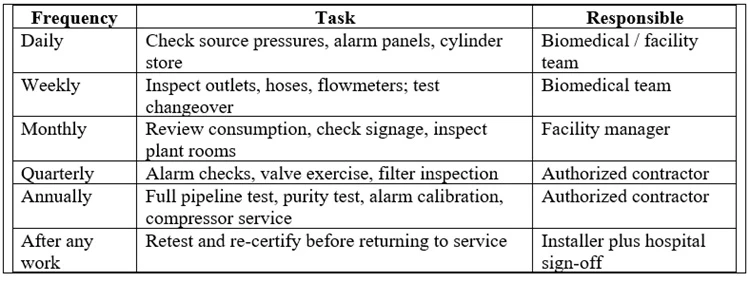
The last row matters most. Any modification, repair or extension must be tested and signed off before patients are connected.
Common Mistakes That Cause Incidents
- Skipping retesting after small repairs
- Assuming color coding makes labels unnecessary
- Letting unqualified staff touch pipeline fittings
- Ignoring recurring nuisance alarms until they become real failures
- No reserve plan for a total supply interruption
- Poor handover documentation between shifts and contractors
FAQs: Medical Gas Safety
What are the main medical gas safety standards?
NFPA 99, ISO 7396-1 and HTM 02-01 are the most referenced, alongside local building and healthcare regulations.
How often should medical gas alarms be tested?
Routine functional checks are usually frequent, with full testing at least annually. Your standard and risk assessment set the exact interval.
Who can work on a hospital medical gas system?
Only trained, qualified and authorised personnel, usually certified installers and verifiers, under hospital supervision.
What is the biggest fire risk with medical gases?
Oxygen enrichment. Even small increases in oxygen concentration make materials ignite more easily and burn more fiercely.
How can hospitals detect medical gas leaks early?
By combining pressure monitoring, consumption trend analysis, area oxygen monitors and scheduled leak-down tests.
Final Thoughts
Medical gas safety is not glamorous, but it is among the most important work in any hospital. The strongest programs share three habits: write it down, test it regularly, and train everyone.
Start small. Print the checklist, assign owners, schedule your next alarm test and review your cylinder store this week. Safety is built from routine actions repeated without fail.