From Incision to Intelligence: How Artificial Intelligence Is Rewriting the Rules of Precision Oncology
Dr Chinnababu Sunkavalli
MS, MCh, PDCR, FIAGES, ACMO, Sr. Consultant, Surgical Oncologist & Robotic Surgeon, Clinical Director, Yashoda Hospitals, Hitec City with Artificial Intelligence
Cancer care is undergoing a major transformation, with artificial intelligence (AI) reshaping diagnostics, targeted therapy, radiotherapy, surgery, and prevention. By translating genomic and molecular complexity into personalised treatment, AI may address ineffective first-line therapies and delayed care. Drawing on precision oncology and robotic surgery, this article examines the evidence and clinical trajectory of AI-driven cancer care, highlighting how AI empowers clinicians rather than replacing them.
The Problem AI Was Built to Solve
Precision oncology rests on a simple but demanding premise: every tumour is biologically unique, and treatment should be matched accordingly - the right patient, the right treatment, at the right time. In practice, this has been extraordinarily difficult to deliver at scale. Genomic profiling, radiographic interpretation, pathology review, and treatment matching each generate more data than any single clinician can synthesise manually. AI is best understood not as a replacement for oncological judgement, but as the intelligence layer that makes precision oncology *scalable* turning what was once boutique, academic-centre medicine into something deliverable anywhere.
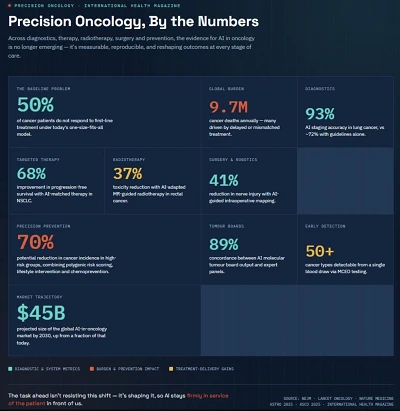
The market signal reflects the urgency: the global AI-oncology sector is projected to reach $45 billion by 2030, driven by convergence across genomics, robotics, real-time imaging, targeted agents, electronic health record analytics, and liquid biopsy. Randomised and real-world data are already substantial - AI-matched targeted therapy has been associated with a 68% improvement in progression-free survival over standard chemotherapy in non-small-cell lung cancer, and AI tumour board recommendations have shown 89% concordance with expert multidisciplinary panels across complex global cases.
Precision Diagnostics: The AI-First Entry Point
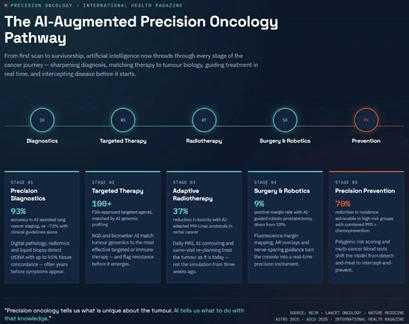
Diagnosis is where AI's impact is most immediately measurable. In digital pathology, deep-learning heatmaps applied to prostate biopsies have cut detection time by roughly 65%. In radiology, AI-enhanced staging models have reached approximately 93% accuracy in lung cancer staging, compared with roughly 72% using clinical guidelines alone. Radiogenomic AI now links imaging phenotypes to underlying tumour genetics non-invasively, and outcome-forecasting models can predict clinically significant radiation toxicity with strong discriminative accuracy.
Liquid biopsy has matured into one of the most consequential diagnostic tools in oncology. A simple blood draw can now detect circulating tumour DNA, circulating tumour cells, and exosomes, achieving up to 95% concordance with tissue biopsy for actionable mutations - with a materially faster turnaround. Population-level screening is following the same trajectory: AI-guided mammography has found roughly 17.6% more cancers, and multi-cancer early detection (MCED) platforms can now screen for 50 or more cancer types from a single 10ml blood sample, many of which currently have no standard screening pathway.
Precision Targeted Therapy: AI as Matchmaker
More than 100 FDA-approved targeted agents now exist - kinase inhibitors, monoclonal antibodies, antibody-drug conjugates, PARP inhibitors, checkpoint immunotherapies, and CAR-T cell therapies. The clinical bottleneck is no longer drug availability; it is matching. AI-driven genomic profiling pipelines take a patient from biopsy through next-generation sequencing, variant classification, tumour mutational burden and microsatellite instability scoring, biomarker matching, and continuous ctDNA-based monitoring of treatment response.
Perhaps most strikingly, AI is compressing drug discovery itself. Tools built on AlphaFold-class protein structure prediction - recognised by the 2024 Nobel Prize in Chemistry - are accelerating target identification and preclinical design, shrinking timelines that once took over a decade toward a fraction of that. In immunotherapy, where historically only 20–30% of patients respond to checkpoint inhibitors, AI-standardised biomarkers (PD-L1 quantification, TMB, MSI, and gene expression profiling) are meaningfully improving patient selection and reducing inter-pathologist variability.
Precision Radiotherapy: Treating the Tumour of Today
Radiotherapy remains part of the treatment plan for roughly half of all cancer patients, and AI is transforming both planning and delivery. Auto-contouring - long the rate-limiting, most variable step in radiotherapy planning - has been substantially accelerated and standardised by AI. Deep-learning dose prediction and knowledge-based planning are turning planning cycles that once took hours into a matter of minutes, enabling same-day radiotherapy in appropriate cases.
Adaptive, MR-guided radiotherapy (MR-Linac) represents the clearest expression of this shift: daily MRI, AI contouring, plan adaptation, gating, and delivery occur as a single real-time loop. In rectal cancer, AI-adapted protocols have shown a 37% reduction in toxicity alongside high rates of pathological complete response. In prostate cancer, Grade 2+ urinary toxicity has fallen from roughly 28% to 9% with AI-guided adaptive hypofractionation. The underlying principle is one every radiation oncologist will recognise as transformative: the plan adapts to the tumour as it exists *that day*, not the simulation from three weeks earlier.
Precision Surgery and Robotics: The View From the Console
As a robotic surgeon, this is where the shift feels most tangible. Surgery has moved through four eras - open, laparoscopic, robotic, and now AI-augmented — each expanding precision while reducing invasiveness. Intraoperative AI now layers real-time intelligence onto every step of an operation:
- **Near-infrared fluorescence** imaging delineates tumour margins with roughly 92% sensitivity, revealing microscopic disease invisible under white light.
- **AI-assisted frozen section pathology** can deliver margin status in under 90 seconds, allowing immediate re-resection before wound closure.
- **Nerve and vessel mapping** projects colour-coded safety margins onto the operative field, reducing nerve injury by around 41% in prostatectomy series.
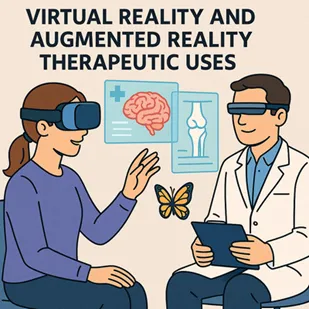
- **Augmented reality overlays** fuse pre-operative imaging with the live surgical field in 3D, guiding resection to millimetre precision even as tissue deforms.
- **AI-assisted stapling and suturing** support routine technical steps, reducing complications such as anastomotic leak.
In AI-guided robotic prostatectomy specifically, comparative series show meaningful gains: positive surgical margins fall from roughly 18% to 9%, nerve-sparing rates rise from 72% to 91%, and 12-month urinary continence improves from 74% to 89%. These are not incremental efficiency gains - they represent a measurable improvement in functional, cancer-relevant outcomes for patients.
Surgical training is being reshaped in parallel. AI-scored operative video, high-fidelity VR simulation, and objective motion-based skill assessment are replacing subjective evaluation, with some programmes reporting up to six-fold faster skill acquisition. Looking toward 2030, the trajectory points toward semi-autonomous robotic tasks, intraoperative genomic feedback, and eventually closed-loop autonomous resection -always, appropriately, under regulatory frameworks that keep patient safety ahead of autonomy.
Precursor Oncology: Intercepting Cancer Before It Begins
Perhaps the most consequential long-term shift is the move from *detect and treat* to *intercept and prevent*. An estimated 70% of cancer cases are preventable with early detection. AI-enabled polygenic risk scoring can analyse over a million genetic variants to stratify lifetime cancer risk across a dozen or more cancer types. Liquid biopsy-based multi-cancer early detection tests now report specificity above 99%, and combined strategies - polygenic risk scoring, lifestyle modification, and evidence-based chemoprevention (such as tamoxifen, aspirin, or finasteride in appropriate risk groups) - have been associated with cancer incidence reductions of up to 70% in high-risk populations.
Equity: AI as the Great Equaliser — If Built Responsibly
Precision oncology has historically been the preserve of well-resourced academic centres. AI offers a genuine opportunity to close that gap: low-cost sequencing-as-a-service models, federated learning that trains global models without moving patient data across borders, digitally stained pathology that removes reagent-cost barriers, and multilingual AI tumour boards that extend expert-level decision support to community oncologists worldwide.
This opportunity carries real obligations. Most genomic reference databases remain overwhelmingly of European ancestry, algorithmic opacity can undermine clinical trust, and genomic data is uniquely sensitive and permanent. Any credible AI-oncology strategy must be validated across diverse populations and health systems, and governed by frameworks that place patient dignity and equitable access above commercial interest.
The Physician Remains the Decision-Maker
None of this displaces clinical judgement. AI compiles, cross-references, predicts, and flags; it does not carry ethical responsibility, build patient trust, or weigh the full context of a person's life and values. In the AI-augmented tumour board model already in use at leading centres, every recommendation carries a full evidence trail -the clinician sees the rationale, confidence level, and relevant trial data, and retains final authority. That balance - AI as a tireless, data-fluent partner, and the physician as the accountable decision-maker - is the model precision oncology should be built around.
Conclusion
Precision oncology tells us what is unique about a tumour. Artificial intelligence tells us what to do with that knowledge — faster, more consistently, and increasingly at global scale. The evidence across diagnostics, targeted therapy, radiotherapy, surgery, and prevention now points in the same direction: earlier detection, better-matched treatment, fewer complications, and more equitable access. The task ahead for oncologists, surgeons, and health systems is not to resist this shift, but to shape it — ensuring that as AI becomes a permanent fixture in the operating room, the reading room, and the tumour board, it remains firmly in service of the patient in front of us.