Regulatory Landscape of Coronary Stents
A Comparative Overview of Regulatory Frameworks in the United States, European Union, and India

Krishna Goyal
Department of Pharmaceutics, National Institute of Pharmaceutical Education and Research Raebareli (NIPER-R)

Ashish Dilip Sutar
Department of Pharmaceutics, National Institute of Pharmaceutical Education and Research Raebareli (NIPER-R)

Dr. Rahul Shukla
Assistant Professor, National Institute of Pharmaceutical Education and Research (NIPER-Raebareli)
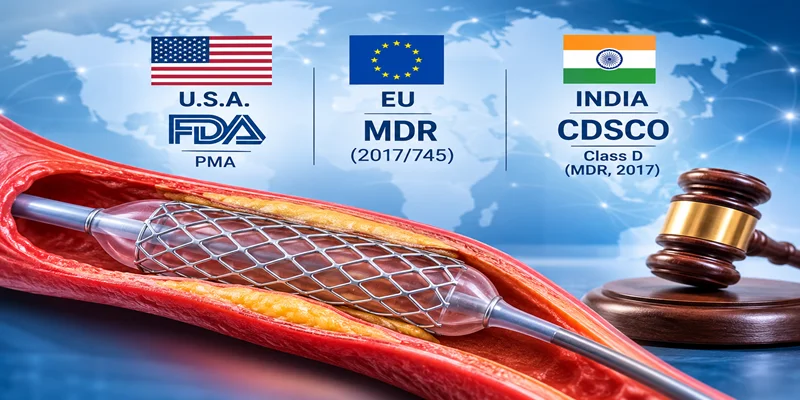
Coronary artery disease, or CAD, is the leading cause of mortality worldwide. It is characterized by the narrowing or blockage of the coronary arteries due to the progressive accumulation of atherosclerotic plaques, resulting in reduced blood flow to the heart muscle. The treatment of CAD has advanced significantly with the evolution of coronary stent technology, progressing from bare-metal stents (BMS) to drug-eluting stents (DES). These developments have improved clinical outcomes and increased the complexity of regulatory assessment, as coronary drug-eluting stents combine mechanical performance with drug delivery. The regulatory requirements for coronary stents differ across major regulatory jurisdictions. They are regulated as Class III devices requiring PMA by the USFDA, as Class III devices under the EU MDR (2017/745), and, in India, Class D medical devices under the Medical Devices Rules, 2017, by CDSCO. This article provides a comparative overview of the regulatory frameworks in India, the United States, and the European Union.
Introduction
Coronary artery disease (CAD) is a condition that develops when atherosclerotic plaque builds up inside the coronary arteries. This buildup reduces the oxygen supply to the heart, which may result in angina and myocardial infarction. Percutaneous coronary intervention (PCI) is a procedure that restores blood flow to the heart by opening blocked coronary arteries with a catheter-based system that places and expands a stent at the site of the blockage. A coronary stent is an expandable scaffold placed in the artery to hold the space open after angioplasty (Fig. 1a). The first-generation stents implanted in humans were bare-metal stents (BMS). BMS were associated with in-stent restenosis due to excessive tissue growth within the stent. This excess tissue growth is due to the body’s response to the stent's foreign material and can be mitigated with drug-eluting stents [1,2].
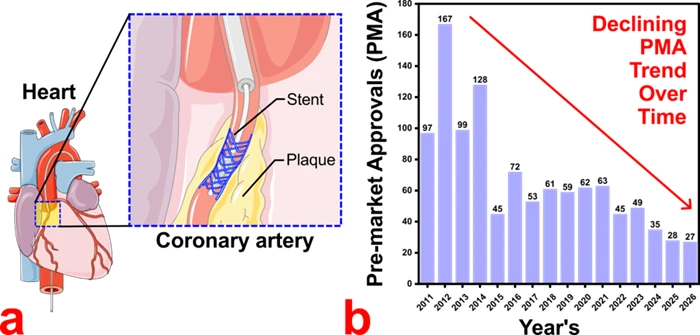
Fig. 1 Schematic representation of stent placement to restore blood flow, illustrating the stent and plaque (a). Bar graph depicting a declining temporal trend in PMA of stents [3] (b).
Drug-eluting stents (DES) are combination products consisting of a metallic scaffold, a therapeutic drug, and a polymer that controls the drug's release [2]. Fig. 1b illustrates the temporal distribution of Premarket Approvals (PMA) for coronary stents in the United States, provides a regulatory perspective on their development and approval history. These trends highlight the relationship between technological advances in coronary stent design and the regulatory processes governing their introduction into clinical practice. This decreasing trend may be due to the combinatorial nature of DES; they are more difficult to develop and assess than conventional mechanical devices. Regulatory agencies evaluate the mechanical properties of stents, the drug and drug-related properties, the coating, biocompatibility, the stent's effect on the procedure, the stent's safety and efficacy, and its long-term effects. The United States, the European Union, and India all have regulatory systems in place. These systems assess the quality, safety, and performance of coronary stents. Although the regulatory pathways differ (Table 1), all three jurisdictions require manufacturers to demonstrate that the device meets applicable safety and performance requirements before it can be marketed.
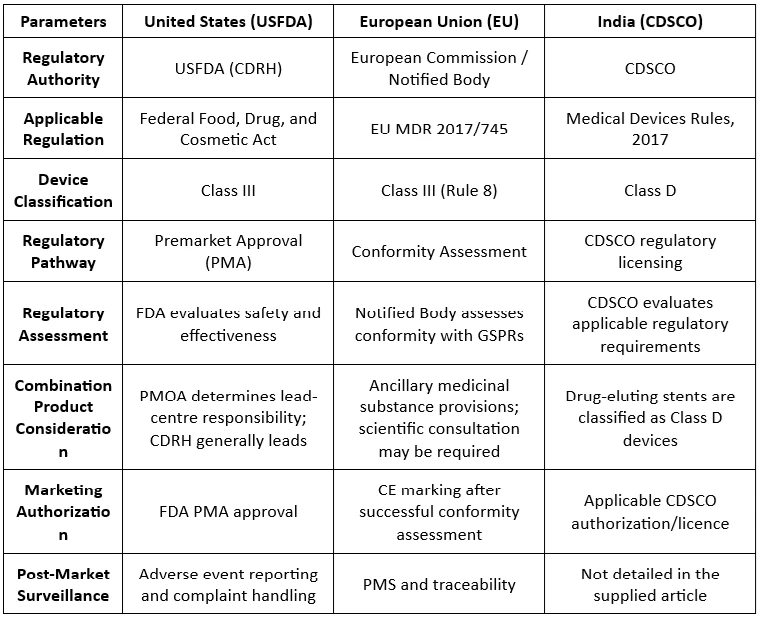
Table 1. Comparative Regulatory Framework for Coronary Drug-Eluting Stents. (Source: Official USFDA regulatory database and PMA information [3,4]; Regulation (EU) 2017/745 [5]; CDSCO Medical Devices Rules, 2017 [6] .)
Regulatory Framework in the United States (US)
In the United States, the Food and Drug Administration’s Centre for Devices and Radiological Health (CDRH) governs medical devices. Coronary drug-eluting stents fall into Class III because they are placed in the coronary circulation and therefore pose a high risk [3,4]. Class III devices are required to have a Premarket Approval (PMA) unless an exemption is granted. Devices in Class III are subject to the highest level of controls, and PMAs are required to provide reasonable assurance of the device's safety and effectiveness. A sponsor of a coronary drug-eluting stent would be required to submit a PMA and include scientific and technical data to support the requested indication for use.
The Coronary DES are classified by the FDA under product code NIQ. A DES is considered a combination product because it is a device that contains a medicinal substance. Therefore, a regulatory assessment of a drug-eluting stent involves aspects of both a medical device and a drug. The FDA determines the primary mode of action (PMOA) to establish which centre will have the primary regulatory responsibility. For drug-eluting cardiovascular stents, the primary mode of action is generally considered to be the mechanical action of the stent in maintaining vessel patency. Therefore, CDRH serves as the lead centre while the Centre for Drug Evaluation and Research (CDER) may provide consultation regarding the drug component.
The FDA requires manufacturers to continue certain activities such as post-marketing surveillance, reporting of adverse events and complaint handling. Manufacturers are also required to ensure that their quality systems remain effective after the medical device is approved. The FDA's Total Product Life Cycle (TPLC) provides users with information on various medical devices, including details on regulatory classification, approval and clearance status, and reasons for caution and/or device recalls.
Regulatory Framework in the European Union
The European Union’s Regulation (EU) 2017/745, known as the Medical Devices Regulation (MDR),replaced the former Medical Devices Directive and increased the requirements for clinical evidence, technical documentation, and post-market surveillance. Most coronary stents are classified as Class III devices under Rule 8 of Annex VIII of the MDR. Class III devices are the highest risk classification of medical devices and are defined as “devices for which there is no available information from which the risk to the health of individuals can be assessed” (Annex XV, MDR). Coronary stents meet this definition, as they are implanted in the body and come into direct contact with the heart and the central circulatory system.
Manufacturers of coronary stents seeking to place their devices on the European market must demonstrate compliance with the applicable General Safety and Performance Requirements (GSPRs) set out in Annex I of the MDR. Typically, the assessment of Class III devices requires involvement of a Notified Body. An EU Member State appoints a Notified Body to verify the conformity of a specific medical device with the relevant EU regulatory requirements. Depending on the assessment route, a Notified Body may assess and evaluate the manufacturer's quality management system, review detailed technical documentation, and assess clinical data and manufacturing control activities. After successful conformity assessment, the manufacturer is authorised to issue the EU Declaration of Conformity and affix the CE marking to the device, thereby allowing the device to be placed on the European market in accordance with the MDR.
Drug-eluting coronary stents require additional regulatory consideration because they incorporate a medicament that has an ancillary effect relative to the device's principal action. Under Article 1(8) and the relevant provisions of the MDR, the regulatory assessment considers the safety, quality and usefulness of the medicinal substance in the context of the device. Devices that contain an ancillary medicinal substance may require the Notified Body to obtain a scientific opinion from a competent authority or the EMA, depending on the regulatory pathway and the nature of the substance. The assessment is conducted to evaluate the safety and quality of the medicinal substance and its benefit-risk profile when incorporated into the device. This is particularly relevant for drug-eluting stents, because the therapeutic drug and the mechanical scaffold must act in tandem to achieve the clinical endpoint.
Regulatory Framework in India
Medical devices in India are regulated under the Medical Devices Rules, 2017, which are made under the Drugs and Cosmetics Act, 1940. The Central Drugs Standard Control Organisation (CDSCO) is the national regulator, and the Drugs Controller General of India (DCGI) heads it. Devices are sorted into four risk classes: A (low), B (low-moderate), C (moderate-high), and D (high). The higher the class, the stricter the approval requirements. Coronary drug-eluting stents are classified as Class D devices under the applicable Indian classification framework due to their high-risk, implantable nature and interactions with the cardiovascular system.
CDSCO classification information includes drug-coated metallic coronary stents, antibody-coated drug-eluting stents, bioabsorbable-polymer drug-eluting stents, and fully bioabsorbable drug-eluting stents within the relevant Class D categories. Manufacturers and importers must obtain the applicable licences before placing these devices on the Indian market. For manufacturing Class C and Class D devices, applications are generally submitted using Form MD-7, with manufacturing licences issued in Form MD-9, subject to applicable requirements. For imports, Form MD-14 is generally used for the application, and Form MD-15 is used for the import licence.
The licensing process requires information concerning the device, intended purpose, manufacturing site, quality management system, technical documentation, and applicable safety and performance evidence. Manufacturers must establish controls ensuring consistency in design, production, testing, packaging, sterilisation, and release of the finished product. Technical documentation should address materials, manufacturing processes, risk management, verification and validation, biological safety, performance testing, and labelling. For DES, it should additionally describe the medicinal substance, drug loading, release profile, coating characteristics, and stability. Clinical evidence may be required according to the device category and applicable regulatory requirements. Where a clinical investigation is necessary, the relevant provisions of the Medical Devices Rules, 2017 apply; Form MD-22 is generally used for the application and Form MD-23 for permission, subject to the applicable requirements.
Post-market surveillance is essential for monitoring the safety and performance of coronary stents after introduction into the Indian market. Manufacturers and importers must maintain appropriate systems for complaint handling, adverse-event reporting, investigation of device-related problems, and implementation of corrective and preventive actions. Long-term monitoring is particularly important for implantable devices because certain complications may develop over time. Manufacturers should verify the applicable requirements against current CDSCO notifications and the device's precise intended purpose and description before preparing regulatory submissions.
Conclusion
Coronary stents have become an important treatment option for patients with CAD. Their development from BMS to modern DES systems has improved treatment possibilities but has also increased regulatory complexity. The presence of mechanical, biological, and pharmacological components requires a comprehensive assessment of the device as a whole. The United States regulates coronary drug-eluting stents as high-risk Class III devices through the PMA pathway. The European Union generally classifies coronary stents as Class III under Rule 8 of the Medical Device Regulation and requires conformity assessment involving a Notified Body. India classifies coronary drug-eluting stents as Class D under the Medical Devices Rules, 2017, with regulatory oversight provided by CDSCO. Despite differences in regulatory pathways, the primary objective of all three systems is to ensure that coronary stents are safe, effective and consistently manufactured. A clear understanding of these regulatory frameworks is essential for regulatory affairs professionals involved in medical device development, regulatory submissions, clinical evaluation and post-market compliance.
References
- J. Nicolas, C. A. Pivato, M. Chiarito, F. Beerkens, D. Cao, R. Mehran, Cardiovasc. Res. 2023, 119, 631.
- D. Padovani, N. Afsharimani, A. Cioncolini, Y. Ding, Communications Engineering 2026, 5, 167.
- USFDA, “USFDA TPLC Total Product Life Cycle,” can be found under https://www.accessdata.fda.gov/scripts/cdrh/cfdocs/cfTPLC/tplc.cfm, 2026.
- U. S. F. and D. Administration, NonClinical Engineering Tests and Recommended Labeling for Intravascular Stents and Associated Delivery Systems: Guidance for Industry and FDA Staff, U.S. Food And Drug Administration, Silver Spring, MD, 2010.
- E. Parliament, C. of the E. Union, Regulation (EU) 2017/745 of the European Parliament and of the Council of 5 April 2017 on Medical Devices, 2017.
- G. of I. Ministry of Health and Family Welfare, Medical Devices Rules, 2017, Government Of India, New Delhi, India, 2017.