The Challenges of Healthcare Logistics through the Lens of GLP-1 Medications

Brajesh Hurkat
Senior Director, Client Excellence, Distribution, DKSH

Healthcare logistics is no longer a tertiary subject. As the prevalence of infectious and non-communicable diseases grows alongside supply chain disruptions due to regional conflicts, unhindered access to medicines remains an emergent need. However, balancing demand and supply is often a colossal task due to the complexities of distribution networks. One case in point is the extremely high demand for glucagon-like peptide-1 receptor agonists or GLP-1 agonists, which are groundbreaking for managing diabetes and aiding in weight loss. This is reflected by its market size which was worth USD 46.70 billion in 2024 and is predicted to grow to USD 322.85 billion by 2034.
Healthcare systems make a great effort to streamline their supply chain to meet the rising demand for various drugs, including GLP-1 class medications. This has become apparent in Southeast Asia – a region characterized by its diversity and latent growth potential. The rising number of patients using inpatient services in public hospitals, which has surpassed pre-pandemic levels, and the increasing prevalence of private hospitals are clear signs of this increase in demand.
Understanding the internal processes as well as the external factors involved in the medication supply chain is a crucial starting point in building a holistic picture of what effects popular drugs like GLP-1 can have on healthcare systems.
Understanding medication supply and demand
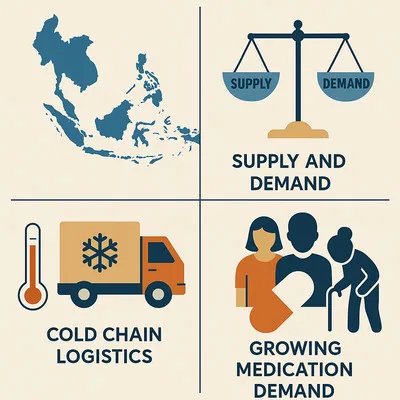
When it comes to understanding supply and demand in healthcare, Southeast Asia offers a valuable case study due to its unique challenges. Though often overlooked, the region accounts for around 8.5% of the global population spread across 11 nations. Each country in this region comprises diverse population groups with equally unique characteristics. This ranges from cultural aspects like spoken language and behavioural nuances, to socio-politically driven factors such as economic capability and legislation.
The diversity of Southeast Asian countries is further reflected through their differing approaches to public healthcare. For instance, public spending on healthcare from country-to-country shifts wildly. This also shapes varied consumer behaviors and regulatory landscapes, which require private healthcare firms to adopt different methods to better cater for the region’s needs. The regulatory norms are particularly challenging as product approvals take longer time compared to many other regions.
Distribution, particularly cold chain logistics, is another complex yet critical area of concern. Drugs, including vaccines and insulin, must be kept in temperature-controlled environments until they are used. Southeast Asia’s vast geography and irregular infrastructure pose hurdles to ensuring these medicines reach consumers in a usable condition. While global networks can deliver products to key regional hubs, the challenge lies in last-mile connectivity. These issues shape services of the market experts and solution. For example, companies like DKSH leverage state-of-the-art cold chain infrastructure, which includes temperature-controlled warehouses, validated transport solutions, and real-time monitoring systems, to ensure product integrity.
The region is also seeing a rise in demand for medication due to an increase in non-communicable diseases, an ageing population, and lifestyle changes. Several conditions, including diabetes, are becoming more prevalent, straining healthcare systems in some countries. This is exacerbated by the growing elderly population that requires more medical attention and specialized care. Furthermore, the rising incidence of chronic diseases such as obesity and Type 2 diabetes requires long-term management that must be backed by a robust supply chain.
These shifts are influencing demand for medicines and reshaping market trends. Increased awareness of health trends through social media and consumer facing communications are driving the demand for certain drugs. As a result, specific drugs such as GLP-1 class medications, are witnessing heightened demand. This increases the pressure on pharmaceutical companies to maintain a consistent supply while overcoming limitations.
These spikes in demand can be devastating for fragile or developing supply chains as they can be overwhelming. Hence, handling these surges must be approached with a focus on flexibility and scalability. This can be achieved with a deep knowledge of demand patterns, effective inventory management, and robust and nimble distribution networks. Additionally, bolstering local production capacities and forming partnerships with key distributors can help ease some of the pressure and ensure the timely delivery of medications, particularly in countries with underdeveloped infrastructure.
Overcoming demand for GLP-1 agonists
For decades, a key challenge in diabetes management was keeping blood sugar levels in check and preventing complications using just a single drug. In this context, GLP-1 agonists not only control blood sugar but improve insulin sensitivity and aid weight loss, thereby delaying complications. In patients with obesity and diabetes, the multiple benefits of this drug make it akin to a silver bullet. However, due to its impact on weight loss, this drug is perceived less as an anti-diabetic and more as a weight-loss aid by the public.
This has led to misinformation, with some recent incidents where social media ads claim it to be a weight loss supplement. Consumption of these drugs without supervision or firm understanding has placed individuals at greater risk. This ever-growing demand has also led to a concerning rise in counterfeit drugs, endangering patients.
One of the key fallouts of this demand-supply gap is the inability of companies to maintain a consistent supply. As production limitations and regulatory hurdles persist, distribution has become a major challenge. Cold chain logistics are particularly critical for GLP-1 agonists, as even a slight deviation can render them ineffective. Real-time tracking, demand forecasting, and proactive replenishment strategies are also used by companies such as DKSH to mitigate supply disruptions and ensure patients receive their medication safely and on time.
Safeguarding the supply chain
Addressing pitfalls in the supply chain in Southeast Asia requires meticulous planning and collaboration with multiple stakeholders such as government bodies, pharmaceutical companies, regulators, and distributors.
Strengthening the quality control protocols is the foremost step to halt the circulation of spurious drugs. Thorough checks at every step of the supply chain prevent the entry of counterfeit drugs. Furthermore, the implementation of cutting-edge technology can also improve transparency and traceability.
In the case of GLP-1 agonists, patient education is critical to shed light on proper usage, potential side effects, and the importance of consulting healthcare professionals. This helps in reducing the risks associated with self-medication and accurately quantifying the benefits and challenges of treatments.
Preparing for future challenges
Such solutions can significantly benefit Southeast Asia, but the demand for innovative medications will continue to grow alongside newer challenges that will test the integrity of the supply chain. As the region grapples with a growing demand for medications, especially innovative treatments like GLP-1 agonists, it is essential to take an active role in addressing these challenges. By fostering collaboration, strengthening patient education, and ensuring the safety and integrity of supply chains, we can create a healthcare ecosystem that benefits both providers and consumers. A strategic alliance between the private and public sectors is essential to develop systems, regulations, and initiatives that will guide the region toward a more secure, efficient, and patient-centric future.
References:
- https://www.globenewswire.com/news-release/2024/11/20/2984125/0/en/GLP-1-Analogues-Market-Outlook-Rapid-Growth-at-21-3-CAGR-to-Surpass-USD-322-85-Billion-by-2034-PMR.html
- https://pmc.ncbi.nlm.nih.gov/articles/PMC8119733/