Preventing Chronic Kidney Disease in Low-Resource Settings: Community-Based Strategies for West Africa

Dr. Hema Aravind
MD, Practising Nephrologist, Dr. Kamakshi Memorial Hospital
Chronic Kidney Disease (CKD) poses a growing public health challenge in West Africa, where limited access to dialysis makes prevention the most effective and sustainable strategy. This article explores community-based approaches to CKD prevention, emphasising early screening for hypertension and diabetes, task-shifting to community health workers, low-cost diagnostic tools, and public education on nephrotoxic substances. Strengthening prevention can significantly reduce CKD burden and healthcare inequities in resource-limited settings.

Introduction
Chronic Kidney Disease (CKD) has emerged as a silent epidemic across low- and middle-income countries, particularly in West Africa. While global attention often focuses on dialysis and transplantation, these interventions remain inaccessible to the majority of patients in this region due to high costs, limited infrastructure, and workforce shortages. As a result, CKD frequently progresses undetected until end-stage kidney disease (ESKD), where treatment options are either unavailable or unaffordable.
In this context, prevention is not merely a clinical choice but a public health imperative. Early detection and risk reduction strategies offer the highest impact per dollar spent and the greatest opportunity to reduce morbidity, mortality, and economic burden. Community-based prevention models—rooted in primary care, supported by task-shifting, and tailored to local realities—represent the most viable pathway forward.
The Burden of CKD in West Africa
West Africa faces a disproportionate burden of CKD driven by a convergence of factors: rising prevalence of hypertension and diabetes, infectious diseases, environmental toxins, herbal medication use, and limited access to routine healthcare. Epidemiological data suggest that CKD prevalence in parts of West Africa rivals or exceeds global averages, yet awareness remains critically low.
Healthcare systems in the region are often overstretched, prioritising acute infectious diseases and maternal-child health. As a result, non-communicable diseases such as CKD receive limited policy attention. The absence of national screening programs and renal registries further obscures the true scale of the problem.
Why Prevention Must Come First
Dialysis and transplantation, while lifesaving, are not scalable solutions in most West African settings. Hemodialysis centers are concentrated in urban areas, require stable electricity and water supply, and remain financially inaccessible to most patients. Even when dialysis is initiated, high dropout rates are common due to out-of-pocket costs.
Prevention, by contrast, offers a cost-effective and equitable alternative. Slowing CKD progression through early identification and risk factor control can dramatically reduce the need for renal replacement therapy. Investing in prevention also aligns with broader public health goals, including cardiovascular disease reduction and health system strengthening.
Hypertension and Diabetes: The Primary Targets
Hypertension and diabetes are the leading causes of CKD worldwide and are increasingly prevalent in West Africa. Unfortunately, both conditions often remain undiagnosed or poorly controlled due to limited screening and follow-up.
Primary Care–Based Screening
Integrating blood pressure and blood glucose screening into routine primary care visits is a foundational step. Opportunistic screening at outpatient clinics, pharmacies, religious gatherings, and community events can significantly improve early detection rates.
Community Outreach Programs
Mobile clinics and outreach initiatives can extend screening to rural and underserved populations. These programs are particularly effective when combined with culturally sensitive education on lifestyle modification, medication adherence, and long-term disease management.
Task-Shifting: Empowering Community Health Workers
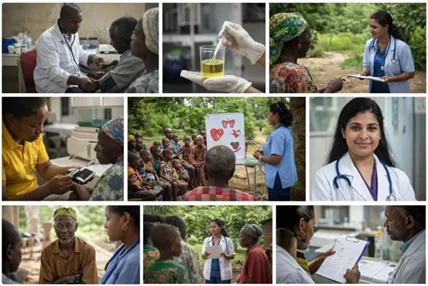
One of the most promising strategies for CKD prevention in low-resource settings is task-shifting—the redistribution of healthcare responsibilities from physicians to trained non-physician personnel.
Role of Community Health Workers (CHWs)
CHWs can be trained to:
- Measure blood pressure and capillary blood glucose
- Perform urine dipstick testing
- Identify high-risk individuals
- Provide basic counseling and referrals
This approach addresses workforce shortages while enhancing community trust and engagement.
Training and Supervision
Effective task-shifting requires standardized training protocols, clear referral pathways, and ongoing supervision by physicians or nurses. Digital tools and telemedicine platforms can further support CHWs, particularly in remote areas.
Low-Cost Diagnostic Tools: Urine Dipstick Screening
Urine dipstick testing is a simple, inexpensive, and underutilized tool for early CKD detection. Screening for proteinuria can identify kidney damage long before serum creatinine levels rise.
Advantages
- Low cost and minimal training required
- Immediate results
- Suitable for mass screening
Implementation Strategies
Urine dipstick testing can be integrated into:
- Primary care visits
- Antenatal clinics
- Diabetes and hypertension programs
Positive findings should trigger repeat testing, risk stratification, and referral when necessary.
Addressing Herbal Nephrotoxins and NSAID Misuse
Traditional herbal remedies play a significant role in healthcare across West Africa. While culturally important, many herbal preparations are unregulated and potentially nephrotoxic. Additionally, widespread over-the-counter availability of non-steroidal anti-inflammatory drugs (NSAIDs) contributes to kidney injury.
Public Education Campaigns
Community education must address:
- Risks of unregulated herbal medicines
- Safe use of painkillers
- Early symptoms of kidney disease
Engaging traditional healers as partners rather than adversaries can improve messaging effectiveness and community acceptance.
Integrating CKD Prevention into Public Health Policy
For prevention strategies to be sustainable, CKD must be embedded within national non-communicable disease (NCD) frameworks. This includes:
- Inclusion of CKD screening in primary healthcare packages
- Subsidisation of essential diagnostics and medications
- Development of referral networks
International partnerships, non-governmental organisations, and academic collaborations can provide technical and financial support during early implementation phases.
The Role of Data and Surveillance
Reliable data are essential for policy planning and resource allocation. Establishing CKD registries, even at a regional or hospital level, can improve understanding of disease patterns and outcomes. Simple data collection tools can be integrated into routine care without overburdening clinicians.
Conclusion
In West Africa, where access to dialysis remains severely limited, preventing CKD is the most realistic and humane strategy to reduce kidney-related mortality. Community-based interventions—centered on early screening, task-shifting, low-cost diagnostics, and public education—offer scalable and sustainable solutions.
By prioritising prevention, healthcare systems can move from crisis-driven care to proactive disease management, improving outcomes not only for kidney disease but for overall population health. The time to act is now, before the growing CKD burden overwhelms already fragile healthcare systems.










-(1).webp)
-(1).webp)