From Code Red to Continuity: Digital Strategies for Climate-Ready Healthcare in Asia

Toni Laracuente
Digital Health Strategist and Global Advisor, Senior Director, Head of Analytics and Digital Health, CHIME
The Asia-Pacific region faces mounting health system threats from climate change, including extreme weather, flooding, heatwaves, sea-level rise, worsening air quality, and energy insecurity. Hospital executives must lead a transition from reactive crisis response to proactive resilience strategies grounded in digital health. This article outlines how telehealth, predictive analytics, virtual care, clean energy, and sustainability-focused infrastructure can strengthen operational readiness, ensure equitable access to care, and deliver long-term financial value. Drawing from regional and global case studies, it offers actionable insights for Board engagement, investment strategy, and health equity leadership.

The New Reality of Climate-Driven Health Disruption in Asia
Asia is the world's most disaster-prone region. In 2022 alone, over 140 climate-related events across Asia displaced millions and disrupted healthcare access, with high mortality among vulnerable populations. Typhoons, urban heatwaves, flooding, and clean water scarcity are testing the limits of healthcare infrastructure and revealing access, digital capability, and operational challenges. According to the WHO, climate change is expected to cause approximately 250,000 additional deaths per year globally between 2030 and 2050, with a disproportionate burden in low- and middle-income countries, many of which are in Asia. Direct impacts on health systems, including physical infrastructure damage, power failure, and workforce displacement, not only disrupt current care delivery models but also escalate costs of care and cause lost income for populations. Indirect impacts include increased frequency of disease outbreaks, mental health deterioration, and increased demand for emergency and chronic care.
Case Study: Kerala, India – Flood Emergency Response (2018)
When massive monsoon flooding hit Kerala, hospitals faced power outages, transportation barriers, and overwhelmed emergency departments. Digital platforms for resource mapping and remote consultations helped mitigate loss of life, but the crisis exposed the need for stronger telehealth capacity and cloud-based infrastructure in rural and semi-urban areas.
Case Study: Pakistan's 2022 Super-Floods
The 2022 monsoon season in Pakistan resulted in catastrophic flooding that submerged a third of the nation. The deluge damaged or destroyed over 2,000 hospitals and clinics, severely hampering healthcare delivery. In the months that followed, health officials reported a dramatic rise in waterborne diseases, including cholera and typhoid, as well as a significant spike in malaria and dengue fever cases. This large-scale, prolonged health crisis underscores the necessity for resilient infrastructure, mobile and virtual care delivery, cross-border data sharing and a digitally enabled supply chain to preposition medical supplies and support remote consultations when physical access is cut off.
Case Study: The 2024 Pan-Asian Heatwave
Across Asia, the spring of 2024 brought a devastating preview of the new reality: extreme heat. In Thailand, more than 60 heatstroke fatalities were recorded as temperatures soared. In the Philippines, the heat index reached dangerous levels, forcing widespread school closures. In India's capital, Delhi, temperatures climbed to a record 52.9°C (127.2°F), leading to a surge in patients suffering from heat-related illnesses and overwhelming emergency services and hospital capacity. These events highlight the urgent need for hospitals to develop and implement heat action plans, utilising digital tools to monitor high-risk patients, manage surges in demand, and adapt models of care.
Case Study: Southern China Floods (July 2025)
In late June and early July of 2025, southern and eastern China were hit by extreme rainfall, causing severe flooding and landslides across several provinces, including Hunan and Guizhou. These historic floods led to dozens of fatalities and forced the evacuation of hundreds of thousands of people. The widespread destruction damaged infrastructure, cut off transportation and communication links, and inundated entire towns, affecting over 400,000 residents and displacing more than 95,000. Such events place immense pressure on healthcare systems, not only by damaging facilities but also by creating a secondary crisis of disease and displacement that requires a coordinated, large-scale emergency response.
Case Study: Singapore's National Electronic Health Record (NEHR) During Haze Events
Singapore's integrated NEHR system has proven invaluable during transboundary haze pollution episodes:
- Automatic alerts to patients with respiratory conditions when PM2.5 levels spike
- Population-level analytics identifying vulnerable clusters
- Integration with environmental sensors for real-time risk stratification
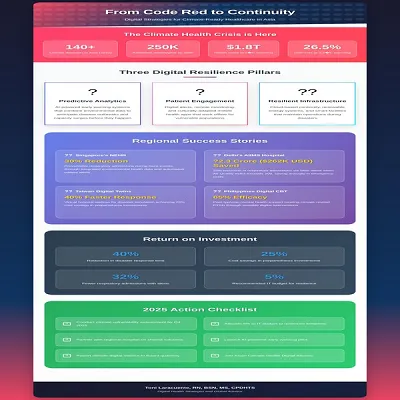
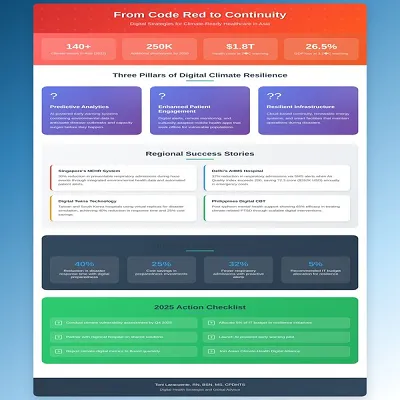
- 30% reduction in preventable respiratory admissions during the 2019 haze event
Learning opportunities for healthcare leaders in Asia:
- Integrated environmental, health data analytics and patient communications systems enable proactive population health management and improved outcomes.
- Hospitals in Asia's urban centers must prepare for heat stress and service surges, while rural systems face power instability, limited internet connectivity, and workforce shortages. Resilience and adaptation strategies must be designed for both settings.
Digital Health: The Strategic Enabler of Resilience
Digital health capabilities support climate resilience by enabling:
Remote and Distributed Care: Telemedicine, virtual speciality care and mobile health reduce dependence on physical access, particularly in remote islands, mountainous areas, and flood zones.
Predictive Analytics: Environmental data and AI-enabled early warning systems anticipate climate-linked disease outbreaks and emergency demand surges, improving capacity and resource management.
Cloud-Based Continuity: Cloud-hosted EHRs and mobile command platforms preserve operations during typhoons, brownouts, or infrastructure damage.
Smart Supply Chain: Platforms track logistics, reposition stock, and prevent shortages of medications, oxygen, or IV fluids during port or road closures. Robotics and drone delivery technologies improve access to critical supplies during times of disruption.
Actionable Strategies for Climate Adaptation and Mitigation
Hospital leaders can transition from reactive crisis response to proactive resilience by investing in key digital health strategies. These strategies strengthen operational readiness, ensure care continuity, and protect vulnerable populations.
1. Implement Predictive Analytics for Proactive Response
Leveraging data is critical for anticipating and mitigating climate-related health threats before they escalate.
Early Warning Surveillance Systems: Use predictive analytics that combine environmental data with AI to anticipate climate-linked disease outbreaks and emergency surges.
Air Quality Forecasting: Implement air quality forecasting and integrate real-time pollution data with electronic health records (EHRs). This enables proactive outreach to populations at high risk of respiratory illness. Delhi's AIIMS Hospital reduced respiratory admissions by 32% through SMS alerts when the Air Quality Index exceeds 200, auto-prescription refills for maintenance inhalers, virtual pulmonology clinics during peak pollution, resulting in ₹2.3 crore saved in emergency costs annually.
Disaster Simulation: Develop digital twin models of hospital facilities and surrounding regions to run disaster simulations for better planning and response.
Digital Twins: Virtual Hospitals for Real Disasters
Healthcare systems in Taiwan and South Korea are pioneering digital twin technology to model climate impacts:
- Virtual replicas of hospital infrastructure test flood scenarios
- AI simulates patient surge patterns during heatwaves
- Supply chain stress testing identifies critical failure points
- ROI: 40% reduction in disaster response time, 25% cost savings in preparedness investments
2. Enhance Patient Engagement and Communication
Digital tools can bridge communication gaps and enable targeted care during climate emergencies.
Proactive Outreach: Adopt remote monitoring systems to proactively reach high-risk patients during events like heatwaves, potentially diverting unnecessary hospital admissions.
Targeted Alerts and Education: Deploy digital alert systems and educational materials that are culturally and linguistically adapted for diverse populations across India, Southeast Asia, and the Pacific.
Inclusive Design: Ensure mobile health applications are designed to work offline or on basic phones to reach communities with limited internet connectivity. These apps should also integrate with local community health volunteer systems.
Medication Management: Use digital tools like remote spirometry and medication adherence apps to help patients manage chronic conditions like asthma, reducing exacerbations during periods of poor air quality.
The Hidden Crisis: Climate Anxiety and Digital Mental Health
Climate disasters create lasting psychological impacts requiring scalable digital interventions:
- Post-typhoon PTSD rates reach 30-40% in affected populations
- Digital CBT platforms in the Philippines showed 65% efficacy post-Haiyan
- AI chatbots providing 24/7 crisis support in local languages
- Integration with traditional healers through digital training programs
3. Strengthen Digital and Physical Infrastructure
Resilient infrastructure is the backbone of healthcare continuity when a disaster strikes.
Cloud-Based Continuity: Transition to cloud-hosted EHRs and mobile command platforms. This approach preserves access to critical patient data and operational systems even if physical hospital infrastructure is damaged or experiences a power failure.
Data Interoperability: Establish cross-border health data interoperability protocols to facilitate care for populations displaced by climate-related disasters.
Energy Security: To counter power failures during typhoons or brownouts, invest in local power backups. Transitioning diesel backup generators to solar-battery hybrid systems can improve energy security and reduce emissions.
Smart Facilities: Invest in energy-efficient infrastructure, such as smart HVAC systems, to reduce operational costs and improve uptime during climate extremes.
Health Equity: A Central Pillar of Resilient Care in Asia
The region is marked by diversity, wealth, language, geography, and health access challenges. Climate change disproportionately impacts low-income, rural, and indigenous populations, who often lack access to digital infrastructure. Asia, particularly the South-East Asia region, is warming faster than most other highly populated regions on Earth. One of the most pressing health threats linked to climate and environmental conditions in Asia is the rising rate of asthma and respiratory disease due to poor air quality. Cities such as Delhi, Jakarta, and Ulaanbaatar routinely experience pollution levels far exceeding WHO thresholds, leading to chronic respiratory conditions and spikes in emergency admissions. Climate change exacerbates these risks by increasing ground-level ozone, dust storms, and wildfire smoke.
The Widening Threat of Vector-Borne Diseases
Beyond respiratory illnesses, climate change is fueling the spread of vector-borne diseases. Warmer, wetter conditions are expanding the habitats of disease-carrying mosquitoes. For instance, dengue fever is now being reported in mountainous regions of Nepal, areas previously considered too cold for the vector to thrive. In 2023, Bangladesh faced its most severe dengue outbreak in history, with over 300,000 cases and more than 1,500 deaths, a public health emergency linked to an unusually long monsoon season.
This escalating threat necessitates the use of predictive analytics, integrating climate data with epidemiological surveillance to forecast outbreaks and allow for targeted public health interventions and community awareness campaigns delivered via mobile platforms.
Digital health solutions can help mitigate this burden. AI-powered air quality forecasting, real-time alert systems, and integration of pollution data with electronic health records enable proactive outreach to at-risk populations. Digital inhaler tracking, remote spirometry, and medication adherence apps can further reduce exacerbations and improve patient outcomes.
The Financial Case for Resilient and Sustainable Systems
Under projected global warming scenarios, Asia faces escalating health and economic consequences by 2050. At a 2 °C increase in temperature, the region could incur direct health-related expenses of $1.8 trillion and suffer an estimated 588 million disability-adjusted life years (DALYs) lost. In a worst-case scenario of 3.2 °C warming, the economic toll is projected to climb sharply, with losses reaching 26.5% of regional GDP. These projections highlight the compounding burden of climate change on public health and economic stability, reinforcing the urgency for decisive mitigation and adaptation efforts across the region (Ellerbeck, 2022).
In resource-constrained settings, the financial case for resilience is essential:
Cost Avoidance: Downtime from flooding or brownouts costs hospitals thousands in diversion penalties and emergency response.
Efficiency Gains: Digital triage and remote monitoring reduce avoidable ED visits and hospital admissions.
Energy and Infrastructure ROI: Solar microgrids, efficient HVAC systems, and smart facilities cut energy costs while improving uptime.
Funding Opportunities: Asian hospitals can tap into global climate finance (e.g., Green Climate Fund, ADB resilience loans, Asian Development Bank).
The principle of "first, do no harm" must extend beyond clinical care to environmental stewardship. Powering hospitals with fossil fuels contributes to the very emissions driving climate-related disasters. Transitioning to clean and renewable energy not only reduces operational costs and emissions but also ensures that care delivery is part of the solution. By investing in solar, wind, and battery storage systems, health systems can strengthen energy security, reduce pollution-related illness, and lead by example in climate mitigation.
Additional actions:
- Perform a baseline carbon footprint audit and publish a net-zero roadmap.
- Transition diesel backup generators to solar-battery hybrid systems.
- Join regional health sustainability networks (e.g., GGHH Asia, ASEAN Health and Environment Alliance, Healthcare without Harm etc.).
Engaging Boards in Asia: Governance Strategies
Board engagement may vary in Asia where governance structures include government-run systems, family-owned hospitals, or academic-medical institutions. Suggested approaches:
Link to National Resilience Goals: Align with disaster risk reduction strategies in national health plans (e.g., Thailand, India, Philippines).
Showcase Peer Models: Present successful regional examples (e.g., Singapore's Smart Health, Kerala's response model).
Quantify Risk and ROI: Use typhoon history or flood risk maps to model downtime costs and compare them with digital investment paybacks.
Leverage Multilateral and NGO Support: Frame digital and climate investments as co-funded opportunities, not solely budget burdens.
Use a Readiness Index: Benchmark digital climate resilience across peer institutions in the region.
Create a Climate and Resilience Subcommittee: Integrate reporting into standard Board dashboards and governance cycles.
Strategic Priorities for Asian Hospital Leaders
- Integrate climate risk into digital health strategy and capital planning
- Build hybrid and mobile care models for disaster-prone regions
- Invest in energy-efficient infrastructure and local power backups
- Transition to renewable energy sources to reduce emissions and dependency on fossil fuels
- Strengthen local health worker digital training and surge planning
- Develop regional health-climate data hubs for shared risk modelling
- Partner with NGOs, development banks, and public health agencies for co-investment
2025 Imperative: Your Action Checklist
Asia's health systems are on the frontlines of climate disruption. The C-suite must lead by embedding digital health, sustainability, and equity into strategic transformation. This is not just a climate or technology issue. It is a health system survival imperative. Those who act now will safeguard operations, improve outcomes, and elevate their role as regional health leaders.
Act today:
☐ Conduct climate vulnerability assessment by Q4 2025
☐ Allocate 5% of IT budget to resilience initiatives
☐ Partner with one regional hospital on shared solutions
☐ Launch one AI-powered early warning pilot
☐ Report climate-digital metrics to the Board quarterly
☐ Join the Asian Climate-Health Digital Alliance
As technology continues to evolve, healthcare professionals must remain vigilant in applying ethical frameworks to new situations while maintaining focus on patient welfare, equity, and safety and information protection. The evidence is clear: Hospitals that invest in digital climate resilience today will not only survive tomorrow's disasters but will thrive as leaders in sustainable, equitable healthcare delivery. The time for action is now.