Ferroptosis vs Apoptosis: How Cancer Cells Die Differently
Ferroptosis vs Apoptosis: How Cancer Cells Die Differently
.webp)
Kate Williamson
Editorial Team, Asian Hospital & Healthcare Management
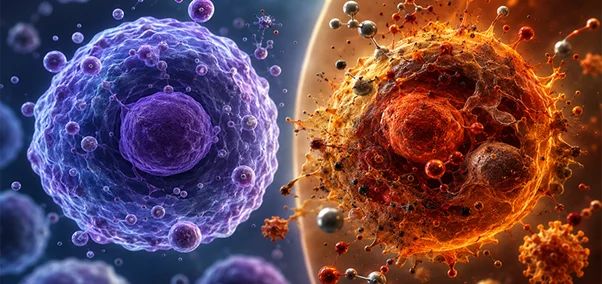
This article explores ferroptosis vs apoptosis, two distinct cancer cell death pathways. While apoptosis relies on caspase signaling, ferroptosis involves iron-dependent cell death cancer researchers now target therapeutically. Comparing these regulated cell death mechanisms reveals why ferroptosis-inducing therapies offer promising alternatives for tumors resistant to conventional apoptosis-based cancer treatments.
Introduction:
For decades, apoptosis was the star of the cell death story. It was the pathway researchers understood best, the one drug developers targeted most often, and the one textbooks used to explain how the body clears out damaged or dangerous cells. But cancer cells are notoriously good at dodging apoptosis, which is exactly why oncology research has turned its attention to alternative routes to cell death. Among these, ferroptosis has emerged as one of the most promising and heavily studied mechanisms.
Understanding ferroptosis vs apoptosis isn't just an academic exercise. It has real implications for how we design cancer therapies, especially for tumors that have become resistant to conventional treatment. This article breaks down how each process works, why the differences matter, and what they mean for the future of cancer research.
Why Cell Death Matters in Cancer Biology
Every cell in the body operates on a kind of built-in expiration policy. When a cell becomes damaged, infected, or simply outlives its usefulness, the body has systems in place to eliminate it. This isn't random destruction — it's a tightly controlled process governed by an entire family of regulated cell death mechanisms, each with its own triggers, molecular players, and biological purpose.
Cancer happens, in part, when these systems break down. Cells that should be marked for elimination instead find ways to survive, divide, and spread. This is why so much cancer research revolves around a single question: how do we push malignant cells back into a death pathway they've learned to avoid?
Apoptosis has traditionally been the go-to answer. But as tumors develop resistance to apoptosis-inducing drugs, scientists have had to look elsewhere — and that search led them to ferroptosis.
What Is Apoptosis?
Apoptosis is often described as "programmed cell death" because it follows a predictable, orderly sequence of events. It's the body's clean-up crew — quiet, efficient, and non-inflammatory. When a cell undergoes apoptosis, it shrinks, its DNA fragments in a controlled manner, and the cell eventually breaks apart into small membrane-bound pieces called apoptotic bodies. These are then quietly cleared away by neighboring cells or immune cells, without triggering inflammation.
There are two main routes into apoptosis:
- The intrinsic pathway, triggered by internal stress signals such as DNA damage or mitochondrial dysfunction. This pathway relies heavily on proteins from the Bcl-2 family, which regulate whether mitochondria release cytochrome c, a key trigger for the death cascade.
- The extrinsic pathway, triggered by external signals — specifically, death receptors on the cell surface that bind to signaling molecules instructing the cell to self-destruct.
Both pathways converge on a family of enzymes called caspases, which execute the final steps of cell dismantling. This is why apoptosis is often called "caspase-dependent" cell death.
The problem for cancer treatment is that many tumors accumulate mutations that disable this pathway. Overexpression of anti-apoptotic proteins, loss of functional p53, or disruptions in death receptor signaling can all make cancer cells essentially immune to apoptosis-based therapies. This resistance is one of the central obstacles in modern oncology, and it's a major reason researchers began exploring other forms of regulated cell death.
What Is Ferroptosis?
Ferroptosis is a comparatively newer discovery, first formally characterized in 2012. Unlike apoptosis, it doesn't rely on caspases at all. Instead, ferroptosis is driven by iron and lipid chemistry — specifically, the uncontrolled buildup of lipid peroxides within cell membranes.
Here's the basic mechanism: cells normally rely on an enzyme called glutathione peroxidase 4 (GPX4) to neutralize lipid peroxides before they cause damage. GPX4 depends on the antioxidant glutathione, which in turn depends on a functioning cystine transport system (commonly referred to as system Xc-). When this defense system is disrupted — either because glutathione is depleted or GPX4 is inhibited — lipid peroxides accumulate unchecked.
This is where iron enters the picture. Iron catalyzes reactions (via Fenton chemistry) that generate reactive oxygen species, accelerating lipid peroxidation even further. The result is a form of iron-dependent cell death cancer researchers now recognize as structurally and mechanistically distinct from apoptosis. The cell membrane becomes progressively more damaged until it ruptures, releasing cellular contents in a manner quite different from the tidy packaging seen in apoptosis.
Morphologically, ferroptotic cells look nothing like apoptotic ones. Instead of shrinking, mitochondria in ferroptotic cells become smaller and denser, with reduced or absent cristae, and the outer membrane often ruptures. There's no chromatin condensation and no apoptotic body formation — this is a fundamentally different death process at the cellular level.
Ferroptosis vs Apoptosis: Key Differences
When comparing ferroptosis vs apoptosis, several distinctions stand out:
Trigger mechanism. Apoptosis is driven by caspase activation through internal or external signaling cascades. Ferroptosis is driven by iron-catalyzed lipid peroxidation and failure of the GPX4 antioxidant system.
Morphology. Apoptotic cells shrink and fragment into apoptotic bodies. Ferroptotic cells swell, and their membranes rupture without the orderly packaging seen in apoptosis.
Key regulators. Apoptosis depends on Bcl-2 family proteins, death receptors, and caspases. Ferroptosis depends on GPX4, iron metabolism, glutathione levels, and polyunsaturated fatty acid content in cell membranes.
Inflammatory response. Apoptosis is generally considered immunologically silent. Ferroptosis, by contrast, can release damage-associated molecular patterns that provoke inflammation, which may have implications for anti-tumor immunity.
Resistance in cancer. Many cancer cells evolve resistance to apoptosis but remain vulnerable to ferroptosis, particularly cancers with high iron dependency or mesenchymal characteristics, such as certain drug-resistant and metastatic cell populations.
These differences are precisely why ferroptosis has generated so much excitement in cancer research. If a tumor has shut down its apoptotic machinery, ferroptosis offers a separate door into cell death — one that operates on entirely different biochemistry.
Why This Distinction Matters for Cancer Treatment
Cancer cells often have an altered relationship with iron. Rapidly dividing cells generally require more iron to support DNA synthesis and metabolic processes, which means many tumors accumulate higher intracellular iron levels than normal tissue. While this supports their growth, it also creates a vulnerability: more iron means more potential for ferroptosis-inducing reactions once the right trigger is applied.
This has led to growing interest in therapies that specifically induce iron-dependent cell death cancer researchers can exploit — including GPX4 inhibitors, system Xc- blockers, and iron-modulating compounds. Some experimental drugs, like erastin and RSL3, work precisely by disabling the cell's defenses against lipid peroxidation, pushing cancer cells toward ferroptotic collapse.
There's also growing evidence that combining ferroptosis-inducing agents with traditional apoptosis-based therapies could improve outcomes in resistant cancers. Since these are two mechanistically separate regulated cell death mechanisms, they don't necessarily share resistance pathways. A cancer cell that has adapted to survive apoptotic signals may have no defenses at all against ferroptotic stress, and vice versa.
This dual-pathway approach is particularly relevant for cancers known for poor response to standard chemotherapy, including certain subtypes of pancreatic cancer, ovarian cancer, and treatment-resistant melanoma. Research continues to explore how ferroptosis sensitivity varies across cancer types and what biomarkers might predict which tumors will respond best to ferroptosis-based interventions.
The Bigger Picture: A Growing Family of Cell Death Pathways
It's worth remembering that apoptosis and ferroptosis are just two branches of a much larger tree. Necroptosis, pyroptosis, and autophagy-dependent cell death are among the other regulated cell death mechanisms currently under investigation. Each has unique triggers, molecular signatures, and potential therapeutic applications.
What makes the apoptosis-ferroptosis comparison particularly significant is the scale of resistance apoptosis-targeted therapies have encountered in clinical settings. As more tumors demonstrate the ability to bypass apoptotic signaling, ferroptosis has moved from a niche research topic to a genuine therapeutic target with active clinical investigation underway.
Final Thoughts
The comparison of ferroptosis vs apoptosis reveals two fundamentally different strategies the body uses to eliminate unwanted cells — one orderly and caspase-driven, the other chaotic and iron-fueled. For cancer researchers, this distinction isn't just interesting biology; it's a roadmap for new treatment strategies.
As apoptosis resistance continues to limit the effectiveness of many standard cancer therapies, ferroptosis offers a genuinely different angle of attack. By targeting iron metabolism and lipid peroxidation instead of caspase signaling, researchers may be able to reach cancer cells that have otherwise learned to survive. The future of oncology likely won't rely on any single cell death pathway, but on a combined understanding of how these regulated cell death mechanisms can be leveraged together to outmaneuver even the most resistant tumors.
Frequently Asked Questions
What is the main difference between ferroptosis and apoptosis?
Apoptosis is a caspase-driven, programmed cell death process involving controlled cell shrinkage and fragmentation. Ferroptosis is an iron-dependent cell death caused by uncontrolled lipid peroxidation in cell membranes. They differ in triggers, regulatory proteins, morphology, and inflammatory response.
Is ferroptosis a type of apoptosis?
No. Ferroptosis is a distinct, caspase-independent form of regulated cell death. It does not involve the Bcl-2 family proteins or caspase activation that define apoptosis, making it mechanistically separate rather than a subtype.
Why is ferroptosis important in cancer treatment?
Many cancer cells resist apoptosis but remain vulnerable to ferroptosis. Since cancer cells often have higher iron demands, inducing iron-dependent cell death offers a therapeutic pathway for tumors that no longer respond to apoptosis-based treatments.
What triggers ferroptosis in cells?
Ferroptosis is triggered when glutathione levels drop or GPX4 enzyme activity is inhibited, allowing iron-catalyzed lipid peroxides to accumulate in cell membranes until the membrane ruptures.
What role does iron play in ferroptosis?
Iron drives ferroptosis through Fenton chemistry, generating reactive oxygen species that accelerate lipid peroxidation. This iron dependency is what distinguishes ferroptosis from other regulated cell death mechanisms.
Can ferroptosis and apoptosis be targeted together in cancer therapy?
Yes. Since these are mechanistically independent regulated cell death mechanisms, combining ferroptosis-inducing agents with apoptosis-based therapies may overcome drug resistance in tumors that have adapted to survive one pathway but not the other.
Most Read Articles







-(1).webp)