From Data to Diagnosis
How Agentic AI and EHRs Can Close the Diagnosis Gap in Minority Estrogenopathies
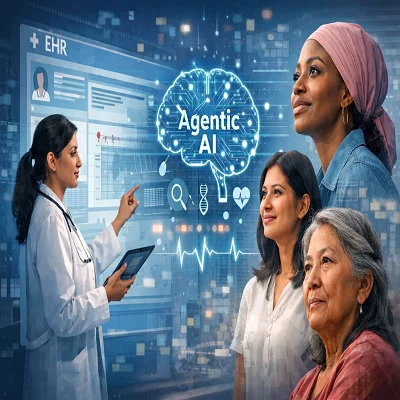
We propose an AI-driven alert embedded in electronic health records to flag symptom patterns suggestive of systemic lupus erythematosus. By prompting patients and clinicians earlier, the system accelerates referral and diagnosis, mitigates diagnostic delays affecting women and minorities, and reduces discriminatory practices that worsen morbidity, organ damage, and quality-of-life outcomes.
Introduction:
Electronic Health Records (EHRs) are no longer passive repositories built for regulatory compliance. They are evolving into dynamic engines that can actively improve care quality, equity, and outcomes. When coupled with agentic artificial intelligence (AAI), EHRs have the potential to address one of healthcare’s most persistent failures: delayed and inequitable diagnosis among minority women with estrogen-driven diseases, or estrogenopathies.
Estrogenopathies, including flares in systemic lupus erythematosus (SLE), endometriosis, estrogen receptor–positive breast cancer, ovarian and cervical cancers, and osteoporosis, disproportionately affect women and are strongly influenced by estrogen dysregulation. While biology plays a role, delayed diagnosis is not a biological problem. Across healthcare systems, women experience longer diagnostic timelines than men, and these delays are amplified among racial and ethnic minority women. The consequences are profound: later-stage disease at presentation, delayed treatment initiation, higher morbidity, and poorer long-term outcomes.
This article explores how the convergence of EHRs and AAI can move healthcare from reactive documentation to proactive, equitable diagnosis, particularly for minority estrogenopathies.
The Diagnosis Gap in Minority Estrogenopathies
Evidence consistently shows that minority women are diagnosed later and at more advanced stages across multiple estrogen-driven conditions. Black and Hispanic women are less likely to receive timely diagnosis for endometrial disease, are diagnosed years later than White women in some cohorts, and are less likely to undergo definitive diagnostic procedures such as laparoscopy for endometriosis. In breast and ovarian cancers, minority women experience longer diagnostic intervals and higher odds of late-stage disease at presentation. Similar disparities exist in osteoporosis, where Black and Hispanic women are significantly less likely to receive bone density testing, this even after sustaining a fracture.
These delays are not random. They reflect a complex interplay of structural bias, socioeconomic constraints, limited access to specialty care, and symptom dismissal, particularly when symptoms are non-specific, chronic, or perceived as “imaginary or psychosomatic” The result is a systemic diagnosis gap that traditional clinical workflows have failed to close.
EHRs: From Digital Records to Clinical Intelligence
Modern EHRs are living, longitudinal narratives of patient health. Beyond demographics, diagnoses, and laboratory results, EHRs increasingly integrate imaging, pathology, genomics, medication histories, and social and behavioral data. With tokenisation and privacy-preserving architectures, data can now be linked across providers, payers, and healthcare ecosystems without compromising patient confidentiality.
Large-scale initiatives such as the All of Us Research Program and the UK Biobank demonstrate how EHR-linked datasets can extend far beyond episodic clinical encounters to include wearable data, lifestyle factors, geographic indicators for both patient and provider, and social determinants of health. These dimensions are particularly relevant to estrogenopathies, where disease risk and progression are influenced by environmental, behavioral, and socioeconomic variables alongside biology.
Yet, despite the abundance of data, most EHR systems remain underutilised for early diagnosis. Alerts are typically protocol-driven, retrospective, and siloed. What is missing is an intelligence layer capable of continuous reasoning across time, data sources, and populations.
Machine Learning to AAI: A Step Change
Machine learning (ML) models already extract value from EHRs by predicting disease risk, staging disease, estimating time-to-event, and identifying fast progressors. Tools such as the Kidney Failure Risk Equation, biomarker-based flare predictors in lupus, and point-of-care decision support platforms like MDCalc illustrate the clinical utility of data-driven models. They can predict secondary diseases following the index injury or disease, such as lupus nephritis in patients with systemic lupus erythematosus, and congestive heart failure following a myocardial infarction. Emerging diagnostic copilots, including large language model (LLM)–based systems, can rapidly generate differential diagnoses from clinical narratives.
AAI represents the next evolution. Unlike static predictive models, AAI can autonomously plan, reason, and act toward defined clinical goals. By integrating ML, LLMs, and reinforcement learning, these systems can continuously analyse longitudinal EHR data, adapt to new information, and coordinate actions across workflows.
In the context of minority estrogenopathies, AAI can:
- Continuously monitor symptom trajectories, laboratory trends, and care utilisation patterns.
- Incorporate external risk modifiers such as race, geography, diet, and access to care.
- Estimate individualized time-to-diagnosis or time-to-complication risk.
- Most importantly, proactively alert clinicians and patients when diagnostic thresholds are likely to be crossed.
Rather than waiting for the disease to declare itself overtly, AAI enables earlier, anticipatory engagement.
Reducing Bias, Advancing Equity
Crucially, AAI can be designed to counteract, rather than reinforce, existing biases. By grounding alerts in objective longitudinal data and transparent risk logic, these systems can prompt evaluation even when symptoms are subtle or historically discounted. For minority women, whose concerns are more likely to be minimised and even dismissed, this represents a powerful mechanism for bias mitigation.
Alerts can be structured to recommend diagnostic escalation, guideline-based testing, or specialist referral, while simultaneously engaging patients through portals or digital outreach. In doing so, AAI shifts the burden of advocacy away from patients and embeds equity directly into clinical workflows.
From Compliance to Care Quality
The convergence of EHRs and AAI mirrors a broader shift in healthcare, from documentation to decision-making, from volume to value, and from reactive care to prevention. Earlier diagnosis of estrogenopathies not only improves individual outcomes but also reduces downstream costs associated with advanced disease, hospitalisations, and complications.
The data infrastructure already exists. The analytical tools are maturing rapidly. What remains is intentional deployment, governance, and cultural adoption.
Conclusion
Delayed diagnosis in minority estrogenopathies is not an intractable problem; rather, it is a solvable systems failure. By marrying AAI with rich, longitudinal EHR data, healthcare organisations can identify risk earlier, reduce diagnostic bias, and initiate treatment when it is most effective.
EHRs are no longer just records of what has happened. With AAI, they become instruments of foresight and actionable, driving more timely, equitable, and human-centered care. The opportunity is clear, and the time to act is now. Weaponisation of AAI for diagnostic equity should be mandated.

Prakash Narayan
Prakash Narayan, PhD, is the Founder and CEO of Nodes and Edges, LLC, NC. He is an experienced biotechnology and pharmaceutical leader specializing in drug development strategy. With approximately 25 years of experience leading programs from concept to clinical trials, he has worked across small molecules and biologics and has led IND-, BLA-, and NDA-enabling programs. He has published extensively, advises life science ventures, while advocating for precision medicine, and improved patient outcomes.