Symptom Bots in India: Bridging the Gap Between Patients and Doctors

Dr. (Col.) Surendra Ramamurthy
Chief Medical Officer & Founding Member, Nextcare Life
Symptom bots are revolutionizing healthcare in India by providing AI-powered preliminary assessments, bridging the gap between patients and doctors. These intelligent chatbots enhance accessibility, reduce unnecessary doctor visits, and streamline healthcare delivery. This article explores their impact, benefits, challenges, and future potential in India's rapidly evolving digital health landscape.
Introduction
India’s healthcare system is characterized by significant disparities between urban and rural access to medical services. With a population exceeding 1.4 billion and a severe shortage of healthcare professionals, millions of Indians face challenges in receiving timely medical attention. The advent of digital health technologies, particularly AI-driven symptom bots, is revolutionizing how healthcare is accessed and delivered. These bots serve as the first line of medical inquiry, guiding patients through preliminary symptom assessments, offering potential diagnoses, and advising on next steps.
The Growing Need for Symptom Bots in India
1. Doctor-to-Patient Ratio Crisis
India has a doctor-to-patient ratio of 1:1511, which falls short of the WHO-recommended 1:1000 ratio. The situation is even more dire in rural areas, where only 25% of healthcare professionals cater to nearly 70% of the population. With such a shortfall, symptom bots act as virtual assistants, guiding patients in understanding their symptoms and determine whether a hospital visit is necessary.
2. High Out-of-Pocket Healthcare Costs
More than 60% of India’s healthcare expenditure is out-of-pocket, placing a significant financial burden on households. Many patients either rush to expensive consultations for minor ailments or delay seeking medical attention due to financial concerns. Symptom bots provide a cost-effective initial screening, reducing unnecessary doctor visits and guiding patients toward more economical healthcare solutions.
3. Overburdened Healthcare Facilities
Public hospitals and clinics experience significant overcrowding, leading to long waiting times and rushed consultations. AI-powered symptom bots can handle preliminary queries, allowing doctors to focus on critical cases. By reducing patient loads for minor ailments, bots enhance the overall efficiency of the healthcare system.
4. Rise of Digital Health and Telemedicine
With the implementation of the Ayushman Bharat Digital Mission (ABDM) and the rapid growth of smartphone usage (over 800 million users in India), digital health solutions are gaining widespread adoption. Symptom bots integrate seamlessly with telemedicine platforms, guiding users toward appropriate virtual consultations, reducing travel time, and providing timely interventions.
How Symptom Bots Work
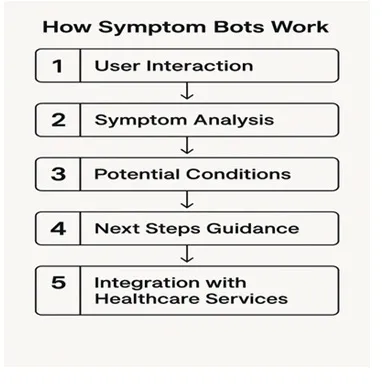 Symptom bots use Artificial Intelligence (AI) and Natural Language Processing (NLP) to interact with users in real time. The process involves several steps:
- User Interaction – The bot prompts users to describe their symptoms via text or voice input.
- Symptom Analysis – AI algorithms analyze the data, cross-referencing it with extensive medical databases.
- Potential Conditions – The bot suggests possible medical conditions based on the symptoms entered.
- Next Steps Guidance – It recommends whether self-care is sufficient or if a doctor’s consultation is required.
- Integration with Healthcare Services – Some bots connect users to telemedicine services, book appointments, or provide pharmacy recommendations.
For instance, a user experiencing fever, fatigue, and a cough could receive guidance on whether their symptoms indicate a common cold, flu, or COVID-19, along with recommended actions.
Benefits of Symptom Bots in India
1. Improving Healthcare Access in Rural Areas
With limited doctors and hospitals in rural India, symptom bots empower people with basic medical insights. Rural patients can use smartphones to check symptoms before traveling long distances to see a doctor, saving time and money.
2. Reducing Self-Diagnosis Risks
Many Indians rely on unverified sources, such as Google searches or local chemists, for medical advice, leading to misinformation and anxiety. AI-powered symptom bots offer credible and evidence-based guidance, reducing reliance on inaccurate sources.
3. Enhancing Preventive Healthcare
By detecting early warning signs of diseases such as diabetes, hypertension, or infections, symptom bots encourage users to seek medical intervention early. This reduces the long-term burden of chronic diseases on the healthcare system.
4. Optimizing Hospital & Doctor Workflows
Doctors often spend valuable time diagnosing common ailments. If patients arrive at clinics with preliminary assessments from symptom bots, consultations become more efficient, allowing doctors to focus on treatment rather than symptom analysis.
5. Empowering Patients with Health Awareness
Symptom bots educate users about diseases, prevention strategies, and lifestyle modifications. This fosters a culture of health consciousness, encouraging individuals to make informed medical decisions.
Challenges & Limitations
1. Language & Literacy Barriers
India has 22 officially recognized languages and numerous dialects. Many rural users are not proficient in English or Hindi. To maximize effectiveness, symptom bots must support multiple languages and voice-based interactions.
2. Accuracy & Misdiagnosis Concerns
AI models are still evolving, and incorrect symptom analysis can lead to misdiagnosis or undue panic. To improve accuracy, symptom bots must continuously update their medical databases and undergo medical expert validation.
3. Limited Internet Connectivity in Rural Areas
Although smartphone penetration is high, internet access in remote villages remains a challenge. Offline-capable bots or SMS-based solutions could help bridge this gap, ensuring accessibility in low-connectivity regions.
4. Regulatory & Ethical Concerns
The Indian healthcare industry is highly regulated, and AI-based bots must comply with data privacy laws such as the Personal Data Protection Bill. Additionally, symptom bots should clearly state that they do not replace professional medical diagnosis.
Future of Symptom Bots in India
1. Integration with ABDM and EHRs
By integrating with the Ayushman Bharat Digital Mission (ABDM) and Electronic Health Records (EHRs), symptom bots can offer personalized recommendations based on a patient’s medical history, leading to more tailored healthcare solutions.
2. Advancements in AI & Machine Learning
Ongoing developments in AI, deep learning, and real-time diagnostics will improve the accuracy and reliability of symptom bots. Future bots will be able to analyze complex symptoms with greater precision.
3. Expansion to Mental Health Support
Given the increasing prevalence of stress, anxiety, and depression, future symptom bots could integrate mental health assessments, guiding users to counseling services or teletherapy platforms.
4. Integration with Wearables & IoT Devices
Symptom bots can sync with smartwatches, glucose monitors, and pulse oximeters, analyzing real-time health data. This integration will allow bots to detect potential health risks, such as hypertension or irregular heartbeats, and provide early alerts.
5. AI-Powered Voice Assistants for Healthcare
Expanding into voice-based AI assistants in multiple Indian languages will enhance accessibility for elderly users and those unfamiliar with text-based interfaces. Such bots could guide users in a conversational manner, making healthcare information more user-friendly.
Conclusion
Symptom bots have the potential to revolutionize healthcare access in India by providing instant, AI-driven medical guidance to millions. While challenges such as language barriers, regulatory concerns, and technological limitations remain, the integration of AI, telemedicine, and digital health records will make symptom bots an indispensable tool in India’s healthcare ecosystem.
With continued advancements and government support, symptom bots will play a crucial role in bridging the gap between patients and doctors, ensuring that every Indian—regardless of location or financial status—has access to timely, accurate, and affordable healthcare insights.
Final Thought:
As India strides towards a digital healthcare future, symptom bots will serve as the frontline of medical assistance, making healthcare more accessible, efficient, and patient-centric. The future of healthcare in India is digital—are we ready to embrace it?
References:
1. World Health Organization (WHO) – Artificial Intelligence in Healthcare: Opportunities and Challenges.
• URL: https://www.who.int/publications
2. National Digital Health Mission (NDHM), Government of India – Ayushman Bharat Digital Mission (ABDM) Guidelines.
• URL: https://abdm.gov.in
3. Indian Council of Medical Research (ICMR) – Telemedicine and AI in Indian Healthcare.
• URL: https://www.icmr.nic.in
4. NITI Aayog – Healthcare Transformation with AI and Digital Technologies in India.
• URL: https://www.niti.gov.in
5. The Lancet Digital Health – AI-powered Chatbots for Healthcare: A Systematic Review (2021).
• DOI: https://doi.org/10.1016/S2589-7500(21)00045-6
6. BMJ Health & Care Informatics – Efficacy of Symptom Checker Chatbots in Triage and Diagnosis.
• URL: https://informatics.bmj.com/
7. Harvard Medical School – AI Chatbots and the Future of Symptom Analysis in Healthcare.
• URL: https://hms.harvard.edu/
8. McKinsey & Company – Digital Health in India: The Rise of AI-driven Solutions in Healthcare.
• URL: https://www.mckinsey.com/
9. Stanford AI in Medicine – Machine Learning in Healthcare Chatbots: Current Trends and Challenges.
• URL: https://aimi.stanford.edu/
10. Frost & Sullivan Report – AI in Indian Healthcare: Market Forecast & Trends (2023-2030).
• URL: https://www.frost.com/
11. Economic Times Healthcare – Digital Health Startups in India and the Role of AI-driven Chatbots.
• URL: https://health.economictimes.indiatimes.com/
12. Nextcare.Life – Innovations in Clinical Decision Support Systems (CDSS) and Symptom Bots.
• URL: https://nextcare.life





-(1).webp)