Infection Control and Patient Safety
The Gap Between Infrastructure Investment and Barrier Science

Tulsi Singh
COO, Shalex Meditech
Personal Protective Equipment is the first infection control barrier, yet it remains the least monitored. Unlike sterile instruments, barrier performance degrades invisibly through real-world laundering. This silent failure creates unseen patient risk. Healthcare systems must replace basic wash counts with validated lifecycle monitoring to ensure textiles and PPE perform as engineered, not just as purchased.
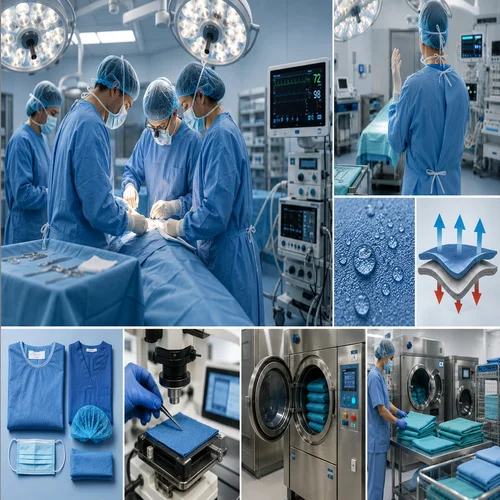
Summary:
Have you ever noticed how much careful thought goes into designing a modern operation theatre?
Airflow patterns are mapped with precision. HEPA filtration is validated and re-validated. Positive pressure gradients are calibrated to the nearest pascal. Sterilisation logs are maintained with the kind of discipline that would satisfy even the most exacting regulatory auditor. The modular OT has become, in many ways, a symbol of a hospital's commitment to patient safety and rightly so.
Now here is a quieter question. One worth sitting with.
Have you ever paused to consider what actually walks into that controlled environment before the first incision is made?
A human being. Several of them, in fact.
And the human being - well-trained, conscientious, protocol-adherent, remains the single largest source of particulate and microbial contamination in any surgical environment. Not because anyone is careless. Not because protocols are weak. But simply because biology behaves the way it does. We shed skin particles constantly. We exhale. We move. And every movement disperses. That is not a criticism of anyone in the OT. It is a description of physiology.
The question, then, is not whether contamination risk from the human body exists. It does. The question is what stands between that risk and the patient.
The answer is Textiles.
The OT environment is engineered to remove contaminants. The gown is engineered to contain them. If either one underperforms, the system weakens gradually, invisibly, and without a single alarm going off.
The First Barrier We Rarely Discuss
Infection control conversations in hospitals have become genuinely sophisticated. Antibiotic stewardship programmes are robust. Sterilisation assurance levels are tracked. Environmental monitoring is data-driven. Audit frameworks have teeth.
Yet one component rarely receives equal intellectual attention: the textile barrier. The mask. The cap. The gown. The scrub suit.
These are not just garments. They are engineered interfaces, specifically designed to contain what the human body generates and prevent its transfer to a sterile field. But in many hospital procurement discussions, they are treated as routine supply items rather than risk-control tools. They live on a price list, not in a validation framework.
Consider a scenario familiar to many hospital procurement leads: a vendor presents two gown options. One is marginally cheaper. Both carry regulatory certifications. The procurement decision defaults to the lower price because, at the surface, both look equivalent. What is rarely examined is how each gown will perform after twenty wash cycles in the hospital's specific laundry environment, with its particular detergent formulation, its water hardness profile, and its sterilisation cycle temperatures. The certification was earned under controlled test conditions. The gown will live in far less controlled conditions.
This gap between certification and real-world lifecycle performance is where the risk silently accumulates.
Why 'How Many Washes?' Is an Incomplete Question
If there is one question that follows reusable OT textiles into every procurement conversation across Asia and Europe, it is this: 'How many washes?'
It is a fair question. Hospitals need predictability. Budget planning requires numbers. Lifecycle costing matters enormously in a resource-constrained environment.
But consider an analogy. If someone asked you, 'How many kilometres will this car last?' you would want to know a great deal more before answering. City driving or highway? Maintained regularly or serviced when something breaks? Parked in a covered garage or left in the elements? The mileage is not a fixed property of the vehicle. It is an outcome of how the vehicle is used and cared for.
Textile performance works on the same logic. A reusable cleanroom gown's lifecycle is shaped by: the type of detergent used (a mild, pH-balanced formulation designed for technical textiles performs very differently from a standard industrial one); the mechanical action in the wash drum; the water quality and mineral content; the sterilization method, steam autoclaving at 134°C stresses fabric differently than ethylene oxide or plasma; the drying process; and the handling discipline between cycles.
Two hospitals using the identical gown model can experience dramatically different performance outcomes simply because their processing environments differ. A large tertiary hospital in Singapore that runs a validated in-house CSSD with strict temperature controls and documented wash protocols will get a very different lifecycle from the same garment than a facility outsourcing its laundry to a commercial operation that also processes kitchen linen.
Both scenarios are common. Neither is unusual. But only one is being managed with any scientific rigour.
So when someone asks, 'How many washes?' The honest, technically accurate answer is: it depends. Not as an evasion. As a scientific reality. And perhaps as an invitation to ask the more productive question: how do we validate performance across the actual lifecycle this garment will experience in our facility?
Asking 'how many washes?' without knowing the conditions is a bit like asking how long a candle will burn without knowing the room it's in. The answer is always: it depends on the environment.
The Subtle Nature of Textile Degradation and Why It Goes Unnoticed
Here is what makes textile performance decline particularly difficult to manage: it is rarely dramatic.
Unlike an autoclave that throws an error code, or an air handling unit whose performance drop registers on a monitoring dashboard, a gown does not fail visibly.
It does not tear at the seam in the morning; it crosses a performance threshold. Instead, barrier efficiency gradually reduces. Fluid resistance declines over time. Micro-level pore expansion occurs at the fibre level - invisible to the eye, invisible to the person wearing the garment, but measurable under standardised testing.
A quality assurance professional at a European medical textile reprocessing facility described it well: a gown at the end of its useful life often looks, to the naked eye, perfectly acceptable. It is clean. It is intact. It is folded correctly. But place it under particle penetration testing, and the results tell a different story. The margin of safety has narrowed, and no one in the facility was aware because no one was looking.
This is not negligence. It is the absence of a monitoring framework. Sterilisation efficacy is routinely validated through biological and chemical indicators. Environmental cleanliness is measured through settle plates and active air sampling. But textile barrier performance, in most hospitals, is validated once at the point of procurement and then assumed to hold for the garment's commercial life.
That assumption is where the gap lives.
A System Issue, Not a People Issue
It is worth being clear about something. The gap described here is not about individuals failing to do their jobs. It is about a system that has not yet provided structured frameworks for healthcare textile science as a discipline.
Medical education focuses, appropriately, on clinical excellence. Biomedical engineering training centres on equipment and instrumentation. Infection control programmes focus on protocol adherence, sterilisation science, and surveillance. Healthcare textile lifecycle science, how barrier performance is maintained, validated, and monitored across real-world processing conditions, rarely forms part of formal hospital education or training.
The result is that procurement teams, often highly competent professionals working with the tools available to them, make decisions based on vendor brochures, commercial wash guarantees, and price comparisons. The 'how many washes?' question becomes the only tangible anchor because no one has provided a better framework.
In Germany and the Netherlands, where textile reprocessing for healthcare is governed by more structured standards and where accredited reprocessors are required to document and validate their processes, the conversation is more advanced. Hospitals are more likely to engage with their textile reprocessors on validated cycle counts, quality monitoring, and periodic testing. The infrastructure for that conversation exists. In many markets across Asia and indeed in parts of Southern and Eastern Europe, that infrastructure is still developing. The gap is not a reflection of intent. It is a reflection of where the industry conversation currently stands.
Rethinking the Conversation - Practically
The goal is not to complicate what works. Most hospital infection control teams are already stretched. The last thing anyone needs is an additional layer of process for its own sake.
But there is a practical middle ground between 'trust the vendor's wash count' and 'build a textile validation laboratory.' It looks something like this: engaging laundry or reprocessing partners on their documented protocols and asking for evidence of how those protocols have been validated; specifying detergent type and water quality thresholds when outsourcing textile reprocessing; including a post-use performance check in your garment procurement criteria rather than evaluating purely at the point of purchase; and for high-criticality applications - cardiac surgery, orthopaedic implant procedures, cleanroom pharmaceutical environments, considering periodic third-party barrier testing as part of the quality calendar.
None of this is radical. It is the same logic applied to sterilisation validation, applied to textiles. The scientific rigour already exists in your facility. It simply has not been extended to this particular component of the infection control system.
The Sustainability Dimension
There is a growing reason, beyond infection control, to get this right, and it is arriving with some urgency.
Healthcare systems across the EU are under increasing pressure to reduce single-use plastic and non-woven waste. PPE, much of it polypropylene-based, represents a substantial and largely unmeasured element of hospital waste streams. The push toward reusables is accelerating, driven by sustainability mandates, ESG reporting requirements, and a generation of healthcare professionals who factor environmental impact into professional decisions.
The circular economy model for surgical and cleanroom textiles, high-performance reusable garments, scientifically reprocessed and returned to validated service, is environmentally compelling. But it only works if the circle is managed. Reusability without structured lifecycle management does not reduce risk. It redistributes it.
The future is not about choosing between disposable and reusable. It is about validating whichever system is adopted through documented protocols, measurable performance standards, and the same evidence-based discipline already applied to the other components of a world-class infection control programme.
A Closing Reflection
Infection control does not begin when the first incision is made. It begins when the first person walks into the OT.
And what stands between that human being and the sterile field is not the architecture, not the HEPA filtration, not the laminar airflow system, though all of those matter enormously.
It is a barrier. Made of fabric. Simple in appearance. Sophisticated in function. Sitting at the intersection of materials science, microbiology, and operational discipline.
Perhaps it is time we gave it the same intellectual attention we give to everything else in that room.
Not because something is broken. But because the most important things are so often the ones we have learned to take for granted. And in patient safety, assumptions are never quite as safe as they feel.
This editorial is intended for hospital leadership, infection control professionals, CSSD managers, and procurement decision-makers across Asia and Europe. Views expressed represent an industry perspective on evidence-based textile management in healthcare settings.








-(1).webp)
-(1).webp)