Managing Hospitals in Asia: What Today’s Healthcare Executives Need to Know

Kate Williamson
Editorial Team, Asian Hospital & Healthcare Management
The hospital systems in Asia are changing with the increase in demand, complexity in regulations, workforce shortage and the rapid digitalization. This article explains the ways in which healthcare executives can operate across a range of markets, remain financially sustainable, enhance governance, incorporate technology, and provide high-quality and patient-centered care and create resilient and future-ready hospitals in Asia.

Introduction:
In Asia, hospital management has been changing radically. Blistering urbanization, demographic changes, the increasing load of chronic illnesses, medical tourism, increasing pace of digital health development, and regulatory fragmentation among nations have made the healthcare landscape both opportunity-filled and operationally complicated. In the current context of healthcare management, running hospitals in Asia needs more than clinical superiority or economical management. It must entail tactical brilliance, cultural shrewdness, regulating refinement and a thorough understanding of how healthcare provision is changing within diverse economic and social contexts.
Asia is not a homogenous healthcare market. It is a complex of systems of public and private, the systems of financing, patient expectations and the systems of governance. Between high-income economies with Japan, Singapore and South Korea on one side and the fast-growing healthcare systems in India, Indonesia, Vietnam and one or another of the Philippines, the hospital leaders are forced to balance between the unequal infrastructure levels of maturity and the international quality, safety and patient outcome standards.
The Asian Healthcare Landscape: Complexity at Scale
More than half of the world is in Asia and this alone presents overwhelming pressure on the hospitals. East Asia aging populations will be coupled with youthful demographics in South and Southeast Asia. There is a sharp increase in non-communicable diseases like diabetes, cardiovascular and cancer even though infectious diseases and sporadic outbreaks are also looming.
In most areas, the demand in healthcare is growing at a higher rate than the hospital capacity. Government tertiary hospitals in the cities are being overcrowded, rural and semi-urban hospitals have a shortage of workforce and access to high-level diagnostics. For executives, balancing between capacity planning, controlling patient flows, and fair access is not a choice anymore; it is a strategic need.
Meanwhile, Asian patients are also becoming more knowledgeable and more demanding. Globally based expectations regarding service quality, openness, online availability, and individualized care are being influenced more and more by international standards and not local ones.
Governance and Regulatory Diversity: A Leadership Stress Test
Hospital management in Asia is characterized by one of the key problems such as regulatory fragmentation. Every nation has licensing standards, accreditation standards, reimbursement plans, price controls and compliance structures. Even in one nation, there are usually varying regulatory expectations imposed on public and private hospitals.
Healthcare executives need to develop internal compliance frameworks that are not inflexible but strong. Forecasting of finances has lost its importance and regulatory foresight has taken its place. Hospitals that take on cross-border expansion, either as a management contract, joint venture, or a medical tourism program bear increased regulatory risk in case the governance models are not standardized and transparent.
Accreditation is increasingly becoming part of the executive decision making. The various international standards like JCI are now also being perceived as credibility signs particularly to hospitals with international patients. Nonetheless, accreditation does not ensure operational excellence. The leaders should be able to transform compliance into improved and persistent clinical outcomes and patient experiences.
Financial Sustainability in Cost-Sensitive Markets
In contrast to the western healthcare model, most of the Asian hospitals are in a highly sensitive price-sensitive environment. The out-of-pocket spending is high in most countries, which restricts the flexibility of prices. In the meantime, the capital expense on technology, infrastructure upgrading and human resource training is increasing.
Hospital leaders must be taught how to strike a thin balance between the price and the services. The key elements of sustainability are revenue cycle management, optimization of payer mix, and operational efficiency. Value-based care models are on the rise, but their usage is not uniform with insurance penetration and lack of data being fragmented.
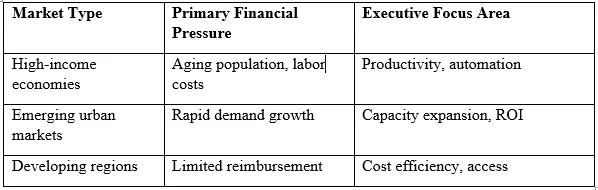
The following table shows how there is a difference in financial priorities in Asian hospital markets:
Partnerships with payers, pharmaceutical companies, device-makers, and digital health companies are becoming more popular to shoulder the financial burden and speed up the innovation.
Workforce Management: Talent Scarcity Meets Burnout
The human capital is the very foundation of the hospital operation, but the Asian region is experiencing an increasing discrepancy between the demand of the healthcare services and the number of skilled workforce. The shortage of physicians and nurses is a widespread issue in various countries, whereas the rates of burnout and attrition have been increasing after the pandemic.
Hospital leaders need to reconsider the conventional ways of workforce. This involves the redesign of task assignment, the investment of on-going clinical education and the use of technology to minimize the administrative load. Compensation is no longer a key factor in retention strategies; career pathways, work-life balance, leadership culture, and mental health support have been brought to the centre-stage of workforce stability.
The issue of cultural sensitivity is also important. Multinational hospital groups that have activities in Asia have to balance between the local expectations in leadership style and similarity in organizational values.
Digital Transformation: From Adoption to Integration
The pace of digital health adoption in Asia has increased, although there is a wide range of maturity. The use of EHR, telehealth, AI-based diagnostics, and hospital information systems are already established in the leading hospitals. However, the digital transformation is not only about the purchase of technology.
The executives are required to deal with system integration, data governance, cybersecurity, and clinical adoption. Dispersed digital systems are inefficient and not efficient. The issue of interoperability especially between the public and the private providers is a significant challenge.
The ability to make decisions based on data is emerging as a characteristic skill of hospital administrators. Real-time operational dashboards, predictive patient flow and clinical decision support based on AI are transforming the manner in which hospitals are run. However, these tools do not only need investment in software, but also in change management and employee training.
Quality, Safety, and Patient Experience as Strategic Assets
The two aspects, clinical quality and patient safety are no longer subject to medical governance committees. They are priorities at the board level, which affect reputation, regulatory status, and profitability in the long term.
Patient experience has become a competitive advantage in the Asian healthcare markets. Particularly, hospitals that serve medical tourists have to be able to match clinical excellence with hospitality quality of service. The success factors are language access, cultural competence, and coordination of care throughout the patient journey.
Outcome metrics, patient-reported experience measures, and clinical benchmarking are some outcomes measures that are being used by executives to drive strategy. Quality reporting is now seen as a quality-building device instead of a form of regulation.
Medical Tourism and Cross-Border Care
Asia has been a medical tourism destination since time immemorial due to the cost factors, clinical skills, and superior infrastructure in some of its markets. Hospitals with patients of international background need an extra level of operational complexity.
Executives need to coordinate international patient services with the core operations of the hospital without establishing internal inequalities. Liaison with travel facilitators, insurers and overseas referring physicians should also be standardized in order to avoid reputational risk.
Executive Q&A: Key Questions Leaders Are Asking
How can hospital leaders manage growth without compromising quality?
The solutions to achieve sustainable growth would include progressive capacity development, standardized clinical practice, and the investment into leadership development on mid-management tiers.
Is digital transformation a cost center or a value driver?
In tandem with clinical workflow and operational objectives, the digital systems are the drivers of long-term value by means of efficiency, safety, and data-driven insights.
What distinguishes high-performing hospitals in Asia?
Effective leadership, patient-focused culture, empowered clinical leadership, and disciplined performance in all operations is a consistent way to distinguish the best performers.
Key Definitions for Healthcare Executives
Hospital governance can be defined as arrangements and procedures that inform strategic path, responsibility and ethical control within a healthcare organization.
Value-based care has been described as a framework of providing healthcare in which reimbursement is based on patient outcomes instead of volume of service.
Interoperability refers to the capability of various health information systems to share, comprehend and use data in a unified manner.
Executive Checklist: What Leaders Must Prioritize Now
Asian hospital leaders who excel in their roles are preoccupied with governance transparency, staff robustness, financial discipline, digital transformation, and quantifiable quality results. They acknowledge that today leadership is as complex a matter as it is care giving.
The Road Ahead: From Operators to System Architects
The issue of managing hospitals in Asia is no longer about managing the facilities but about creating resilient healthcare systems. Executives should also think outside the hospital walls by working with policy makers, technology vendors, insurance company and community health systems.
The successful ones will be leaders who are both operationally rigorous and strategically visionary, culturally intelligent and technologically fluent, as well as financially responsible and poisoned by an uncompromising focus on patient care. The future of hospital leadership is in those who can adjust, assimilate, and operate with an aim in a very dynamic and diverse region like Asia.