Closing the Silent Revenue Gaps: The Operational AI Opportunity in Healthcare
The Cost of a Thousand Small Failures

Chetan Saundankar
Founder & Chief Executive Officer, Executive Leadership, Coditation Systems
Mid-market hospitals often lose revenue through small, invisible operational gaps: unspecified diagnoses causing downcoding, physicians delayed by credentialing, or supplies misaligned with surgical schedules. This article explores how task-specific AI can augment existing EHR, ERP, credentialing, and supply-chain systems to close these leakage points without costly platform replacement. Drawing on emerging adoption patterns, it examines why human-in-the-loop design builds greater staff trust than full automation and offers practical guidance for healthcare administrators evaluating intelligent automation.

Introduction:
Ask a hospital finance director where their organisation is losing money, and the answer is rarely dramatic. It is not a single catastrophic billing error or a headline-grabbing compliance breach. It is something far less visible: a diagnosis documented as "unspecified" because no physician memorises seventy thousand ICD-10 codes, a newly hired cardiologist sitting on payroll for three months while a credentialing application moves between payer portals, a box of surgical implants expiring unused in a storeroom because nobody cross-checked the surgery schedule against inventory.
None of these failures make it into a board report on its own. Together, industry data suggest they account for a meaningful share of a hospital's operating margin. Recent figures illustrate the scale: Experian Health's 2025 State of Claims report found that 41 per cent of US providers now see more than one in ten claims denied, up from 30 per cent as recently as 2022, while a 2024 MGMA survey put claim denial or delay rates as high as 15 per cent industry-wide. This is precisely the gap that a new generation of task-specific, operational artificial intelligence is beginning to address, not by replacing hospital systems, but by working quietly inside the seams between them.
Why It Matters Beyond the Finance Office
Revenue leakage is often framed as a finance-department problem, but its consequences reach further. Every delayed credentialing approval postpones a new physician's ability to see patients, constraining access in specialties already facing shortages. Every under-coded encounter narrows the margin available for capital investment in equipment or staffing. Every write-off of expired inventory is money that cannot be redirected toward clinical programmes. Framed this way, operational leakage becomes a strategic concern for chief executives and chief financial officers alike, not merely a back-office inefficiency to be tidied up when time allows.
Where the Leakage Hides
The pattern repeats across several corners of hospital operations that rarely appear together in the same conversation, yet share a common structure: high-volume, rules-heavy, cross-system work that is too specific for a full enterprise platform, yet too costly to leave unattended.
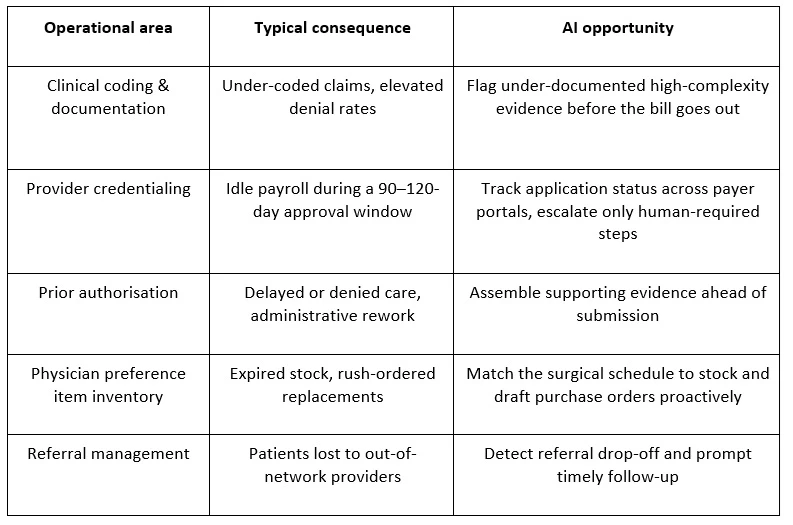
Consider a mid-sized cardiology practice. Coding teams face constant pressure between speed and accuracy, and when clinical documentation does not explicitly support a higher-complexity code, even when the underlying evidence sits in the notes, the safer, faster path is to code conservatively. The Experian survey noted that initial denial rates reached 11.8 per cent in 2024, up from 10.2 per cent only a few years earlier, with documentation and coding gaps consistently cited among the leading causes.
Consider, too, a hospital system onboarding five new physicians in a quarter. Industry benchmarks from MGMA and CAQH put the average provider credentialing timeline at 90 to 120 days, and in some states considerably longer, during which the organisation pays full salary for zero billable revenue. Multiplied across several hires a quarter, the idle-payroll cost becomes difficult to ignore.
Or consider an orthopaedic surgery centre managing a high volume of physician preference items, screws, plates, joint implants, where ordering is reactive rather than schedule-driven. The Association for Healthcare Resource & Materials Management estimates that up to 30 per cent of hospital inventory is expired, lost or wasted due to tracking failures, a figure echoed by supply chain reviews that put annual waste at well over ten million dollars for an average hospital.
Five Silent Revenue Leaks
"Hospitals have spent two decades digitising healthcare. The next decade may be defined not by new systems, but by making the ones already in place work together more intelligently."
Why Point Solutions Have Fallen Short
Healthcare organisations are not short of technology. Most run mature electronic health record, enterprise resource planning and practice management systems, often layered with years of point solutions bought to solve individual problems. Yet the leakage described above persists in organisations that are, on paper, well systematised.
Part of the explanation is that these problems sit between systems rather than inside any one of them. Coding depends on clinical notes held in the EHR, but decisions are made by staff working in a separate coding platform. Credentialing spans a provider's internal HR record and a dozen external payer portals that share no common interface. Supply ordering depends on a surgical schedule maintained by one team and inventory levels tracked by another. Rules-based automation, scripts, and macros built to flag exceptions tend to work adequately in stable, narrowly defined situations and degrade quickly whenever documentation, payer requirements, or scheduling patterns vary, which in healthcare is constant.
The Shift Toward Overlay Intelligence
What has changed is the emergence of systems capable of reading unstructured information, clinical notes, payer correspondence, scheduling data, and reasoning about it in something closer to the way a trained staff member would, rather than matching rigid rules. These systems are typically designed to sit alongside existing infrastructure rather than replace it.
A simplified operational flow illustrates the approach:
Operational data → Pattern detection → Human review → Workflow action → Revenue recovery → Continuous learning
In coding, this looks like a cardiology department's system reviewing documentation, identifying where evidence for a higher-complexity code exists but is not stated explicitly, and prompting a coder to confirm before submission. In credentialing, it looks like a system tracking an application across multiple payer portals simultaneously, raising a flag only when a wet signature or peer review genuinely requires a person's attention. In the supply chain, it looks like a system reading an ambulatory surgery centre's upcoming schedule against current stock and drafting a purchase order ahead of a shortfall, rather than reacting after one occurs.
Trust Is Earned, Not Assumed
The most consistent lesson from early healthcare deployments of operational AI is organisational rather than technical: sustained adoption has rarely come from systems that automated a task completely. It has come from systems that kept a person in the decision loop.
This is a distinct finding from what might be assumed about automation generally. A 2025 American Medical Association survey found that while 66 per cent of physicians were already using AI tools in some form and 68 per cent saw clear value in them, 47 per cent still cited increased human oversight as the single most important step regulators could take to build trust in AI-generated recommendations. In other words, clinicians are not asking for less automation, they are asking for automation that keeps their judgement in the loop rather than around it. For healthcare specifically, where errors carry clinical and regulatory consequences, this is arguably the difference between a tool that staff actively rely on and one quietly worked around within months of go-live.
A Practical Lens for Evaluation
Before introducing operational AI into any workflow, healthcare leaders may find it useful to ask:
- Where is the leakage genuinely invisible? The strongest candidates are problems too small individually to warrant a dedicated team, but large in aggregate.
- Does the system augment or replace existing infrastructure? Overlay systems connecting to current EHR, ERP, or scheduling platforms typically carry lower implementation risk than a wholesale platform change.
- Where does the human checkpoint sit? A system with no clear point of human review, particularly in clinical or financial decisions, warrants closer scrutiny.
- Is the data access proportionate? Systems reading clinical notes or payer data should be evaluated as rigorously for compliance and governance as any other system with comparable access.
Looking Ahead
The organisations most likely to benefit from operational AI in the coming years are unlikely to be those chasing the most visible or ambitious use cases. They are more likely to be the ones willing to look closely at the unglamorous, distributed inefficiencies that never make it into a strategy presentation. Hospitals have spent two decades digitising healthcare. The next decade may not be defined by new systems, but by making existing ones work together more intelligently, and the greatest financial opportunity may lie not in solving the biggest problems, but in eliminating the thousands of small ones that quietly shape organisational performance every day.