Medical Gases and Vacuum Systems in Hospitals - Safe and Cost-Effective Clinical Applications
.webp)
Kate Williamson
Editorial Team, Asian Hospital & Healthcare Management
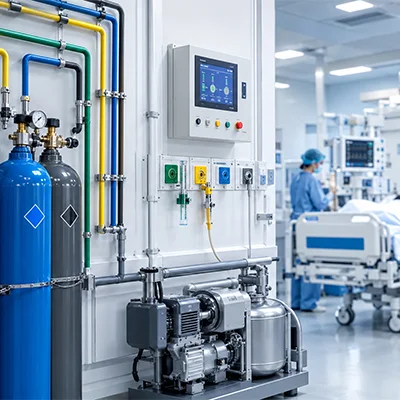
Medical gas and vacuum systems form the invisible backbone of hospital care, delivering oxygen, medical air, and suction exactly where needed. This article explains how these systems work, why hospital gas supply safety is non-negotiable, and how proper design and maintenance make medical gas infrastructure both safer and more cost-effective long-term.
Introduction:
Most patients never think about it, and most visitors never notice it - but behind every hospital wall runs a silent network of pipes carrying oxygen, powering surgical tools, and suctioning fluids exactly when they're needed. This hidden infrastructure is what we call medical gases hospital systems, and it's the backbone of nearly every clinical procedure performed today.
These systems don't make headlines. Nobody posts about them on social media. But without them, modern healthcare simply doesn't work. From a newborn in the NICU needing precise oxygen support to a surgeon relying on medical air for a pneumatic drill, medical gas infrastructure is one of the most critical - and most overlooked - parts of hospital design.
In this article, we'll break down what medical gas and vacuum systems actually do, why safety and cost-efficiency both matter, and what hospital administrators, facility managers, and healthcare planners should know before installing or upgrading one.
What Are Medical Gases Hospital Systems?
At its core, a medical gas system is a centralized network that generates, stores, and distributes gases - like oxygen, nitrous oxide, medical air, carbon dioxide, and nitrogen - directly to patient care areas through a fixed pipeline. Instead of wheeling individual gas cylinders from room to room, hospitals use a piped infrastructure that delivers gas on demand, right at the bedside or the operating table.
This isn't a single piece of equipment. It's an entire ecosystem that includes:
- Central gas manifolds and storage tanks
- Medical gas pipeline systems running through the building
- Zone valves and pressure regulators
- Outlets and terminal units in patient rooms, ICUs, and ORs
- Alarm systems that monitor pressure and gas purity
- Medical vacuum systems for suction and waste gas evacuation
Each component has to work in sync. A failure anywhere in the chain - a cracked pipe joint, a faulty valve, a contaminated gas source - can directly endanger patient lives. That's exactly why these systems are held to strict engineering and regulatory standards.
Why Oxygen Gas Delivery Systems Matter So Much
Of all the gases used in hospitals, oxygen is the one most people are familiar with, especially after the pandemic exposed just how fragile oxygen supply chains can be under pressure. Oxygen gas delivery systems hospitals rely on need to do three things consistently: deliver the right pressure, maintain purity, and never run dry.
A modern hospital typically sources oxygen through one of these methods:
- Bulk liquid oxygen tanks – Ideal for large hospitals with high, continuous demand.
- Oxygen concentrators (PSA plants) – Generate oxygen on-site from ambient air, reducing dependency on external suppliers.
- Cylinder manifold systems – A backup or primary source for smaller facilities with lower gas consumption.
Whichever method is used, the oxygen still travels through the same medical gas pipeline systems to reach the patient. This is where engineering precision matters - pipes must be sized correctly, pressure has to stay within a tight range, and every outlet needs to be tested for leaks and correct gas identification before it's ever used clinically.
Getting this wrong isn't a minor inconvenience. It's a patient safety incident waiting to happen.
The Often-Ignored Half: Medical Vacuum Systems
While oxygen delivery gets most of the attention, medical vacuum systems are just as essential, arguably even more so in surgical and emergency settings. Vacuum systems handle:
- Suctioning of bodily fluids during surgery and postoperative care
- Airway clearance for patients on ventilators
- Removal of waste anesthetic gases from operating rooms (WAGD)
- Drainage support in wound care and ICU settings
A hospital vacuum system typically consists of central vacuum pumps, receiver tanks, and a network of pipelines that create negative pressure at each outlet. If this system fails during surgery, the consequences can be immediate and severe. That's why vacuum systems are engineered with redundancy - usually with duplicate pumps so that if one fails, the other takes over without interrupting service.
Hospital Gas Supply Safety: Non-Negotiable by Design
Hospital gas supply safety isn't just a compliance checkbox - it's a layered system of engineering controls, monitoring, and human protocols working together. Here's what that typically looks like in a well-run facility:
Design and Installation Safeguards
- Color-coded and labeled pipelines for each gas type (to prevent misconnection)
- Pressure-specific, non-interchangeable connectors (NIST/DISS fittings)
- Zone valve boxes that allow gas shutoff to a specific area without affecting the entire building
- Emergency oxygen supply systems as backup during outages
- Monitoring and Maintenance
- /7 pressure and alarm monitoring at nursing stations and engineering control rooms
- Routine leak testing and pipeline pressure verification
- Scheduled preventive maintenance of compressors, vacuum pumps, and manifolds
- Regular gas purity testing, especially for medical air and oxygen
- Human Protocols
- Trained biomedical and facility engineering staff
- Clear emergency response procedures for gas failure or contamination
- Documentation and audit trails for regulatory compliance (NFPA 99, HTM 02-01, ISO 7396-1, depending on region)
Hospitals that treat gas supply safety as an ongoing operational priority - not a one-time installation task - are the ones that avoid costly incidents and downtime.
Medical Gases Applications Healthcare Teams Rely on Daily
It's easy to think of medical gases as just "oxygen for breathing support," but the range of medical gases applications healthcare facilities depend on is much broader:
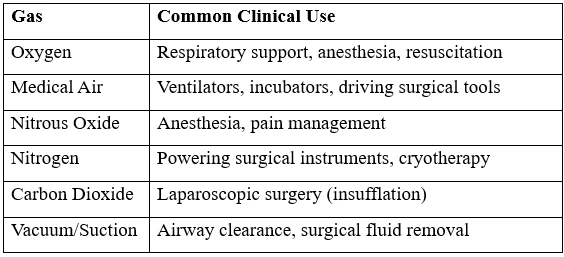
Every department - from the ER to maternity to the ICU - depends on this infrastructure functioning correctly, around the clock, without interruption.
Gas Distribution Hospital Infrastructure: Planning It Right
When hospitals are being built or renovated, gas distribution hospital infrastructure planning has to happen early, alongside architectural and electrical design - not as an afterthought. Poor planning here leads to expensive retrofitting later, along with potential safety compliance issues.
Key planning considerations include:
- Load calculation – Estimating peak simultaneous gas demand across departments
- Pipeline routing – Minimizing pressure drop and avoiding areas prone to physical damage
- Redundancy – Backup sources for critical gases, especially oxygen
- Scalability – Designing for future expansion (new wings, additional beds, new equipment)
- Compliance – Meeting national and international standards from day one, rather than retrofitting for certification
Hospitals that invest properly at the design stage typically spend far less on emergency repairs, compliance penalties, and system failures down the line.
Why Cost-Effectiveness and Safety Aren't Opposing Goals
There's a common misconception that safer medical gas systems automatically cost more. In reality, the opposite is usually true over the system's lifetime.
Cutting corners on medical gas pipeline systems - using substandard materials, skipping redundancy, delaying maintenance - creates hidden costs: emergency repairs, regulatory fines, surgery cancellations, and in worst cases, litigation from patient harm. A well-designed, properly maintained system reduces gas wastage, lowers energy consumption (especially with efficient PSA oxygen plants and vacuum pump systems), and extends the operational life of equipment.
In short: investing correctly upfront is what makes these systems cost-effective, not cutting corners.
Frequently Asked Questions
What is a medical gas pipeline system in a hospital?
It's a centralized network of pipes, valves, and outlets that delivers medical gases like oxygen, medical air, and nitrous oxide directly from a central source to patient care areas, eliminating the need for individual gas cylinders at every bedside.
How often should hospital medical gas systems be inspected?
Most regulatory standards recommend routine daily monitoring of pressure and alarms, along with formal inspections, leak testing, and purity checks at least annually - and after any modification or repair to the pipeline.
What's the difference between medical air and oxygen in hospital systems?
Medical air is compressed, filtered breathing air used for ventilators and to power surgical tools, while oxygen is a separate, purified gas specifically used for respiratory support and resuscitation. They run through completely separate, color-coded pipelines to prevent mix-ups.
Why do hospitals need vacuum systems, not just gas supply?
Vacuum systems are essential for suctioning fluids during surgery, clearing patient airways, and removing waste anesthetic gases - functions that gas supply systems alone can't perform. Both are equally critical to patient safety.
What standards regulate hospital medical gas systems?
Depending on the country, hospitals typically follow standards like NFPA 99 (USA), HTM 02-01 (UK), or ISO 7396-1 (international), which set requirements for design, installation, testing, and maintenance of medical gas and vacuum pipeline systems.
Final Thoughts
Medical gases and vacuum systems will never be the flashiest part of hospital infrastructure, but they're among the most life-critical. Getting them right means combining smart engineering, strict safety protocols, and long-term cost planning - not treating any one of those as optional.
For hospital administrators and facility planners, the takeaway is simple: invest in proper design, prioritize maintenance, and never compromise on hospital gas supply safety, because the return on that investment is measured in patient outcomes, not just budget lines.