Smart Healthcare Systems across Asia: Trends, Technologies, and Transformation
.webp)
Kate Williamson
Editorial Team, Asian Hospital & Healthcare Management
The Asian healthcare systems have been using smart healthcare to change the provisional care by integrating with digital elements, utilizing AI-based insights, interconnected devices, and data-driven decision-making. Since the demands of healthcare increase, such systems better access, efficiency, and patient outcomes and respond to challenges encountered in each region, making healthcare ecosystems more resilient, scalable, and future-ready across different markets in Asia.
Introduction:
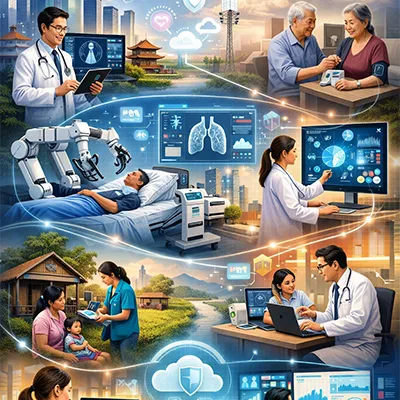
The healthcare systems in Asia are in the midst of a radical change. With the accelerated urbanization, ageing, and growing chronic conditions, as well as access disparities between urban and rural areas, Asian nations are starting to consider smart healthcare systems as a way to redefine the process of care delivery, management, and scale. Digital recordkeeping and pilot projects are no longer the only means of smart healthcare. It has developed to be an interconnected system that incorporates data intelligence, connected devices, artificial intelligence, and patient-centric care models.
Governments, healthcare providers, technology developers and payers in the region are converging on a common goal that is to create a resilient, efficient and inclusive healthcare system that is capable of addressing the current and future needs. Although the speed and maturity of adoption differs among countries, Asia has already become one of the most active regions in terms of smart healthcare innovation, and many solutions tend to move past the legacy infrastructure to adopt a digitally native one.
Understanding Smart Healthcare Systems
Smart healthcare systems are connected healthcare settings in which digital technologies are employed to promote clinical decision-making, operational efficiency, patient engagement, and health outcomes. The systems are based on the smooth flow of data between platforms, devices, and stakeholders to allow real-time insights and proactive interventions.
Smart healthcare focuses on prevention, individualisation and continuity of care, as opposed to the traditional healthcare frameworks, which are reactive and facilities based. It links clinics, outpatient hospitals, pharmacies, and home-based care with a single computer-based system. This practice is especially applicable in Asia due to the size of population and unequal access to healthcare and the necessity to have cost-efficient solutions.
The Regional Context: Why Asia Is Moving Fast
The healthcare transformation in Asia is informed by a set of factors that are unique and comprise of the convergence of demographic, economic and technological factors. Most nations are ageing their populations rapidly, especially Japan, South Korea, China and Singapore and this is putting pressure in the management of long-term and chronic care. Meanwhile, the emerging economies like India, Indonesia, Vietnam, and the Philippines are dealing with two types of disease burdens; that is, the infectious diseases and the lifestyle-related diseases.
There is an increasing expenditure on health care in Asia and a limitation of resources is still a challenge. Smart healthcare systems provide an avenue of maximizing the limited infrastructure through enhanced utilization, minimization of inefficiencies, and care delivery beyond hospital boundaries. Moreover, the high adoption of digital and the popularity of smartphones and the increasing use of cloud infrastructure in Asia offer scalable healthcare technologies a promising territory.
Efforts by the government to spearhead the digitalization of health have been instrumental in enhancing adoption. The enabling environment of the smart healthcare ecosystems is being developed through national health IDs, electronic health record requirements, telemedicine rules and regulations, and public-private partnerships.
Key Technologies Shaping Smart Healthcare in Asia
Smart healthcare systems are based on digital health platforms. EHR is becoming more and more standardized and interoperable, making it possible to track a patient in various care environments. Other countries have also achieved success in terms of developing a national health information exchange that can facilitate continuity of care and population health analytics as observed in countries like Singapore and South Korea.
Artificial intelligence is becoming a disruptive technology in the diagnostics, imaging, pathology, and clinical decision support. AI-based algorithms are being utilized to identify the disease at an earlier stage, prioritize the high-risk patient, and decrease the number of diagnostic mistakes. In the areas where there is lack of specialists with training, AI tools are closing the knowledge gaps especially in radiology and oncology.
The pervasive nature of medical equipment and remote patient monitoring technology is pushing the farthest limits of care provision. The wearables, home diagnostic systems, and internet of things-medical devices enable clinicians to monitor their patients in real time, facilitating the management of chronic diseases and post-discharge care. This movement is especially effective in the rural and underserved regions, where the access to medical facilities is restricted.
Scalable data storage, analytics, and collaboration is also becoming possible within healthcare networks through cloud computing. Cloud-based services facilitate the use of telemedicine, virtual care coordination and massive health data analysis at a lesser expense to on-premise infrastructure. The use of clouds is becoming a necessity of smart healthcare systems in Asia as the volume of data increases.
Telehealth and Virtual Care as Catalysts
Telehealth is no longer an auxiliary service, but a fundamental part of smart healthcare in Asia. Remote diagnostics, online triage and virtual consultations are enhancing access to care and decreasing waiting time and hospital overcrowding of patients. Telehealth can be used to control the demand in crowded cities and environments, and in rural areas, it plays a vital role as a life-saving factor.
The combination of telehealth and electronic health records, e-prescribing, and digital payment systems is generating a virtual care journey end to end. Patients will be able to visit physicians, get prescriptions, diagnostics, and monitor treatment plans without having to visit them physically. This model has been particularly useful in primary care, mental health services and chronic disease follow-ups.
Provider workflows as well as care delivery models are also being transformed by telehealth adoption. Medical practitioners are adopting new practices of implementing hybrid models that blend both face-to-face and online communications with the help of smart scheduling and remote monitoring solutions.
Data-Driven Healthcare and Advanced Analytics
The key to smart healthcare transformation is data. Instead of descriptive reporting, the Asian healthcare systems are using advanced analytics to progress to predictive and prescriptive insights. The big data is applied in population health management systems to identify disease trends, risk factors, and prevention efforts.
Predictive analytics is being applied to anticipate the worsening of patients, efficient utilization of resources, and preventable hospitalizations. Analytics solutions are used in hospitals to aid in the planning of capacity, inventory management, and optimization of the workforce, which adds to resilience in operations.
Smart healthcare systems can allow real-time disease surveillance and response to outbreaks at a public health level. The integrated data platforms enable the health authorities to follow the trends of epidemiology, distribute funds effectively, and interact with healthcare providers and the population.
Cybersecurity, Privacy, and Trust
The need to secure the cyberspace and privacy of data has become one of the priority concerns due to the growing level of interconnectedness and computerization of the healthcare systems. There is sensitive patient information within smart healthcare systems, thus making them an attractive target of a cyber attack. To promote trust and compliance, it is relevant to provide data integrity, confidentiality, and availability.
Asian countries are increasing the control systems of data protection and cybersecurity, and the regulations of healthcare sector become more relevant.
Sophistication in smart healthcare infrastructure is also taking the form of encryption, access control, identity management, and constant observation.
Establishing trust in the patient is also critical. The key to extensive adoption of digital health solutions is transparent data governance practices and clear communication regarding the purpose of using health data and its protection.
A Snapshot of Smart Healthcare Adoption across Asia
Smart healthcare maturity in the region is different across the region depending on policy frameworks, infrastructure and investment capacity.
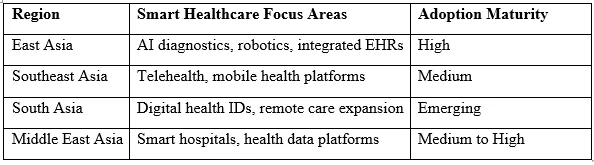
This variety brings out the advancement that has been achieved and also the prospects of cross-regional cooperation and sharing of knowledge.
Challenges Slowing the Transformation
Although the pace is great, a number of challenges that persist in defining the smart healthcare in Asia are still present. Interoperability is still a thorn in the flesh as there are still disjointed systems and lack of data standards with which information can be smoothly exchanged. Another issue is workforce preparedness since medical workers need to be trained and assisted to operate digital tools efficiently.
The difference in the infrastructure between rural and urban regions may also hamper adoption, especially in less connected regions. There are also financial implications and uncertainty on the return on investment that affect decision-making, particularly in smaller healthcare providers.
To avert these looms, there must be concerted efforts in policy, technology, education and financing. The success of digital innovation over the long-term will be determined by the ability to align it with clinical demands and goals on the system-wide level.
What the Future Holds for Smart Healthcare in Asia
In Asia, the future of smart healthcare systems will be defined by more integration, increased personalization and collaboration between stakeholders. The interoperable systems will facilitate data flow across care environments and facilitate holistic patient experiences. AI will improve in the form of a decision support that will transform into a decision augmentation that will be used in conjunction with clinicians to improve the quality of care.
Patient involvement will be further centralized and digital applications will enable patients to be in charge of their health. Preventive services, early diagnosis, and individual treatment plans will reshape the healthcare outcomes measurement and delivery.
The regional cooperation and standardization will be significant in the scaling of innovation. Public-private collaborations, cross-border data programs and shared frameworks can hasten the best practices and eliminate overlaps.
A Brief Q&A for Industry Readers
What makes a smart healthcare system in the Asian context?
It is a digitally connected healthcare system that combats the issue of scale, access, and efficiency with the help of technology-powered care delivery.
Does smart healthcare really mean technology only?
Along with the substantial contribution of technology as a facilitator, policy coordination, workforce preparedness, trust in patients, and sustainable business models are other contributors to the achievements of smart healthcare systems.
What will be the greatest growth areas?
The telehealth, AI-driven diagnostics, remote patient monitoring, and data analytics are predicted to experience high growth in most of the Asian markets.
Conclusion
Smart healthcare systems in Asia imply not just technological improvement but a complete revolution in the format of healthcare design, delivery, and experience. Asian healthcare is establishing a digital integration, data intelligence, and patient-centric framework to eat up a platform of a more robust and inclusive care.
Even though issues persist, the readiness to develop and change and cooperate in the region makes it a leader in changing the healthcare world. With the development of smart healthcare systems, it will be at the center of creating healthier people and more sustainable healthcare ecosystems in Asia.