Medical Gases: Types and Clinical Applications in Hospitals
.webp)
Kate Williamson
Editorial Team, Asian Hospital & Healthcare Management
Hospitals rely on a range of medical gases, oxygen, nitrous oxide, medical air, nitrogen, and carbon dioxide, for anesthesia, respiratory therapy, surgery, and diagnostics. This article breaks down each gas type, its clinical applications, and how proper supply systems like bedside oxygen and high-flow therapy improve patient outcomes and hospital safety.
Introduction:
Most patients never think about where hospital oxygen actually comes from, until they or a loved one need it. Behind every ventilator, every anesthesia machine, every ICU bed, there's a quiet, tightly engineered gas supply network doing the heavy lifting. Pipelines run behind walls and ceilings, cylinders sit ready as backup, and wall outlets deliver exactly the right gas at exactly the right pressure, all without the average visitor noticing a thing.
If you're researching this topic because you write about healthcare infrastructure, work in hospital procurement, or you're simply curious about what keeps a hospital "alive" behind the scenes, this guide covers the main types of medical gases hospitals depend on daily, and where each one fits into patient care.
Why Medical Gases Matter More Than People Realize
Medical gases aren't just "extra equipment." They're classified as pharmaceuticals in most countries, meaning they're regulated, tested for purity, and tracked the same way medications are. A contaminated gas supply or a mislabeled cylinder can cause serious harm within minutes. That's why hospitals invest heavily in gas pipeline systems, redundant backup supplies, and trained biomedical staff who monitor pressure, flow, and purity around the clock.
With that context, let's look at the individual gases and what each one actually does.
1. Oxygen: The Backbone of Hospital Care
Oxygen is, unsurprisingly, the most widely used medical gas in any hospital. It's delivered through a centralized pipeline system that connects to wall outlets in nearly every patient room, a setup commonly known as oxygen supply hospital bedside delivery. Instead of wheeling cylinders room to room, nurses simply connect tubing to the wall outlet, which draws from a large liquid oxygen tank or a bank of cylinders stored outside the building.
Clinically, oxygen therapy is used for:
- Patients with low blood oxygen saturation (hypoxemia)
- Post-surgical recovery
- Chronic respiratory conditions like COPD
- Emergency resuscitation
- Neonatal and pediatric intensive care
In recent years, hospitals have shifted toward more advanced delivery methods. Oxygen therapy high-flow systems hospital setups, often called High-Flow Nasal Cannula (HFNC), deliver heated, humidified oxygen at much higher flow rates than traditional nasal cannulas. This became especially important during COVID-19, when high-flow systems helped many patients avoid invasive ventilation altogether. Unlike standard oxygen delivery, high-flow systems can reach up to 60 liters per minute, giving clinicians finer control over oxygen concentration and patient comfort.
2. Nitrous Oxide: Not Just for Dentists
Most people associate nitrous oxide with "laughing gas" at the dentist's office, and that association isn't wrong. Nitrous oxide dental anesthesia gas is still widely used for minor dental procedures because it works quickly, wears off fast, and keeps anxious patients calm without full sedation.
But its role in hospitals goes beyond dentistry. Nitrous oxide is also used:
- As an adjunct in general anesthesia during surgery
- For pain relief during labor and childbirth (commonly known as Entonox, a mixture of nitrous oxide and oxygen)
- In short outpatient procedures where quick recovery matters
One thing that makes nitrous oxide attractive clinically is its safety margin. It has minimal effect on the cardiovascular and respiratory systems compared to other anesthetic agents, which is why it remains a staple even as newer anesthesia drugs have entered the market.
3. Medical Air: The Quiet Workhorse
Medical air doesn't get much attention, but it's essential. It's used to power pneumatic surgical tools, drive ventilators, and mix with oxygen for patients who need controlled oxygen concentrations rather than pure oxygen.
Hospitals generate medical air on-site using medical air compression systems, which pull in ambient air, filter it, compress it, and remove moisture and contaminants until it meets pharmaceutical-grade purity standards. This is different from oxygen or nitrous oxide, which are usually delivered pre-manufactured. Medical air is made in-house, continuously, which means the compression system itself becomes a critical piece of infrastructure. If it fails, backup cylinder banks kick in automatically, but engineering teams treat any compressor downtime as a priority issue.
Medical air is used in:
- Ventilator support in ICUs
- Respiratory therapy for patients who can't tolerate high oxygen concentrations
- Powering surgical pneumatic instruments like drills and saws
- Blending with oxygen for premature infants, who are highly sensitive to oxygen toxicity
4. Nitrogen: Cold, Dry, and Essential Behind the Scenes
Nitrogen doesn't get administered to patients directly in most cases, but its role in hospitals is still significant. Nitrogen gas hospital applications mostly involve:
- Powering surgical pneumatic tools (in some hospitals, alongside or instead of medical air)
- Cryogenic storage of biological samples, blood, tissue, and reproductive cells
- Preserving organs for transplant
- Sterilization equipment support
Liquid nitrogen, in particular, is critical for tissue banks and fertility clinics attached to hospitals, where embryos, sperm, and eggs are stored at extremely low temperatures for long periods. Without a reliable nitrogen supply, these storage systems simply can't function.
5. Carbon Dioxide: Small Quantities, Big Impact
Carbon dioxide might seem like an odd inclusion in a list of medical gases, but carbon dioxide gas medical use is well established, particularly in surgery. During laparoscopic (minimally invasive) procedures, surgeons inflate the abdominal cavity with CO2 to create working space and better visibility. This technique, called insufflation, has made countless procedures less invasive than traditional open surgery.
CO2 is also used in:
- Blood gas analyzers for calibration
- Certain respiratory function tests
- Cryotherapy in combination with other gases, for tissue removal
Because CO2 is naturally present in the body and easily absorbed, it's considered a safer choice for insufflation compared to alternative gases that could cause complications like embolism.
How Hospitals Manage Gas Distribution Safely
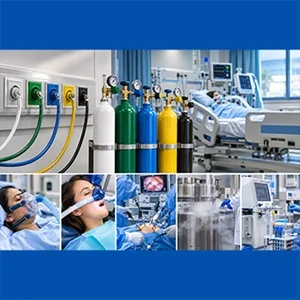
Every type of medical gas travels through a dedicated, color-coded pipeline system to avoid mix-ups. Oxygen lines, for example, are typically painted white or green depending on regional standards, while nitrous oxide lines use blue. Outlets are shaped differently for each gas type so that tubing physically cannot be connected to the wrong outlet, a safety feature called a "pin-index" or "diameter index safety system."
Hospitals also run:
- Daily pressure and purity checks
- Redundant backup supplies (a manifold system with a reserve bank of cylinders)
- Alarm systems that alert staff instantly if pressure drops below safe thresholds
- Scheduled maintenance for compressors, vaporizers, and pipeline valves
This level of redundancy exists because a gas failure during surgery or in the ICU isn't just inconvenient, it can be life-threatening within minutes.
Frequently Asked Questions
What are the main types of medical gases used in hospitals?
The most common types include oxygen, nitrous oxide, medical air, nitrogen, and carbon dioxide. Each serves a distinct clinical purpose, from respiratory support to anesthesia and surgical procedures.
How is oxygen delivered to hospital beds?
Oxygen is delivered through a centralized pipeline system connected to wall outlets at each bedside, sourced from bulk liquid oxygen tanks or cylinder manifolds outside the facility.
What is the difference between medical air and oxygen?
Medical air is a filtered, compressed blend similar to atmospheric air, generated on-site, while oxygen is a purer, concentrated gas typically supplied from external tanks. Medical air is used for ventilators and pneumatic tools, whereas oxygen is used for direct respiratory therapy.
Why is nitrous oxide used in dentistry?
Nitrous oxide provides fast-acting, easily reversible sedation with minimal side effects, making it ideal for anxious patients during short dental procedures.
What is high-flow oxygen therapy?
High-flow oxygen therapy delivers heated, humidified oxygen at higher flow rates than standard nasal cannulas, offering better patient comfort and reducing the need for invasive ventilation in some cases.
Final Thoughts
Medical gases might not be the most glamorous part of healthcare, but they're foundational. Every surgery, every ICU stay, every dental visit that uses sedation relies on a gas supply chain that has to work flawlessly, every single time. Understanding the differences between oxygen, nitrous oxide, medical air, nitrogen, and carbon dioxide isn't just useful trivia; it's genuinely important for anyone working in hospital operations, biomedical engineering, or healthcare writing.
If you're building content around hospital infrastructure or medical equipment, this is exactly the kind of topic that benefits from clear, structured explanations, both for readers and for search engines trying to answer specific medical questions.
Most Read Articles